Indra Kusuma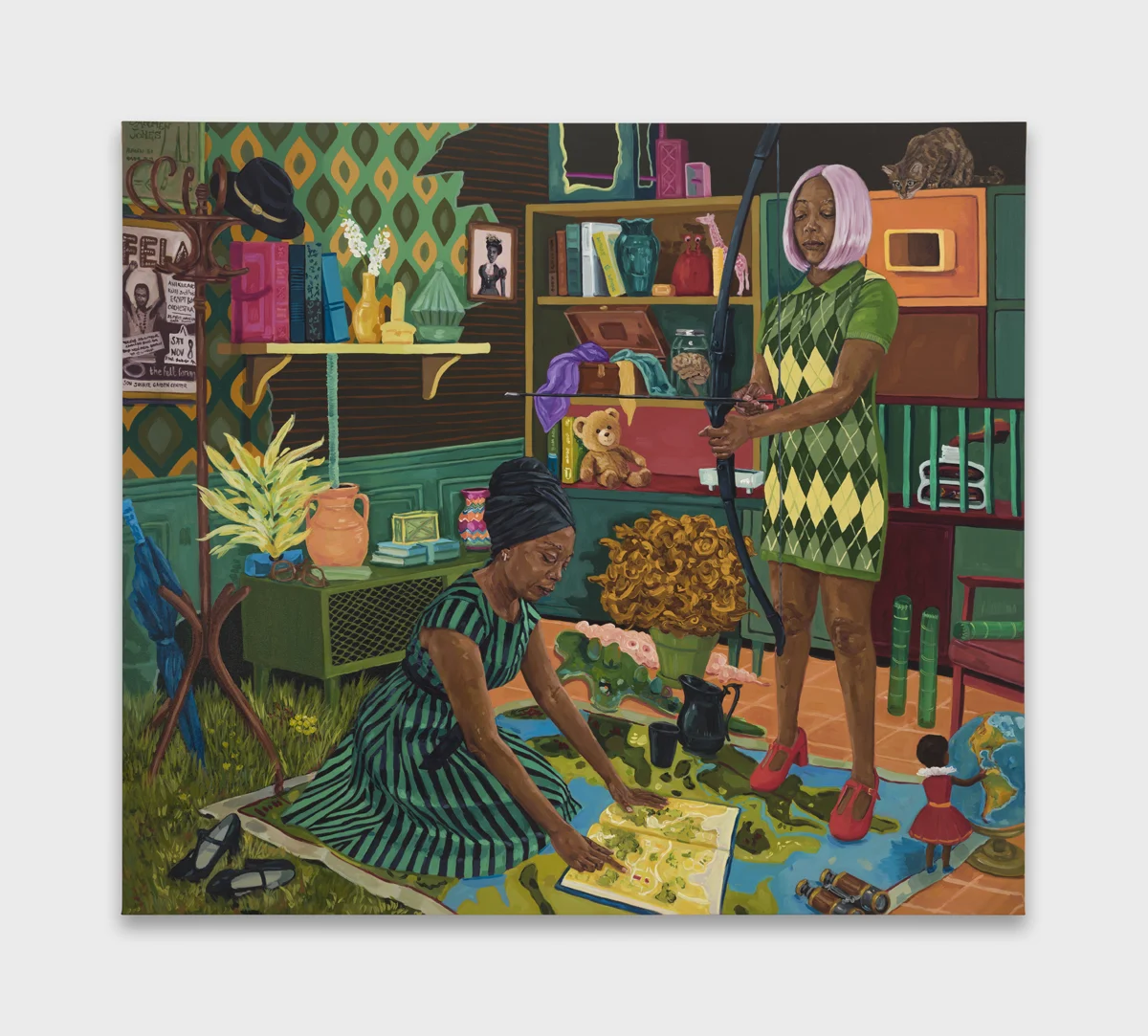
Memory serves as a dynamic force in the work of contemporary artist Wangari Mathenge, evolving from a passive act of retrospection into a rigorous, multifaceted process of historical excavation and reconstruction. This thematic urgency defines Re-membering, the artist’s latest solo exhibition currently hosted by the New York gallery Lévy Gorvy Dayan. On view through October 24, 2026, the exhibition serves as a significant milestone in Mathenge’s career, marking her debut solo showcase at the prestigious venue and offering an expanded look at a series she initiated earlier this year. The presentation encompasses five major new paintings and, notably, the first public display of the artist’s sculptural practice.
The Intellectual Foundation of Re-membering
The conceptual framework for this body of work draws heavily from the scholarship of Ngũgĩ wa Thiong’o, particularly his 2009 treatise, Something Torn and New: An African Renaissance. In this text, wa Thiong’o argues for the necessity of reclaiming African cultural identities that were fractured by the colonial experience. Mathenge engages with this discourse by conducting an exhaustive investigation into Kenyan colonial literature and material culture spanning the period between 1900 and 1963.
The year 1963 holds pivotal significance in this research, as it marks Kenya’s formal independence from the United Kingdom. By examining the domestic artifacts, literature, and visual records produced during the height of the colonial era, Mathenge questions the mechanisms through which national and personal identities are constructed. Her work posits that the "official" history recorded by colonial authorities is inherently incomplete, leaving gaps that the artist seeks to fill through the lens of her own contemporary identity.
Chronology of an Artistic Evolution
Mathenge’s trajectory toward this exhibition has been marked by a deliberate shift from static representation to active, collaborative creation. Her artistic development can be categorized into three distinct phases:
- Early Research (2022–2023): During this period, Mathenge focused on archival research, analyzing how Kenyan history was documented and archived during the transition from British rule to sovereignty.
- The Conceptual Pivot (2024): The artist began the Re-membering series, moving away from purely representative painting toward works that utilize domestic interiors as sites of psychological and historical inquiry.
- Sculptural Expansion (2025–2026): The current exhibition represents the culmination of this evolution, where the flat plane of the canvas is discarded in favor of three-dimensional, tactile expressions of heritage, involving collaborative labor with local artisans.
Analysis of the Exhibition Components
The exhibition at Lévy Gorvy Dayan is divided between the visual intimacy of painting and the physical presence of sculpture. In her latest paintings, Mathenge employs women as avatars for the self, placing them within carefully constructed domestic environments that mirror the aesthetic sensibilities of the 1960s. These interiors are not merely settings; they are dense, layered environments filled with books, toys, textiles, and other eclectic markers of middle-class life during the post-independence era. By populating these spaces with contemporary figures, Mathenge creates a visual dialogue between the past and the present, suggesting that historical trauma and cultural pride are inherited in the home as much as in the public square.

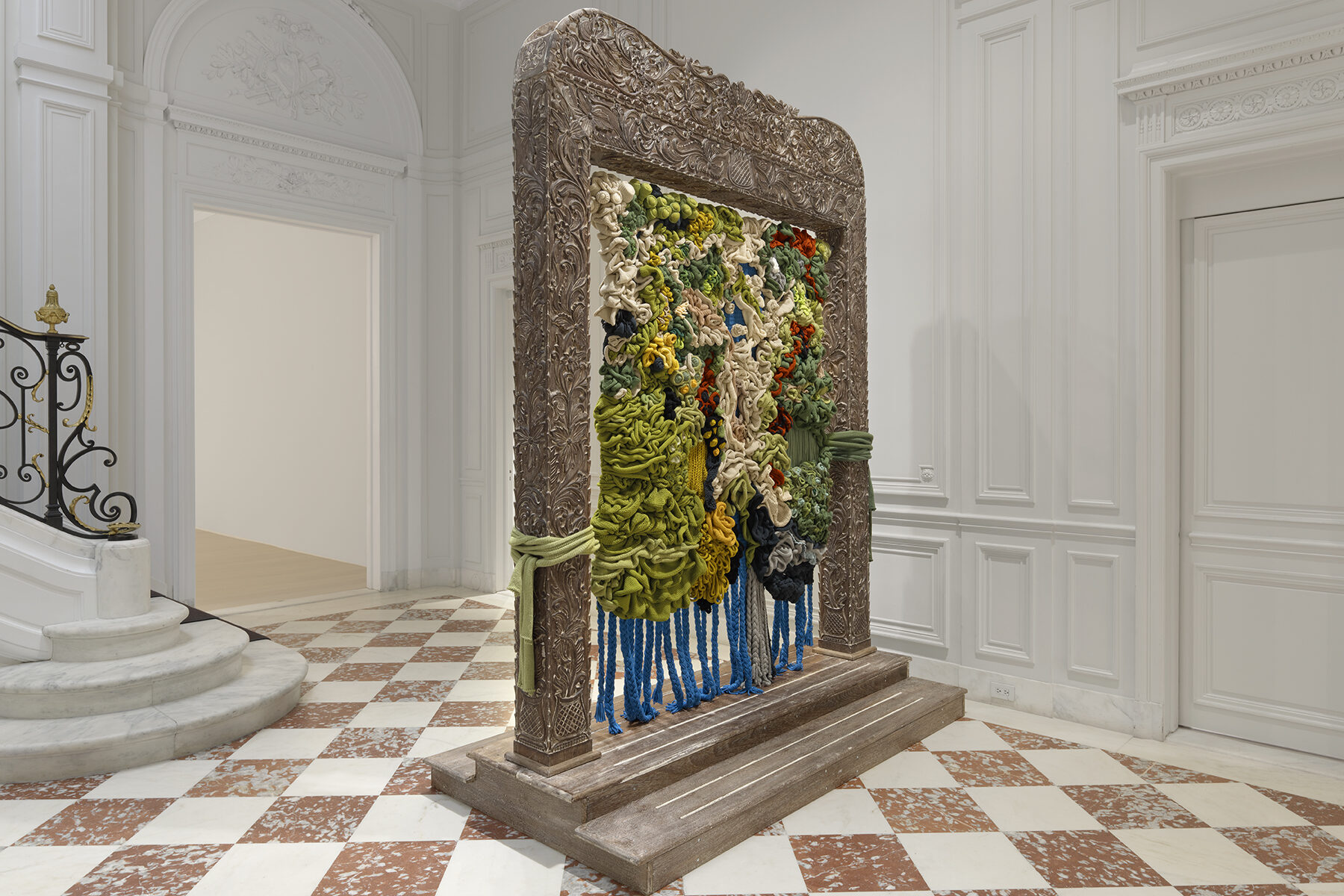
The sculptural works, however, represent a more radical departure. In Re-membering VIII (Before Us, After Us, Ever Changing), Mathenge collaborated with woodworkers in Malindi, Kenya, to craft a doorframe that evokes the traditional architecture of Lamu Old Town—a region known for its intricate, historically significant wooden carvings. By pairing this rigid, traditional structure with a soft, expansive macramé textile created in collaboration with her own community, Mathenge creates a tension between the permanence of architecture and the fluidity of cultural memory.
Similarly, in Re-membering IX (The Shape of Inheritance), the artist explores the evolution of clothing. Using a dress form, the work reinterprets historical Gikuyu dress while simultaneously incorporating elements of the Victorian bustle and train. This deliberate juxtaposition serves as a critique of how colonial influences were absorbed and reconfigured into local fashion, effectively creating a hybrid identity that is neither purely traditional nor entirely western.
Collaborative Practice and Community Impact
A defining characteristic of this exhibition is its reliance on collaborative labor. By involving her family and local Kenyan community members in the production of the textile and knitted elements, Mathenge transitions the role of the artist from a solitary creator to a facilitator of collective memory.

This process of "re-membering"—a term Mathenge defines as the active gathering and reassembly of fragmented histories—is not merely an aesthetic choice but a socio-political one. By involving others in the construction of these pieces, she ensures that the final works contain the literal and metaphorical "threads" of multiple individuals, reflecting a collective, rather than individual, historical consciousness.
Broader Implications and Institutional Reception
The exhibition arrives at a time when the art world is increasingly focused on the role of institutions in addressing colonial histories. Lévy Gorvy Dayan’s decision to mount this exhibition signals a broader trend among high-end galleries to elevate artists whose work engages with post-colonial theory and indigenous historiography.
From an analytical standpoint, the implications of Mathenge’s work are significant. By transforming history into "material" that can be dismantled and reassembled, she offers a model for how contemporary artists can engage with the past without becoming trapped by it. Her work suggests that history is not a closed book, but a malleable resource. For scholars and curators, the exhibition provides a compelling case study on the efficacy of interdisciplinary approaches to historical preservation.

Fact-Based Context: The 1963 Turning Point
To understand the weight of Mathenge’s research, it is necessary to consider the socio-economic reality of Kenya in 1963. Following independence, the nation underwent a rapid process of "Africanization" of the civil service and education systems, yet the domestic spaces of the era remained deeply influenced by British social norms. Statistical data from the period indicates a significant shift in urban demographics, as Kenyans moved from rural areas into colonial-designed residential sectors, creating a unique aesthetic clash that Mathenge highlights in her work. The juxtaposition of traditional Gikuyu aesthetics with Victorian structural forms reflects this exact period of transition, where cultural inheritance was often a negotiation between the indigenous past and the administrative present.
Conclusion and Exhibition Details
The exhibition serves as a profound meditation on the limitations of historical records. By shifting the focus from the grand narratives of colonial history to the intimate, domestic, and sculptural, Wangari Mathenge demonstrates that the most enduring histories are those held within the objects and rituals of everyday life.
Wangari Mathenge: Re-membering remains on view to the public through October 24, 2026, at the Lévy Gorvy Dayan gallery, located at 19 E. 64th St., New York City. The exhibition is accompanied by a series of scholarly notes provided by the gallery, which detail the provenance of the cultural objects and the collaborative nature of the sculptural works. As the art world continues to grapple with the complexities of cultural heritage, Mathenge’s practice provides a vital, tactile bridge between the fragmented past and a reconstructed future.