In an increasingly saturated digital landscape, the distinction between a mere social media posting schedule and a truly effective social media marketing strategy has become paramount for brands and content creators seeking measurable impact. This comprehensive approach, defined as a documented plan outlining target audiences, platform selection, content creation, and performance measurement, moves beyond the rudimentary act of sharing content to actively driving business objectives. Industry professionals contend that without a well-defined strategy, content creators and businesses risk operating on a "content treadmill," perpetually producing material without tangible progress towards specific goals such as increased followers, lead generation, or return on investment (ROI).
The evolution of social media marketing underscores this critical shift. What began in the early 2000s as nascent platforms primarily for personal connection quickly transformed into powerful tools for brand engagement and commerce. Early marketing efforts often involved simply establishing a presence and sharing promotional messages. However, as platforms matured and algorithms grew more sophisticated, a simple posting cadence proved insufficient. Today, with billions of users globally and an ever-increasing volume of content, standing out requires a deliberate, iterative strategy that adapts to rapid changes in technology, user behavior, and platform dynamics. This necessitates a strategic framework that not only dictates what and when to post but fundamentally addresses who the content is for, what core message it conveys, and how its efficacy will be precisely measured.
Laying the Foundation: The Indispensable Social Media Audit and Competitive Analysis
The journey towards a robust social media strategy commences with a thorough assessment of current standing, both internally and externally. A social media audit serves as this foundational step, involving a meticulous review of every owned social media account. This process delves into content types, platform-specific performance metrics, and identifies critical gaps or underperforming areas. As Sabreen Haziq, Senior Brand and Community Manager at Buffer, articulates, "When I joined Buffer, one of the first things I did was audit each of our channels with one question in mind: ‘Where are we really growing, and where are we just present?’" This introspection reveals the lifecycle stage of each channel, informing decisions on where to allocate resources for growth, experimentation, or consolidation. The discomfort often associated with confronting past content, such as outdated posts from a creator’s early days, is precisely the point; identifying deficiencies is the prerequisite for effective remediation.

Concurrently with the internal audit, a concise yet insightful competitive analysis is crucial. By examining three to five direct or aspirational competitors, marketers can discern prevalent content themes, posting frequencies, and overall engagement strategies. The objective is not imitation, but rather to identify unmet needs within the target audience — the "gaps" that the brand or creator can uniquely fill. A lightweight approach, compiling competitor names, active platforms, posting cadences, content angles, and key observations into a simple matrix, can yield significant strategic insights within a focused timeframe, typically an hour, providing actionable intelligence for differentiation.
Precision Targeting: Defining the Audience and Setting Measurable Goals
Following the foundational audit, the next critical phase involves a precise definition of the target audience. This transcends basic demographic data, extending to understanding their online habitats, pain points, aspirations, and frequently asked questions. For established brands, this process often aligns with existing customer profiles. However, for content creators, this step can be more fluid. The recommended starting point is to visualize a single, ideal individual the content aims to assist, articulating their identity and challenges in a concise sentence. This initial sketch is then refined through various research methods: reviewing comments and direct messages on existing content, analyzing competitor audience engagement, and exploring relevant forums or communities.
A key insight from industry experts like Tami Oladipo, Buffer’s Senior Content Creator, suggests that audience definition is an iterative process. "The mistake a lot of people make is trying to define their audience before they’ve made anything," Oladipo notes. "You can’t know who resonates with your content until the content is out there and people have resonated." This highlights a chicken-and-egg scenario where initial content creation helps uncover and validate the target demographic. The continuous interaction with early adopters further sharpens the audience profile, concurrently sparking new content ideas.

With a clear audience in view, the subsequent step is to establish SMART (Specific, Measurable, Achievable, Relevant, Time-bound) social media marketing goals. Vague aspirations like "grow on Instagram" are replaced with quantifiable objectives, such as "Reach 1,000 non-followers per month by Q4." This framework ensures that goals are not nebulous desires but actionable targets with defined outcomes, numerical proofs, and deadlines. The process involves working backward from desired business outcomes (e.g., increased sales, brand awareness) to identify corresponding social media metrics. If a direct line cannot be drawn between a social media goal and a tangible business result, the goal lacks strategic utility.
Experts advise focusing on a limited number of goals—ideally one per platform per quarter, or a maximum of two for highly focused efforts. This discipline prevents content dilution, as each goal often pulls content in a distinct direction (e.g., brand awareness content differs from lead generation content). Key Performance Indicators (KPIs) serve as the measurable component of SMART goals. For instance, "Grow brand awareness on Instagram" translates into a KPI like "Reach 50,000 non-follower accounts per month by Q3." Social media consultant Jade Beason emphasizes this alignment: "Your success metrics will depend on what your objectives are. If you’re on Instagram to grow, then your view-through rate and retention might be the most important. But if you’re on Instagram to build a community, then your interactions are the most important metric." Real-world examples from Buffer, such as Sabreen Haziq’s goal to "lift our average per-post engagement rate… by 20%… by the end of Q4 2026," demonstrate the practical application of SMART goals across diverse objectives.
Strategic Platform Selection and Content Pillar Development
Identifying where the target audience spends time is only the initial layer of platform selection. The more crucial question is: "Where are they in the mindset that matches what I’m trying to do?" A B2B audience might scroll TikTok recreationally, but their buying decisions typically occur on LinkedIn. A craft enthusiast might use Instagram daily, yet actively search for products on Pinterest. This necessitates a nuanced understanding of platform utility.
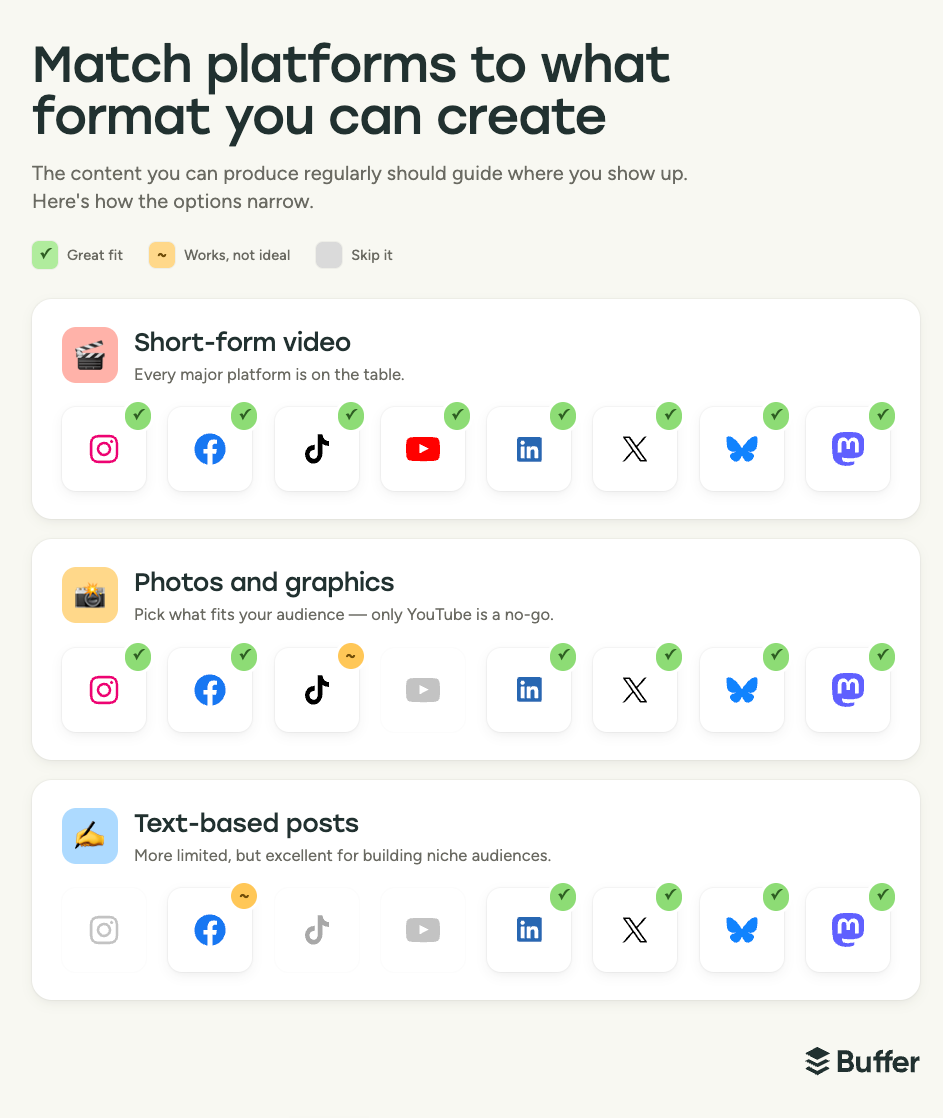
Four key considerations guide this decision:
- Social Media Algorithm: Each platform’s algorithm prioritizes different behaviors and content formats. For example, TikTok rewards fast-paced, unpolished video, while LinkedIn increasingly favors professional insights and carousel posts. Understanding these dynamics is crucial for aligning content strategy with platform mechanics. While crossposting is common and efficient, slight adaptations for each platform’s nuances are recommended.
- Content Format: The resources available for content creation heavily influence platform choice. Short-form video opens up all major platforms, whereas a focus on photos and graphics limits options like YouTube and makes TikTok less ideal. Text-based content thrives on platforms like LinkedIn, X (formerly Twitter), Bluesky, and Mastodon, particularly for niche audience building. Data from Buffer’s "State of Social Media Engagement Report 2026" provides specific insights: LinkedIn carousels boast a median engagement rate of 21.77%, while Instagram carousels lead with 6.9% (measured against reach), and TikTok videos command 3.39%. Sabreen Haziq reinforces that "Social is a pretty democratic medium, and it doesn’t always reward the most premium, polished content," emphasizing substance over cinematic production value.
- SEO Importance: The growing trend of younger audiences using social platforms as search engines (e.g., TikTok and Instagram for product discovery, YouTube as the second-largest global search engine, Pinterest for visual search) makes social SEO a vital consideration. Crafting captions with searchable phrases and keywords relevant to the target audience significantly enhances content discoverability.
- Platform Subculture: Each social platform possesses a distinct cultural identity. TikTok embodies a fast, casual, and authentic vibe, LinkedIn fosters professional networking and thought leadership, while Instagram leans towards aspirational visuals. Aligning brand and content style with the inherent subculture of a platform is critical for resonance. Furthermore, personal enjoyment of a platform, as noted by Jade Beason, is a powerful motivator for consistent and authentic engagement.
Once platforms are chosen, defining content pillars provides thematic structure. These 3-5 recurring topics act as anchors for content creation, preventing creators from "reinventing the wheel" and ensuring brand coherence. For instance, creator Erin McGoff’s consistent focus on "career advice from a big sister" has built a recognizable and powerful brand. Content pillars should ideally sit at the intersection of the creator’s or brand’s expertise, the audience’s interests, and the unique brand identity. Kendall Dickieson, a social media consultant, advocates for maintaining a degree of flexibility within these pillars to allow for experimentation and adaptation to emerging trends or successful content formats. Sabreen Haziq takes this a step further, suggesting that content pillars should stem from a brand’s "lore"—the unique beliefs, stories, and truths that differentiate it from competitors.
Operationalizing and Refining: Calendars, AI, and Analytics
The strategic framework culminates in operational execution, starting with a social media content calendar. This scheduled view of what, where, and when content will be published transforms strategy into a practical workflow, preventing last-minute content decisions that often compromise quality. While various tools exist, integrated platforms that combine calendar functionality with scheduling capabilities across multiple platforms are deemed game-changers for efficiency. Buffer’s own tools, for example, offer visual calendars, drag-and-drop rescheduling, and data-driven recommendations for optimal posting times.

Regarding posting frequency, while "one post a week per platform is a great starting point," Buffer’s data-backed benchmarks provide aspirational cadences: 2-5 posts per day on X, 1-3 times per day on Threads, 3-5 times per week on Instagram, 2-5 times per week on TikTok, and 3-5 times per week on LinkedIn and Facebook. These benchmarks, derived from analyzing millions of posts, offer a roadmap for maximizing visibility and engagement, provided the content quality is maintained.
The role of artificial intelligence (AI) in a 2026 social media strategy is primarily one of efficiency and augmentation. AI excels in tasks such as ideation (generating caption variations), repurposing content across platforms, and brainstorming angles, freeing up human creators to focus on original thought and unique perspectives. Tools like Buffer’s Create space function as AI assistants, drafting content and suggesting adaptations. However, human-generated content consistently outperforms fully AI-written content in authenticity and resonance. The discipline lies in using AI to remove friction in the creative process, not to remove the creator’s unique voice.
Finally, continuous refinement through social media analytics forms the indispensable feedback loop. Tracking performance metrics monthly, rather than weekly (which can be noisy), allows for the identification of meaningful trends. Patience is paramount; most strategies require at least three months to demonstrate real impact. Kendall Dickieson advises against frequent pivots based on short-term data, stating, "Most strategies need at least 3 months to show real impact, so patience is key." Analytics platforms, whether native or integrated solutions like Buffer’s, should be consistently used to monitor metrics aligned with established SMART goals. These may include reach, impressions, engagement rate, link clicks, conversions, and follower growth.
Monthly reviews allow for identifying successful content and strategic areas for expansion. Quarterly assessments involve a more critical evaluation of underperforming elements, determining whether to adjust the approach or discontinue the effort. Tami Oladipo underscores the strategic clarity provided by analytics: "If my goal is awareness and my engagement rate dips, I’m not going to panic since engagement isn’t the metric I tied to that goal. The strategy tells me what to actually worry about, and what I can let go." This iterative cycle of auditing, planning, posting, analyzing, and adjusting is the bedrock of sustained social media success.

Broader Implications and the Future of Social Media Marketing
The emphasis on a data-driven, comprehensive social media strategy carries significant implications for both businesses and content creators. For businesses, it translates into optimized resource allocation, clearer brand messaging, enhanced customer engagement, and a demonstrable return on marketing investment. By aligning social efforts with broader business objectives, companies can leverage social platforms not just for brand presence, but as powerful engines for lead generation, customer support, and sales conversion.
For content creators, a robust strategy is the blueprint for building a sustainable personal brand, cultivating a loyal community, and unlocking diverse monetization opportunities. It transforms passion into a purposeful career path, guiding content development, audience expansion, and strategic partnerships.
The future of social media marketing will undoubtedly be characterized by continued innovation in algorithms, content formats, and AI integration. The core principles of understanding one’s audience, setting clear goals, and continuously adapting based on data will remain timeless. As platforms evolve and new trends emerge, the ability to maintain a flexible yet structured strategic framework will be the ultimate differentiator for achieving enduring digital success. Even a foundational effort—a concise statement of goals, a brief competitor analysis, or a simple audience sketch—can yield substantial dividends in an increasingly complex digital ecosystem.