 Indra Kusuma
San Francisco-based artist and finance professional Grace Zhang is currently challenging the traditional boundaries between analytical precision and creative abstraction. Her debut exhibition, Spacetime Monologue, which opened recently at the GCS Agency gallery in San Francisco and runs through October 25, 2026, serves as a culmination of a multi-year creative journey that synthesizes disparate influences ranging from global market volatility to the structural rigor of Post-Impressionist painting.
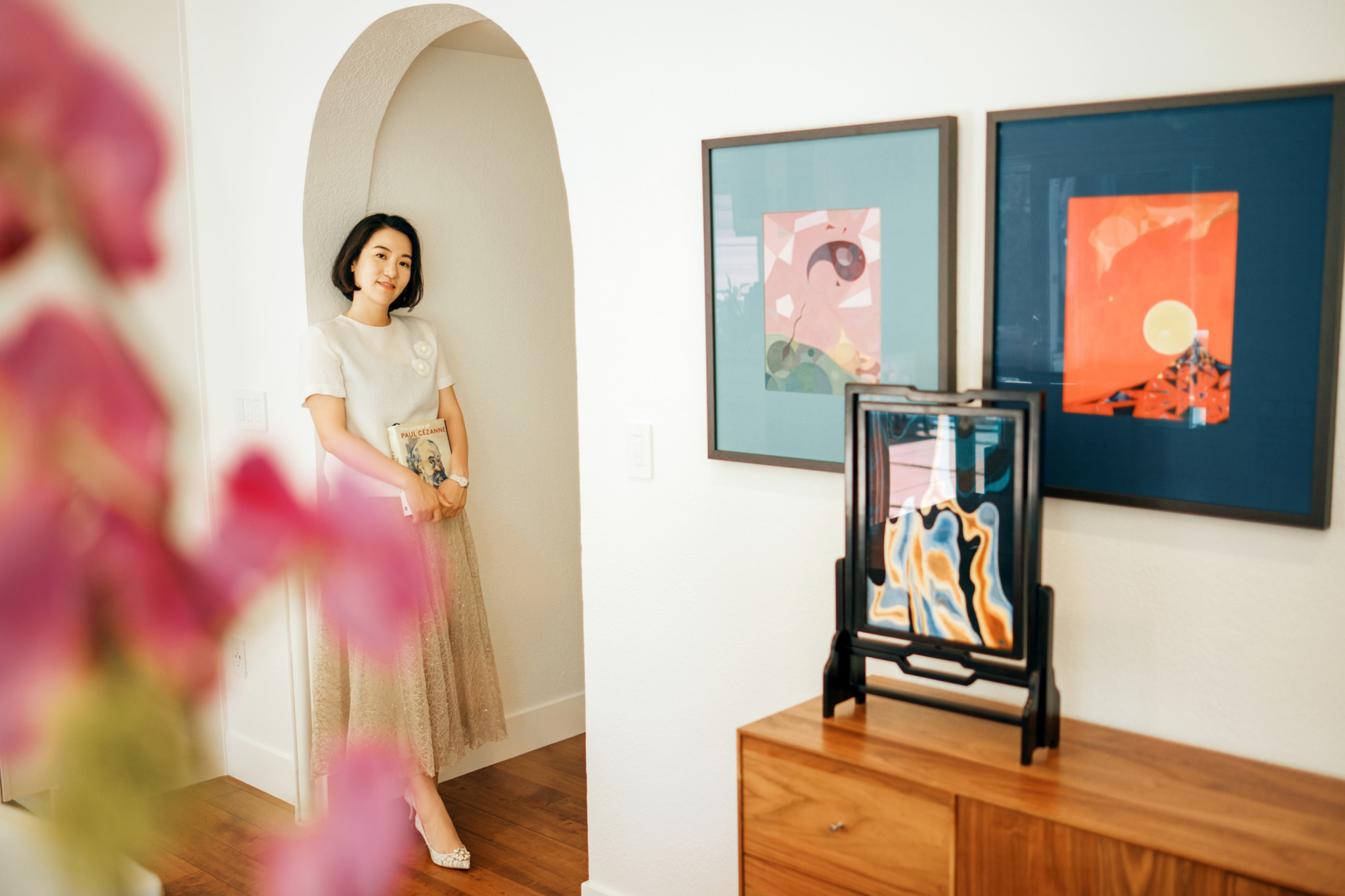
A graduate of Columbia University’s School of International and Public Affairs, Zhang maintains a dual professional identity that is increasingly rare in the contemporary art world. By day, she navigates the high-stakes environment of international finance, a role that requires a constant analysis of complex datasets. By night, she translates those same analytical impulses into a visual language of geometry, color, and rhythm. Her work is not merely a diversion from her career; rather, it is an extension of the same cognitive process—a quest to identify order within perceived chaos.
The Intersection of Market Theory and Aesthetic Form
The intellectual backbone of Zhang’s exhibition is rooted in her application of market theories to visual composition. A primary influence cited by the artist is the Elliott Wave Theory, a method of technical analysis that posits financial markets operate in repetitive cycles dictated by human psychology—specifically the oscillation between fear and greed.

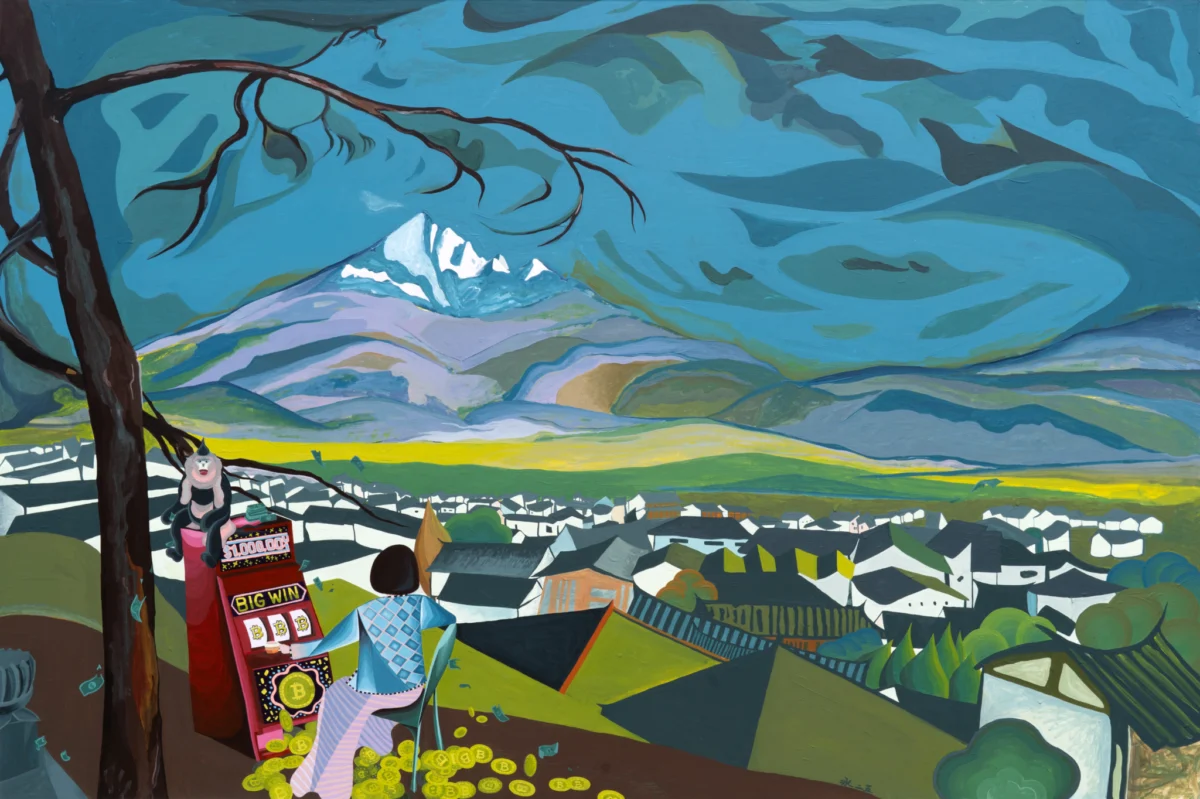
In the piece Jade Hash, Zhang interprets the jagged ridgeline of Lijiang’s Jade Dragon Mountain through the lens of a ticker tape. The peaks and troughs of the mountain range become a metaphorical graph, mirroring the volatility of cryptocurrency and sovereign debt markets. This synthesis of natural landscape and financial data suggests that the rhythms governing our economy are fundamentally linked to the physical structures of the earth.
This, according to financial analysts who observe the intersection of behavioral economics and art, represents a significant shift in how data is visualized. By stripping away the sterile nature of a Bloomberg terminal and re-contextualizing it as a wave-like form on canvas, Zhang provides a tangible emotional resonance to abstract economic events. The implication is that the "invisible hand" of the market is, in fact, subject to the same laws of physics and nature that dictate the movement of light and the growth of mountain ranges.

Chronology and Artistic Evolution
The development of the works presented in Spacetime Monologue did not happen in isolation. The collection, which features 32 distinct works, represents a carefully curated evolution of the artist’s focus over the last several years.
- Early Phase (2021–2022): Zhang began exploring the intersection of haute couture and fine art. Her initial self-portraiture series was prompted by a desire to deconstruct the structural integrity of luxury garments, specifically those from Chanel’s Spring-Summer 2021 collection. During this period, she focused on the "dot-and-wave" motif, which she later identified as a visual bridge between science and fashion.
- Expansion (2023–2024): The artist transitioned toward incorporating broader scientific concepts, specifically the wave-particle duality evidenced in the double-slit experiment. It was during this phase that the influence of Paul Cézanne became more pronounced, specifically his methodology of using color blocks to define structural depth.
- Current Synthesis (2025–2026): The Aurora Undae Country Club series marks her most recent foray into thematic exploration, combining cosmic imagery with the sport of golf. By framing the golf course as a "portal" between the terrestrial and the cosmic, she addresses the Buddhist philosophical questions of life, death, and the universe that underpin her current practice.
Technical Analysis: The Science of Sight
A pivotal moment in the exhibition is the work Quantum Whisper. To understand the depth of this piece, one must consider the physics of the double-slit experiment. In quantum mechanics, the experiment demonstrates that light can behave as both a particle and a wave depending on the method of observation.

Zhang uses this as a foundational conceit for her painting. In her view, the observer—the viewer of the art—effectively changes the outcome of the visual experience. The dots and waves in Quantum Whisper are not static; they are intended to fluctuate in the viewer’s perception. This aligns with the broader goals of contemporary conceptual art, where the "truth" of an object is subjective, dependent entirely on the perspective of the observer.
Industry Perspective and Market Implications
The GCS Agency, in hosting Spacetime Monologue, has positioned Zhang as a significant voice in the emerging trend of "polymathic art." Critics and gallerists have noted that the intersection of finance and art is becoming an increasingly potent sector of the market. As algorithmic trading and high-frequency data become more prevalent in society, there is a growing appetite for art that acknowledges this complexity while maintaining an emotional, humanistic core.

"What I love about J.S. Bach’s Fugue No. 24 in B minor is the balance between structure and emotion," Zhang noted during a recent discussion on her process. "I am fascinated by how something so carefully constructed can also express such profound feelings." This statement encapsulates the goal of her exhibition: to prove that the most rigid, logical systems—whether they be musical compositions, financial markets, or physics equations—are capable of containing deep, resonant humanity.
Broader Impact: Beyond the Canvas
The broader implications of Zhang’s work extend into the realm of professional lifestyle integration. For many, the "work-life balance" is a matter of compartmentalization. For Zhang, it is a matter of synthesis. Her career as a finance professional does not stop at the gallery door; it permeates her creative output, and in turn, her artistic practice informs her approach to financial complexities.

Industry experts suggest that this "cross-pollination" of skills is becoming a defining characteristic of a new generation of creators. By bringing the rigor of the Bloomberg terminal to the canvas, Zhang is not just creating art; she is creating a visual archive of the 21st-century experience—a world where the digital and the organic are constantly colliding.
Conclusion of the Exhibition Run
As Spacetime Monologue continues its tenure at the GCS Agency, the exhibition stands as a testament to the idea that no domain of human knowledge is truly siloed. Whether through the lens of a haute couture jacket, the volatile graph of a stock index, or the meditative silence of a mountain range, Zhang invites the public to look closer at the patterns that govern our existence.

The exhibition remains open for viewing through October 25, 2026. For those interested in the technical aspects of the work, the gallery has provided supplementary materials detailing the mathematical and philosophical theories that informed each of the 32 pieces on display. As a debut, the collection is a rigorous and ambitious start, signaling that Grace Zhang’s trajectory—much like the market trends she studies—is one to watch with close attention.
The success of Spacetime Monologue highlights a shift in the San Francisco art scene, which is increasingly embracing interdisciplinary work that challenges the traditional "art for art’s sake" model. By grounding her work in the tangible reality of global trade and the abstract beauty of quantum physics, Zhang provides a bridge for viewers to engage with complex topics in a deeply personal and aesthetic way. This, ultimately, is the triumph of the exhibition: the transformation of the technical into the transcendental.