Angie Faith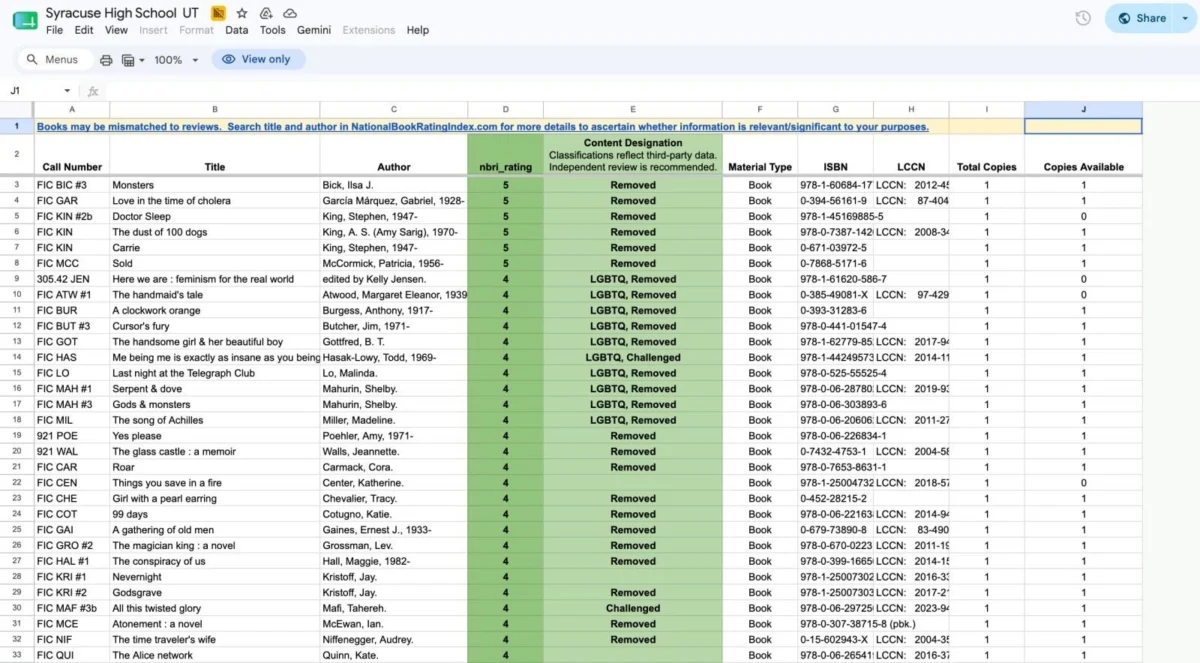
A concerning trend is emerging in public libraries and school districts across the United States, as a growing number of lawmakers and board officials are not only advocating for, but actively attempting to mandate the use of, ideologically driven online platforms for collection development and material review. These partisan-designed websites, often masquerading as objective rating systems, are increasingly being presented as essential tools for librarians and educators, thereby undermining established professional standards and fostering a climate of censorship.
The York County Library in South Carolina serves as a prominent example, citing RatedBooks.org as a reputable source for collection decisions. This platform, celebrated by its proponents, offers content ratings on a zero-to-five scale, categorizing books based on volunteer readers’ interpretations of "inappropriate" content. Such reliance on subjective and politically motivated assessments is a departure from the rigorous, professional evaluation processes typically employed by library professionals.

This trend is not isolated. In the current legislative year, at least two state legislatures have made attempts to codify the use of platforms like RatedBooks.org as requirements for library acquisitions. Utah, where the creator of RatedBooks.org reportedly has ties to certain lawmakers, and West Virginia, have both seen legislative efforts aimed at integrating these partisan review sites into the acquisition process. While these attempts did not succeed in the past year, they signal a persistent and likely escalating effort to influence library collections through non-professional, ideologically driven means.
The Case of Warren County Public Libraries
A stark illustration of this phenomenon occurred at the Warren County Public Libraries in New Jersey. In late 2024, county commissioners controversially pushed through a new policy mandating that the public library system incorporate reviews from BookLooks.org into its decision-making processes. This move, driven by political motivations, also highlighted the inherent instability and unprofessionalism of these platforms. Notably, BookLooks.org ceased to operate mere months after the policy’s enactment, underscoring the unreliable nature of the resources being imposed upon library professionals. This situation, along with other board-driven decisions concerning BookLooks.org, exposes the significant expenditure of time, energy, and financial resources dedicated to advancing right-wing agendas, often at the expense of respecting the expertise of trained and skilled library professionals.
These unprofessional review resources operate outside the established legal framework for obscenity, specifically the three-pronged Miller Test, which defines obscenity based on community standards, prurient interest, and lack of artistic, literary, political, or scientific value. By sidestepping this legal definition, these platforms effectively manipulate the law, influencing which materials are deemed suitable for public and school libraries.
Key Players in the Book Censorship Landscape
As the push for ideological control over library content intensifies, several platforms have emerged as favored tools for book censors. This analysis explores some of the most prominent and newly promoted resources being utilized in 2026, providing a snapshot of their methodologies and objectives.

RatedBooks.org: A Long-Standing Tool for the "Parental Rights" Movement
One of the oldest and most frequently utilized platforms by groups challenging books in public schools and libraries is RatedBooks.org. This website is owned and operated by several "parental rights" organizations, including Utah Parents United and No Left Turn in Education, as well as influential Facebook groups like "LaVerna in the Library" and its affiliated state-level pages.
RatedBooks.org functions similarly to the now-defunct BookLooks.org, employing a content rating system on a scale of zero to five. The site generates curated lists of sentences deemed inappropriate by its volunteer reviewers and presents highly subjective opinions on whether specific books should be accessible to minors. These reviews are updated monthly, and the selection process for which books are reviewed appears arbitrary, lacking the systematic approach characteristic of professional review outlets. There have been documented instances where the site’s operators, while claiming to champion children’s literature, have focused their attention on adult romance novels rather than explicitly targeting books for younger readers. This lack of a structured review process means that RatedBooks.org cannot review titles that are not yet published, as they do not engage with authors or publishers in the way professional review sources do.
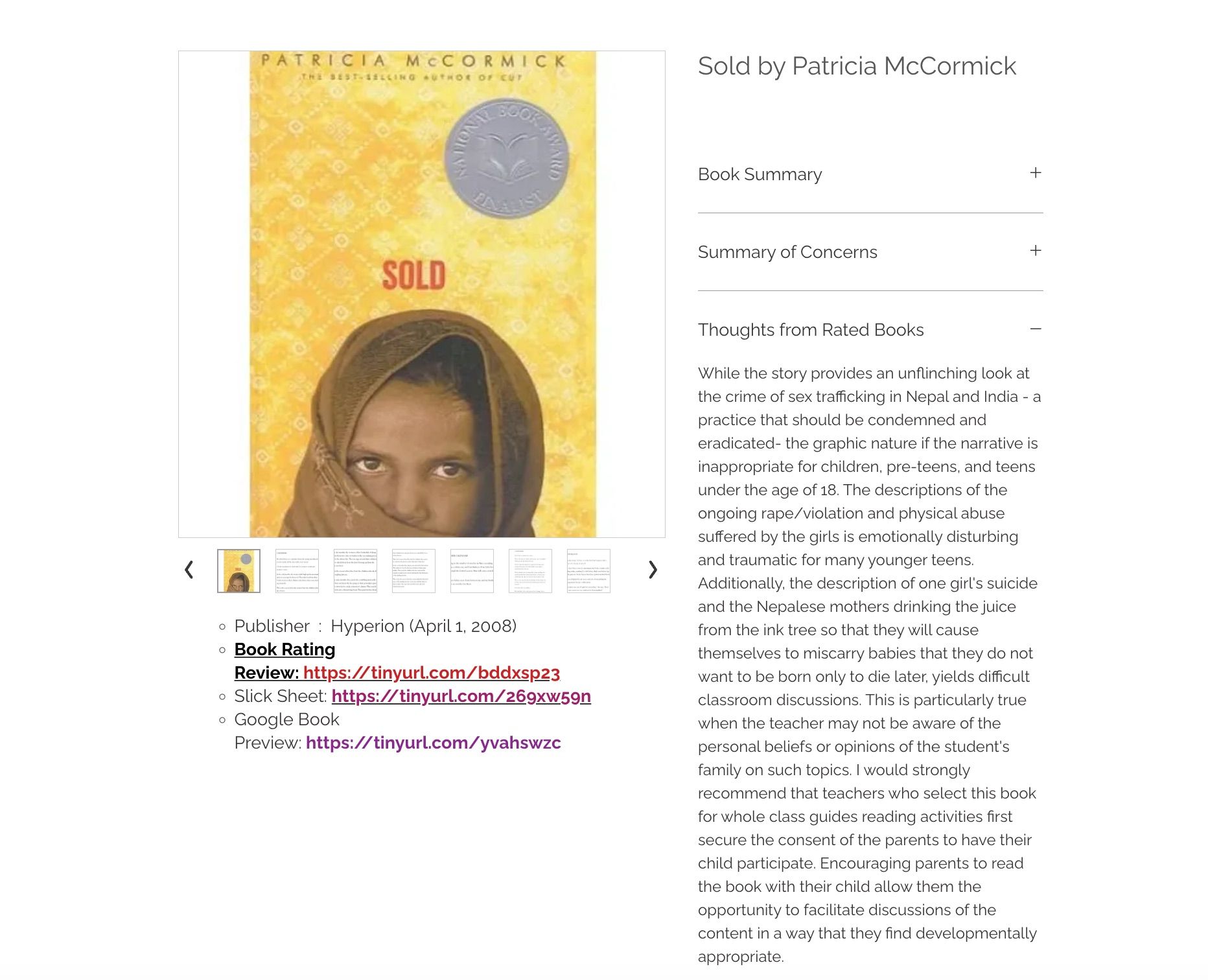
A case in point is the review of Patricia McCormick’s novel Sold. RatedBooks.org assigns this book a five-out-of-five rating, deeming it "explicitly inappropriate content that should be inaccessible to minors." The review itself, while ostensibly addressing content, reads as a patronizing dismissal of educational professionals:

"The description of one girl’s suicide and the Nepalese mothers drinking the juice from the ink tree so that they will cause themselves to miscarry babies that they do not want to be born only to die later, yields difficult classroom discussions. This is particularly true when the teacher may not be aware of the personal beliefs or opinions of the student’s family on such topics."
The review’s framing is particularly noteworthy given the purported concerns of the same groups regarding human trafficking. While these groups often express alarm over human trafficking in the United States, exemplified by their support for films like Sound of Freedom, their stance shifts dramatically when the subject matter involves individuals from other countries, particularly when those individuals are not white. In such instances, the content is readily labeled as "downright aberrant."
The National Book Rating Index: Monetizing Ideological Review
A sister site to RatedBooks.org, The National Book Rating Index (NBRI) aims to provide parents with comparative data from various book review outlets to facilitate "informed" decisions. Initially conceived as a subscription service, designed for sale to institutions and states advocating for "parental rights" in book selection, it now appears to offer all access freely. This strategic shift from a subscription model to free access may indicate a broader outreach effort to embed their framework more widely.

Brooke Stephens, one of the principal figures behind RatedBooks.org, is also an owner of the NBRI. This arrangement allows for the capitalization on the manufactured panic surrounding children’s books, directly benefiting from the partisan efforts of organizations like Utah Parents United.
The NBRI’s landing page showcases its filtering capabilities, with three key categories. Notably, two of these categories directly align with books targeted since 2021: LGBTQ+ content and books centering marginalized people. The use of a Black power image to represent "CRT" (Critical Race Theory) as a filter is a conspicuous tactic. While violence is presented as a filter, the site’s data suggests that books featuring gay characters are more frequently targeted for bans than those depicting violence.
Under the "Ratings" tab, the NBRI aggregates review tools used by various book-censoring organizations, notably omitting professional sources like Library Journal or Kirkus Reviews. Instead, it features data from RatedBooks.org, BookLooks.org, and the index of the "most prolific book banner in America," alongside other groups such as Christian Parent Reviews and Compass Book Ratings. These disparate reviews are synthesized into a "National Score," which mirrors the rating system of RatedBooks.org. The NBRI explicitly defines these scores in terms of its interpretation of "appropriateness" for young readers.

The "Audits" section of the NBRI offers a direct pathway for users to submit complaints to local schools and libraries. This section explicitly states its purpose: to ensure that only conservative viewpoints are represented in public institutions. This is not about fostering dialogue but about establishing a monolithic standard of belief and value. The site offers a "$100 Library Transparency Package," suggesting a commercial incentive to promote this narrow worldview.
Further exploration of the "Lists" tab reveals dropdown menus for five states: Arizona, Florida, Michigan, Texas, and Utah. Selecting Utah leads to a list of schools, seemingly providing access to comprehensive datasets of books available in individual school libraries. The origin of such detailed library inventories, typically proprietary information extracted from cataloging software and not publicly available, raises questions. However, in states mandating parental access to library catalogs, such datasets could be utilized to fulfill legal requirements. For an additional $10, the NBRI offers a "Parent Flag and Notify Letter" service, providing instructions on how to pressure libraries into generating these lists, effectively weaponizing library data for nationwide book banning efforts.
These lists are then processed by the NBRI to identify books that deviate from conservative values, serving as a trigger for challenges or to "empower" parents to restrict their children’s access to certain materials. A linked Google Sheet for Syracuse High School in Utah offers a glimpse into this process. Despite claims that books are not primarily targeted for LGBTQ+ content, the notes within the spreadsheet reveal a starkly different reality. While the spreadsheet may not definitively document book removals, it clearly catalogs books available in schools that have been rated by the NBRI and subsequently challenged or banned elsewhere in the United States. The author’s own book, Here We Are: Feminism for the Real World, is listed as banned due to "LGBTQ+" content, presented without nuance or context. The NBRI "borrows" this challenge information from PEN America’s annual indexes, a practice that further consolidates and disseminates data for censorship initiatives.

Under "Testimonials," the NBRI features a school board member from Arizona who readily admits to using the index to target books for removal without reading them. The NBRI is a product of S&S Apps LLC, a company owned by Brooke Stephens and her husband, who not only profit from book banning but also offer services to facilitate it nationwide. The "Kids’ Index" section presents a filtered version of the main reviews, omitting the decontextualized passages that often fuel censorship campaigns.
A search for Patricia McCormick’s Sold on the NBRI yields a list of conservative "reviews" with accompanying ratings and pull quotes. Below these, a generic link to "industry reviews" points to a 40-page Google document containing professional reviews and instructional guides for teaching the book. This stark contrast highlights the superficiality of the NBRI’s approach versus the depth and educational value provided by professional reviews. The NBRI’s methodology prioritizes easily digestible, sensationalized content, banking on the public’s preference for quick information over in-depth analysis.
The NBRI also flags books with "C" (challenged) and "X" (removed) designations, directly incorporating PEN America’s tracking data. A search for books by Kyle Lukoff, a trans author whose works center queer characters, reveals a pattern: only a picture book about feelings and one about vegetables escape the "LGBTQ+" label and are not deemed inappropriate.

The NBRI also provides an "audit system" to assist parents in informing librarians about books they wish to restrict. The "Parent Permission Greenlight" form, featuring AI-generated imagery, outlines a process whereby parents can request librarians review titles based on NBRI ratings before a child can check them out. This introduces an additional layer of bureaucratic and ideological scrutiny onto the work of library professionals.
BookLens.org: AI-Powered Misinformation for Censorship
Developed by Citizens for Decency, an anti-pornography nonprofit, BookLens.org is being promoted as a resource for identifying books for removal from shelves. Its focus is on highlighting "naughty" content, often exaggerating or fabricating the presence of sexual content, queer themes, and profanity.
BookLens.org utilizes AI for its search functions, which can be performed by scanning book covers, entering ISBNs, or manual searches. However, the AI’s propensity to "hallucinate" means it can generate reviews for books that do not exist, fabricating inappropriate content. This makes it an unreliable tool, even for books that are in circulation.

A review of Amanda Jones’s That Librarian, an adult nonfiction work, reveals no "naughty" content, rendering the review pointless and offering no discernible value beyond what could be found on a retail site like Amazon or through professional reviews. For Sold, BookLens.org redirects to a Google Doc containing the outdated review from the defunct BookLooks.org, stripping away provenance and presenting only a single, ideologically charged perspective.
While the AI’s hallucination of non-existent books may have decreased, its unreliability remains a significant concern. Author Ryan Estrada documented an instance where a fabricated book title generated a fabricated list of inappropriate content from BookLens.org. The platform’s lack of actual tools or resources beyond potentially fabricated reviews makes it a questionable asset for book banners, suggesting its existence is more a testament to an obsession with AI than a practical tool for censorship.
Take Back the Classroom (TBTC): Streamlining the Book Banning Process
Take Back the Classroom (TBTC) remains a favored resource for book banners, distinguishing itself with high-quality images and highlighted excerpts deemed offensive. Unlike other platforms, TBTC avoids assigning ratings, focusing instead on providing all necessary materials for individuals to file challenges without undertaking independent research. A key feature of TBTC is its cataloging of schools that possess "inappropriate" or "pornographic" books. By indexing these institutions, TBTC enables local book banners to target specific schools efficiently, eliminating the need for them to locate books within library catalogs themselves.

In preparation for the new school year, TBTC is launching a "National Book Challenge Initiative" designed to simplify the process of challenging sexually explicit books in public school libraries. This initiative will spotlight one book each month, providing:
- Ready-to-use book challenge forms.
- Documented excerpts from the book.
- Guidance on school district reconsideration policies.
- Talking points and strategic advice.
- Information for speaking before school boards.
- Additional resources to aid in successful challenges.
The stated goal is to create a comprehensive database of "proven strategies" for book removal. TBTC is actively soliciting submissions from individuals who have challenged books in the past three years, requesting copies of their challenges, school district responses, and any supporting correspondence. This information will be used to build a repository of successful challenges, thereby facilitating future censorship efforts. The submission form collects personal data alongside information about successful book removals, raising privacy concerns.
Broader Implications and the Erosion of Professionalism

The proliferation of these partisan review sites and the increasing legislative efforts to mandate their use represent a significant challenge to the principles of intellectual freedom and professional library science. These platforms bypass established legal definitions of obscenity, rely on subjective interpretations, and often generate misinformation. Their influence distorts collection development, diverts valuable resources from genuine educational endeavors, and undermines the expertise of librarians and educators.
The implication of these trends is a gradual erosion of public institutions’ commitment to diverse viewpoints and intellectual inquiry. By prioritizing ideologically driven content filtering over professional judgment and legal frameworks, libraries and schools risk becoming echo chambers that reflect only a narrow segment of societal beliefs, rather than serving as spaces for exploration, learning, and the free exchange of ideas. The financial incentives behind some of these platforms further suggest that book banning is not solely about perceived moral concerns but also a burgeoning industry built on manufactured fear and division.
The professional community, including organizations like the American Library Association, has consistently voiced opposition to such censorship tactics, emphasizing the importance of trained professionals in curating collections that meet diverse community needs and uphold intellectual freedom. The ongoing efforts to embed partisan review sites into library and school operations underscore the critical need for continued advocacy and vigilance in protecting these vital public institutions from ideological encroachment.