Muhammad Hendra
Inner calm, often misconstrued as a mere fleeting sensation of peace or relaxation, is increasingly recognized as a profound human capacity: the ability to disengage from attachments and impulsive reactions to life’s incessant flow of events, thereby fostering a state of ease and clarity. This sophisticated understanding moves beyond superficial tranquility, positioning inner calm as a cornerstone of mental well-being and a critical skill for navigating the complexities of the 21st century.
At its core, inner calm, as a mindfulness skill, hinges on comprehending the inherent impermanence of all phenomena—our thoughts, emotions, desires, and external circumstances. When faced with the modern predisposition for rushing and reactivity, the conscious recognition that "this too shall pass" serves not to negate legitimate feelings but to introduce a vital pause, decelerating accelerated emotional responses. This pause allows for a return to an internal stillness, from which the genesis of reactivity can be observed, intimately revealing its transient nature. This profound insight, according to mindfulness practitioners and neuroscientists, is the true pathway to liberation from emotional entanglement.
Historical and Philosophical Underpinnings of Inner Stillness
The concept of inner stillness is not a novel invention but rather a thread woven through millennia of human wisdom traditions. Ancient philosophies such as Stoicism, with its emphasis on distinguishing between what is within our control and what is not, and Eastern spiritual practices like Buddhism, which advocates for non-attachment and the understanding of anicca (impermanence), have long articulated pathways to cultivating a serene mind amidst external turbulence. While the terminology may differ, the underlying principles—observing thoughts without identification, accepting the present moment, and understanding the transient nature of experience—resonate deeply with contemporary definitions of inner calm.
In recent decades, these ancient insights have found validation in the burgeoning fields of neuroscience and psychology. Researchers are increasingly demonstrating the physiological and psychological benefits of practices that cultivate inner calm, such as mindfulness meditation. This scientific backing has propelled mindfulness from the periphery of alternative wellness into mainstream applications across healthcare, education, and corporate environments.
Inner Calm as a Deliberate Practice: Stopping, Looking, and Letting Go
As a conscious practice, inner calm is articulated as the art of "stopping, looking, and letting go," with the explicit aims of healing and achieving clarity. This involves cultivating both physical composure and mental tranquility. It is often likened to a soothing balm for the soul, providing a restorative effect akin to a cool breeze on a hot day. The tangible benefits manifest in both body and mind: physically, composure is experienced as relaxed muscles and an overarching sense of ease; mentally, inner calm creates the expansive cognitive space necessary to hold all experiences without succumbing to attachment or resistance. Conversely, the absence of this cultivated calm frequently manifests as physical restlessness, mental agitation, or heightened reactivity, highlighting its fundamental role in overall equilibrium.
The Paradox of Pursuit: When Seeking Calm Fuels Anxiety
Ironically, the very desire for inner calm can become an obstacle to its attainment. True inner calm, a "catch-22" for many, is often achieved only when the desire for it, along with other attachments, is released. This paradox is frequently observed in therapeutic settings. Consider the case of a client battling chronic anxiety who, hoping to alleviate his distress, committed to meditation. Contrary to his expectations, he reported increased anxiety following meditation sessions. His aspiration for improved sleep, a primary motivation for his practice, was thwarted by heightened awareness of his restlessness during a body scan meditation, which paradoxically worsened his sleep problems.

The crux of this dilemma lies in the client’s expectations and attachment to a specific outcome. To find genuine peace, he first had to relinquish his preconceived notions about how peace should manifest. Through guided practice, he learned to identify and address the three primary hindrances to his mindful state: a restless mind (running in circles), the relentless striving for a desired outcome (pulling, e.g., to fall asleep), and frustration with his current state (pushing, e.g., against his restlessness). By learning to accept his restless mind without judgment, the intensity of his striving and frustration softened. This acceptance, rather than the elusive sleep itself, allowed him to find ease, ultimately creating the conditions for sleep to occur naturally. This demonstrates that letting go of attachments to specific outcomes does not equate to suppressing or evading challenging situations; rather, this release unfolds organically with the understanding that emotions are transient.
The Ninety-Second Rule: Deconstructing Emotional Lifespans
Central to cultivating inner calm is the understanding that emotions, even intense ones, possess a finite physiological lifespan. Inner calm is not about suppressing, denying, or avoiding our emotions; instead, it is about developing the capacity to "stay with" unpleasant sensations without immediately reacting. This practice is grounded in the recognition that emotions are primarily physiological responses within the body that, like all transient phenomena, will arise and subsequently dissolve. Just as externally triggered happiness eventually fades, so too do negative emotions.
Neuroscientist Jill Bolte Taylor, in her seminal work My Stroke of Insight: A Brain Scientist’s Personal Journey, popularized the "Ninety-Second Rule." Taylor posits that the chemical cascade of an emotion, from its initial trigger to its complete dissipation from the bloodstream, typically lasts no longer than 90 seconds. This biological window is crucial: within this timeframe, the physiological components of an emotion run their course. If we continue to experience negative emotions for minutes, hours, days, or even years, it is because we are actively re-fueling these feelings with our cognitive narratives—our stories, judgments, and interpretations about the event or emotion.
By consciously stopping and allowing the emotion to move through the body without engaging in narrative reinforcement, we create mental space. This space enables us to better understand what the emotion is attempting to communicate, rather than being overwhelmed by its raw intensity. This approach fosters an alliance with our feelings, moving beyond suppression or forced positive thinking. It allows us to uncover underlying needs, identify protective mechanisms, or draw attention to new information in our environment. While the ninety-second rule serves as a powerful reminder to ride the waves of emotion, it acknowledges that some emotions can be so potent they temporarily override rational thought processes. In such instances, recalling the evolutionary origins of these powerful responses—rooted in our hunter-gatherer past where real, immediate threats demanded instant, instinctual action—can provide a valuable perspective.
How Inner Calm Supports Resilience: Navigating the Amygdala Hijack
Modern life, despite its comforts, is replete with perceived threats—to our identity, career, social standing, or relationships. Our ancient, primal reactions—the fight-flight-freeze response—are often profoundly unhelpful in navigating these pervasive psychological and social stressors. Contemporary challenges typically demand clarity, creative problem-solving, and nuanced communication, yet our automatic evolutionary response to any perceived threat is precisely the opposite: to fight, flee, or freeze. This automatic, unconscious reaction bypasses rational thought, leading to suboptimal outcomes.
This phenomenon, where emotions are triggered to such an extent that clear thinking becomes impossible, is widely known as an "amygdala hijack," a term popularized by emotional intelligence expert Daniel Goleman. The amygdala, a key component of the brain’s limbic system, functions as the emotional processing center and threat detector. Upon perceiving a threat, whether a genuine physical danger or a psychological affront, it sends an immediate, urgent signal to release stress hormones—adrenaline and cortisol. This hormonal surge rapidly prepares the body for an emergency response: blood flow is redirected from non-essential organs (like digestion) to the limbs, priming the individual for physical confrontation or escape. Crucially, during this process, the prefrontal cortex—the brain region responsible for executive functions, logical thought, and decision-making—is temporarily inhibited. In a life-threatening scenario, there is no time for analysis; immediate action is paramount.
During an amygdala hijack, an individual’s IQ is said to temporarily drop by ten to fifteen points. This neurobiological reality offers an explanation for those moments of regret following an impulsive verbal outburst: "What was I thinking when I said that?" The answer, often, is that rational thought was temporarily suspended. This state also compromises memory, making it difficult to recall positive attributes of someone during a conflict or locate keys during a panic attack. Furthermore, a chronic state of fight-or-flight, continuously triggered by modern psychological stressors, significantly compromises the integrity of other vital bodily systems, including immunity and digestion, contributing to a host of stress-related illnesses that burden healthcare systems globally.
Cultivating inner calm is a critical intervention for preventing or mitigating the amygdala hijack, thereby preserving cognitive function even in highly charged situations. Practices specifically designed to promote inner calm, such as focused breath awareness, help to slow escalating emotional responses and activate the parasympathetic nervous system—the body’s "rest and digest" system. This physiological shift allows the prefrontal cortex to re-engage, restoring clear thinking. Another effective technique is "noting" or "labeling" emotions (e.g., "anger," "sadness," "frustration"). This cognitive act of identifying and naming an emotion creates a small but significant space between the feeling and the reaction, effectively re-establishing healthy communication between the prefrontal cortex and the amygdala, thus averting a full-blown hijack. Inner calm, therefore, provides opportunities for reflection, learning, and improvement, allowing individuals to move beyond tension and misunderstanding toward harmony and deeper insight into the "what" and "why" behind their actions. It is an indispensable quality for building resilience in relationships and navigating the vicissitudes of life.
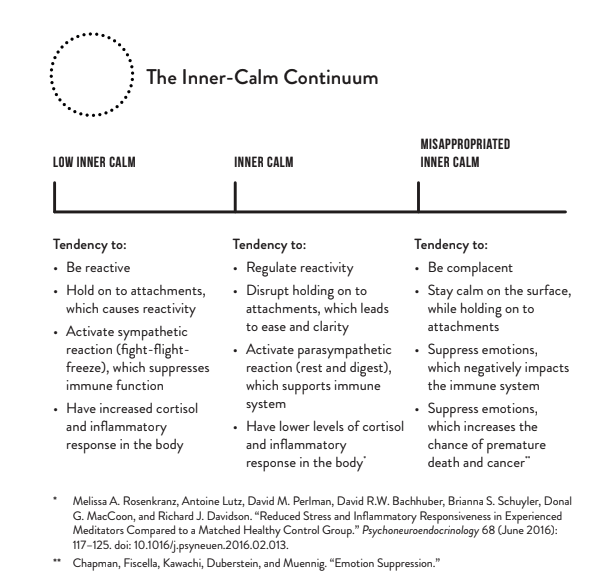
The Inner Calm Continuum: A Path to Greater Resilience
The capacity for inner calm is not a fixed trait but a skill that can be developed and strengthened, regardless of one’s inherent disposition or life circumstances. The journey begins with cultivating self-awareness: consciously observing when one is calm and, crucially, when one is not. This observational practice extends to noticing the specific causes and conditions that promote calm, as well as those that disrupt it. By diligently cultivating habits that calm both mind and body—whether through formal meditation, breathwork, or simply moments of mindful pause—individuals progressively enhance their ability to access this state of inner stillness more quickly and easily. This iterative process of awareness, practice, and integration leads to a gradual shift along an "inner calm continuum," moving towards greater equanimity and resilience.
Daily Practice: The One-Minute Rest
Integrating practices that foster inner calm into daily life does not require extensive time commitments. Even brief, consistent interventions can yield significant benefits. The "One-Minute Rest" is an accessible and powerful practice. As poet David Whyte eloquently states, "Rested, we care again for the right things and the right people in the right way."
The practice involves taking intentional pauses throughout the day, even several times if possible, to metaphorically "empty your cup" and create mental and physical space for what truly matters. This can be achieved rapidly by simply checking in with your body:
- Stop: Cease whatever activity you are engaged in, even for a moment.
- Breathe: Take a few conscious, deep breaths, noticing the sensation of the breath entering and leaving your body.
- Scan: Briefly scan your body for areas of tension. Notice any sensations without judgment.
- Release: Gently soften any areas of tension you find.
- Re-engage: Return to your activity with a renewed sense of presence and clarity.
This simple yet profound practice can be integrated into various contexts—before beginning a work meeting, transitioning between tasks, or even shared with family members or team colleagues to foster collective presence and reduce reactivity. Such micro-practices, when consistently applied, gradually re-wire the brain, strengthening neural pathways associated with calm and focus, and diminishing the automaticity of stress responses.
Broader Implications and Future Outlook
The growing emphasis on inner calm and mindfulness reflects a broader societal recognition of the escalating mental health crisis and the pervasive impact of chronic stress. Organizations across sectors are increasingly investing in mindfulness training and stress reduction programs, understanding their profound implications for employee well-being, productivity, and innovation. Data consistently show that mindfulness interventions can reduce symptoms of anxiety and depression, improve focus, and enhance emotional regulation. For instance, a meta-analysis published in JAMA Internal Medicine found that mindfulness meditation programs can moderately improve anxiety, depression, and pain.
The cultivation of inner calm, therefore, is not merely a personal pursuit but a vital component of public health and societal resilience. By empowering individuals to navigate their internal landscapes with greater skill and equanimity, it contributes to a more compassionate, understanding, and effective global community. The insights shared in works like Shalini Bahl Milne’s Return to Mindfulness: Disrupting Default Habits for Personal Fulfillment, Effective Leadership, and Global Impact (scheduled for release on January 18, 2024), contribute significantly to this evolving discourse, offering practical pathways for individuals to reclaim their inner peace and, in doing so, positively impact their immediate environments and the world at large. The journey towards inner calm is a continuous process of learning, practicing, and refining, promising profound benefits for personal fulfillment, leadership effectiveness, and collective well-being.