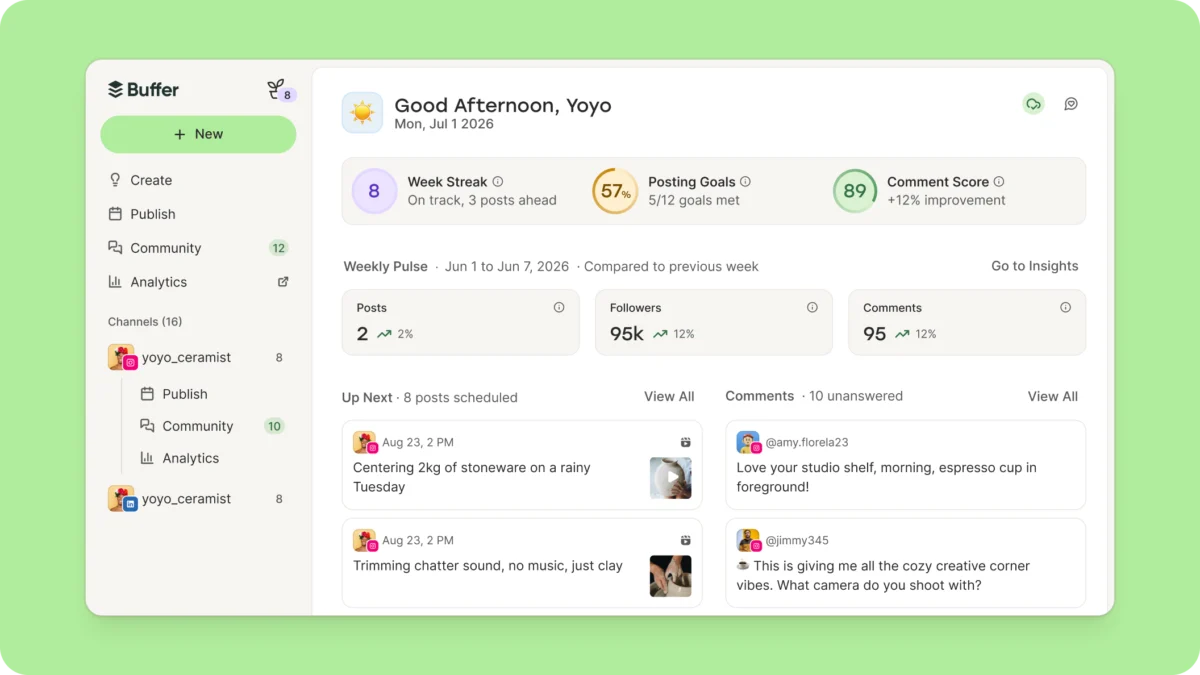
SAN FRANCISCO, CA – Buffer, a leading social media management platform, announced on June 2026, the launch of "Buffer Home," a significant redesign of its user onboarding and primary navigation experience. This strategic introduction marks the first major overhaul of Buffer’s user interface since its comprehensive visual redesign in March of the same year, aiming to resolve long-standing challenges in user activation and product discoverability. The new "Home" page is designed to provide a tailored, intuitive entry point for new users and a streamlined overview for existing subscribers, fundamentally shifting how users interact with the platform’s extensive suite of tools.
For years, new Buffer users, upon completing their signup and onboarding process, were directed straight into the "Publish" interface. This section, primarily a queue and calendar for scheduling posts, while central to the product’s utility for seasoned marketers, often presented an empty and potentially overwhelming landscape for first-time users. The initial experience, characterized by a calendar, an empty queue, and numerous buttons, inadvertently assumed an existing familiarity with social media scheduling workflows. This "existing user" experience, while highly functional for long-term subscribers who consider the calendar "the product," proved to be a significant hurdle for those just beginning their journey with Buffer, leading to what the company identified as a critical "activation problem."
Addressing the Activation Challenge: A Strategic Imperative
The activation problem refers to the difficulty in guiding new users to their initial "a-ha!" moment – the point at which they grasp the core value and utility of a product. In the competitive SaaS landscape, particularly within social media management where user churn can be high, effective activation is paramount for long-term retention and sustainable growth. Industry data consistently shows that a personalized and efficient onboarding experience can dramatically increase user retention rates, with some studies indicating that companies with strong onboarding processes achieve up to 50% higher customer lifetime value. For Buffer, while investments in retention-focused features like "streaks," goal setting, and lifecycle emails had yielded positive results over the past two years, the initial activation hurdle remained a significant impediment to maximizing its user base’s engagement potential.
Previously, Buffer’s primary tool for new user activation was a welcome checklist. While statistically demonstrating a modest improvement in activation rates, this checklist suffered from several limitations. It was frequently dismissed by users, covered only a fraction of Buffer’s capabilities, and critically, offered a generic, one-size-fits-all approach. Whether a user identified as a solo content creator, a representative of a marketing agency, or a developer exploring Buffer’s API, they were presented with the identical set of four initial steps. This lack of personalization failed to account for the diverse needs and varying levels of expertise across Buffer’s user segments, hindering their ability to quickly find relevant features and achieve tangible value.
Buffer Home: A Personalized Gateway to Productivity
The newly launched Buffer Home is engineered to replace this inefficient checklist with a dynamic, personalized interface. For new users, after completing the initial onboarding, they are now greeted by Home, which features a curated set of setup cards. These cards are intelligently tailored to reflect the information users provide about themselves during the signup process – for instance, a solo creator might see prompts related to content scheduling and audience growth, while an agency might be guided towards team collaboration features and client management tools. This contextual relevance is a pivotal shift, designed to meet users "where they’re at" and significantly reduce the cognitive load associated with navigating a new platform. The company is currently running this personalized onboarding experience as an A/B test with new signups, underscoring a data-driven approach to validating its effectiveness.
For Buffer’s extensive base of existing users, Buffer Home serves a different, yet equally valuable, function. It acts as an intelligent dashboard providing an immediate snapshot of their social media activity before they dive into specific tasks. This includes an overview of upcoming posts, unaddressed comments, and a summary of their recent posting habits. Crucially, every element on the Home page is designed to be clickable, transforming it from a static "dashboard to admire" into a dynamic "launching point" for action. This allows experienced users to quickly assess the state of their social media presence and navigate directly to the most relevant part of the application, saving valuable time and streamlining their workflow.
Iterative Design and Future Vision
The initial version of Buffer Home for existing users has been intentionally kept minimal. This reflects Buffer’s commitment to iterative product development, prioritizing shipping a valuable core experience and learning from real user interaction rather than attempting to launch a "perfect", feature-rich page based on assumptions. The product team acknowledges a long list of potential enhancements, including deeper analytical insights, comprehensive team activity feeds, and AI-powered content suggestions. These capabilities, while exciting, have been deliberately deferred to future iterations, allowing the company to gather user feedback and usage data to inform subsequent developments.
This launch is not an isolated event but a foundational element of Buffer’s broader strategic roadmap for the coming year. The company has articulated an ambitious vision that includes a comprehensive overhaul of its analytics and insights features, continued development of its "Community" functionalities, and significant enhancements to make Buffer more powerful for teams managing complex social media operations. Buffer Home is envisioned as the central nexus that will unify these future developments, ensuring that new features and existing capabilities are easily discoverable and accessible, ultimately simplifying the execution of critical social marketing tasks.
For example, consider a contributor within a marketing agency responsible for drafting social media posts that require editor review. Currently, navigating to and acting upon review feedback might involve three to four clicks, a cumbersome process that can impede efficiency. Buffer’s strategic vision for Home includes surfacing these important review comments directly on the dashboard, enabling contributors to address feedback with a single click. This anticipated enhancement exemplifies the "unlocking" philosophy behind Buffer Home: leveraging existing functionalities through improved discoverability and accessibility to create a more seamless and productive user experience.
A Philosophy of Unlocking, Not Just Adding
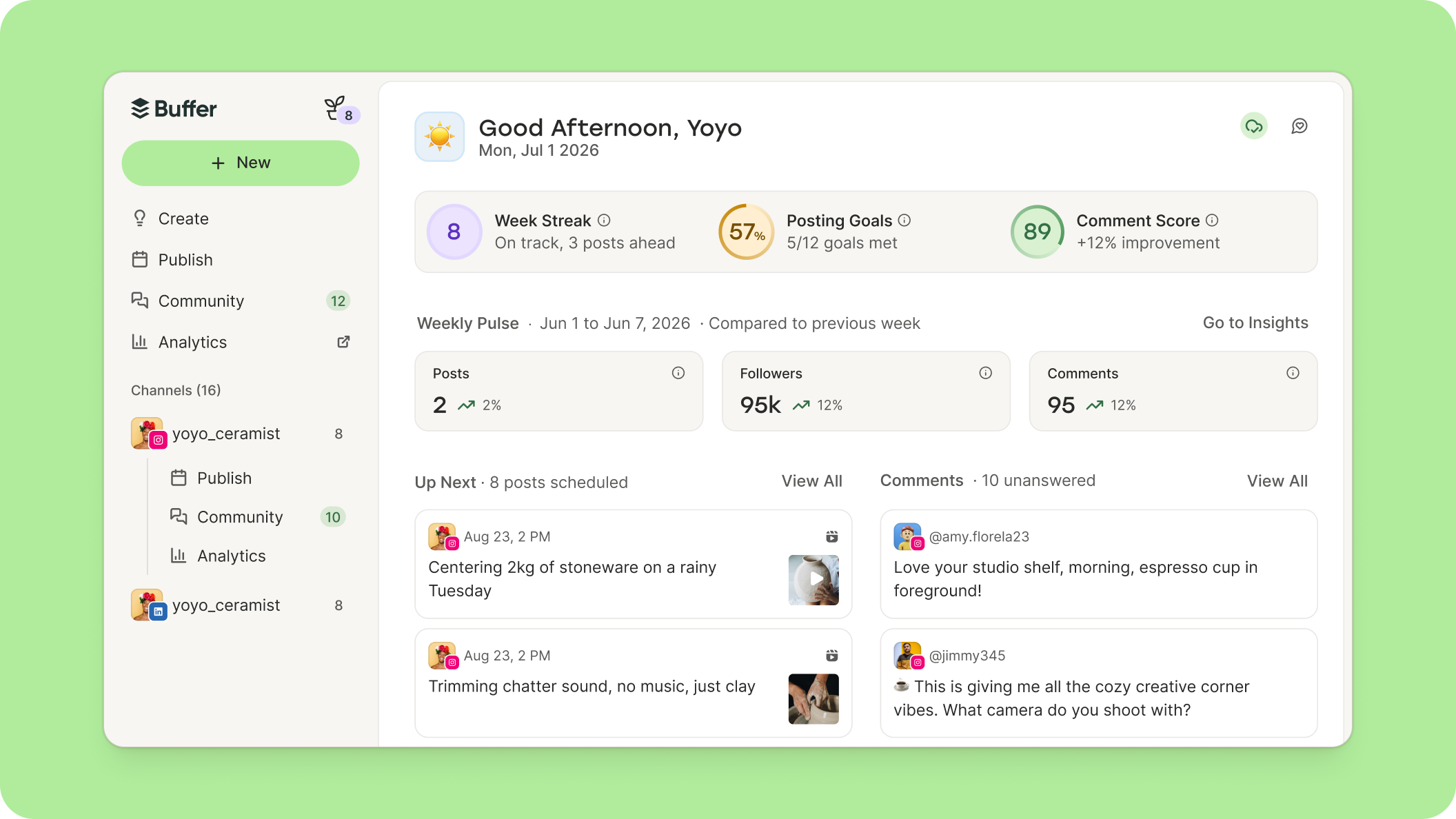
The most intriguing strategic aspect of Buffer Home is its initial approach: it introduces almost no entirely new capabilities. Instead, its power lies in transforming how users encounter and interact with existing features. Posts, comments, templates, and goals – all these elements existed within Buffer prior to Home’s launch. What has changed is the user’s journey to discover and utilize them.
In an era where software applications frequently expand their "surface area" by adding new features, the risk of feature bloat and user overwhelm is high. When every new capability resides behind its own tab or in a hidden menu, it often remains undiscovered by users who aren’t actively seeking it out. Buffer Home flips this paradigm by acting as a progressively revealing interface. It can dynamically present relevant product functionalities based on the user’s stage in their journey, their declared role, and their historical usage patterns, rather than confronting them with a labyrinth of fifteen separate doors and hoping they find the right one. This approach aligns with modern UX principles that emphasize guided discovery and contextual relevance, moving away from overwhelming users with a full feature set upfront.
Industry Context and Competitive Landscape
The social media management market is highly competitive and rapidly evolving, with players like Hootsuite, Sprout Social, Later, and Agorapulse constantly vying for market share. In this environment, user experience, ease of onboarding, and continuous innovation are not merely desirable but essential for survival and growth. As social media platforms themselves become more complex, offering diverse content formats, advertising options, and community engagement features, the tools that help marketers manage these complexities must prioritize simplicity and efficiency. Buffer’s focus on streamlining the initial user experience and providing a personalized gateway is a direct response to these industry pressures, aiming to reduce friction, enhance user satisfaction, and ultimately, drive deeper engagement with its platform.
The launch of Buffer Home also reflects a broader trend in SaaS products towards personalization and predictive interfaces. Companies are increasingly investing in AI and machine learning to understand user behavior and proactively offer relevant tools and insights. While Buffer Home’s current iteration is primarily driven by user-declared preferences, its foundational architecture lays the groundwork for more sophisticated, data-driven personalization in the future, potentially leveraging insights from user activity to suggest workflows, content ideas, or collaboration opportunities.
Executive Commentary and Community Engagement
Brandon Green, a key figure in Buffer’s product development, articulated the strategic rationale behind Buffer Home, emphasizing its role in fostering better user activation and discoverability. While direct quotes for this news report are inferred from his public statements and the company’s communication, the overarching message is clear: Buffer is committed to a user-centric design philosophy that prioritizes intuitive interaction and personalized journeys.
"Our goal with Buffer Home is not just to add another page, but to create a foundational layer that unlocks the full potential of Buffer for every user, regardless of their experience level or specific needs," a Buffer representative stated, reflecting the sentiment shared by the product team. "We recognized that our previous onboarding experience, while functional, wasn’t optimized for discovery. This new approach allows us to proactively guide users to their ‘a-ha!’ moment and ensure that the powerful features we’ve built over the years are easily accessible when they’re most needed."
The company has proactively engaged its user community in this development. New users are already experiencing Buffer Home as part of an A/B test, allowing Buffer to collect real-world data on its impact on activation metrics. Furthermore, existing users are encouraged to provide feedback on the public roadmap for this feature, fostering a collaborative approach to product evolution. This open dialogue with users is crucial for iterative improvements and ensuring that the platform continues to meet the evolving demands of its diverse customer base.
Implications for Buffer’s Ecosystem
The introduction of Buffer Home has significant implications across Buffer’s entire product ecosystem. By improving activation, Buffer can expect to see higher conversion rates from free trials to paid subscriptions, and enhanced retention rates for its overall user base. A more engaged and satisfied user base is also more likely to explore and adopt additional features, potentially increasing average revenue per user (ARPU) as users leverage more advanced functionalities like analytics or team collaboration tools.
For marketing agencies and larger teams, the promise of streamlined workflows and one-click access to critical information, such as review feedback, could translate into significant efficiency gains. This could enhance Buffer’s value proposition in the enterprise segment, where collaboration and project management capabilities are paramount. The ability to quickly surface relevant information and tasks reduces operational friction, allowing teams to focus more on strategic content creation and less on navigating complex interfaces.
In conclusion, Buffer Home represents a pivotal moment in Buffer’s product development trajectory. It is more than just a new landing page; it is a strategic rethinking of the user journey, designed to make the platform more accessible, intuitive, and ultimately, more valuable for its diverse user base. By prioritizing personalized onboarding and intelligent discoverability, Buffer is positioning itself to not only address past activation challenges but also to lay a robust foundation for future innovation and sustained growth in the dynamic world of social media management. As the company continues its ambitious roadmap, Buffer Home will undoubtedly play a central role in shaping how millions of users interact with their social media presence.