
 Ali Ikhwan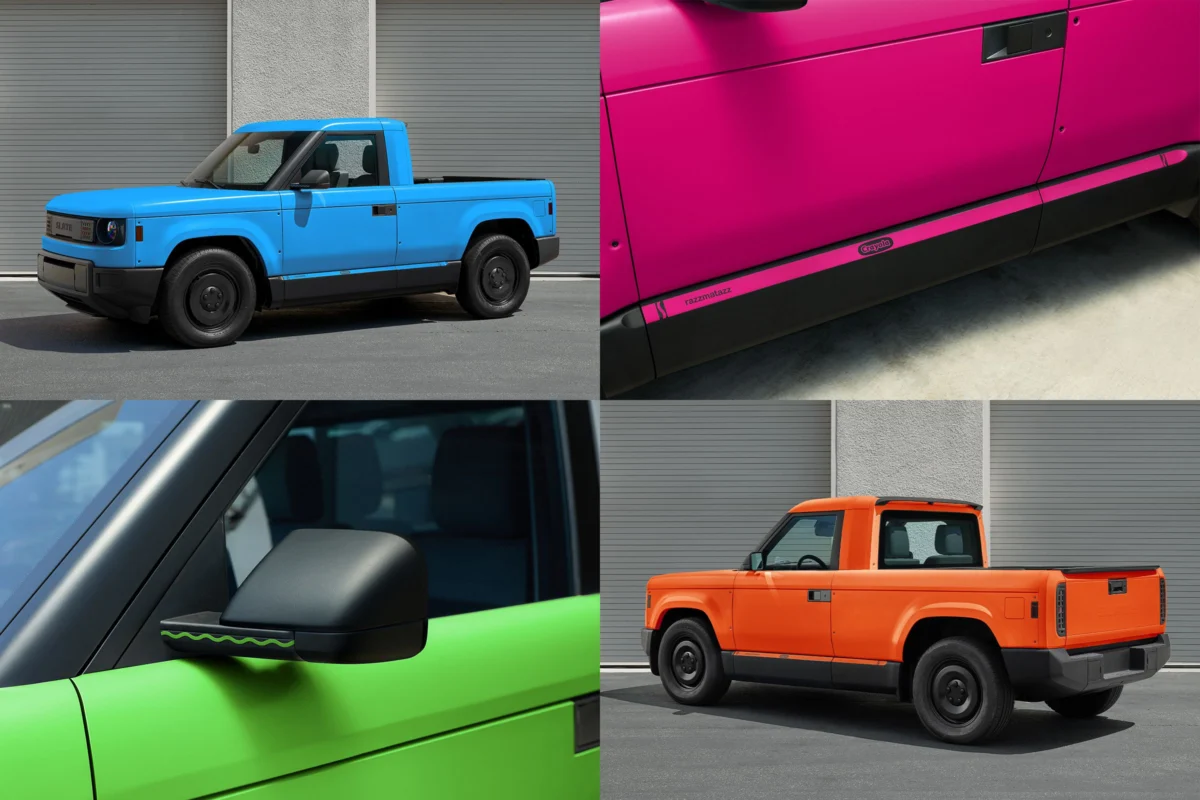
Slate Auto, the Jeff Bezos-backed electric vehicle startup currently developing what is positioned to be the most affordable electric pickup truck in the United States, has announced a strategic partnership with Crayola to offer a unique series of vehicle wraps. This collaboration marks the first time the iconic 121-year-old art supply company has entered the automotive sector, signaling a shift in how manufacturers approach vehicle aesthetics and consumer personalization. The partnership centers on five specific high-visibility colors pulled directly from Crayola’s historic palette: Cerulean, Fern, Jersey Tomato, Razzmatazz, and Dandelion. This move is not merely a marketing exercise but a core component of Slate Auto’s manufacturing philosophy, which prioritizes cost-efficiency by delivering vehicles with unpainted composite bodies designed specifically for aftermarket or factory-applied wraps.
The Strategy of the Blank Canvas
The Slate truck, which carries a starting price of $24,950, achieves its aggressive price point through radical simplification of the traditional automotive manufacturing process. Standard internal combustion and electric vehicles typically undergo a rigorous and expensive painting process, which requires massive capital expenditure for paint shops, environmental controls for volatile organic compounds (VOCs), and significant energy for curing ovens. By shipping every vehicle in a uniform, unpainted gray composite, Slate Auto eliminates one of the most cost-intensive stages of production.
The partnership with Crayola leverages this "blank canvas" approach. While Slate offers over 100 standard wrap hues starting at $500, the Crayola "starter packs" are positioned as premium customization options. Priced at $1,550—more than triple the cost of the standard wraps—these packs include the vinyl wrap, specialized decals, a color-coordinated key-fob cap, and a "Slatelet," which is a clip-on dashboard accessory unique to the brand’s ecosystem. The company has indicated that professional installation for these wraps is expected to cost approximately $500, bringing the total cost of a Crayola-themed transformation to just over $2,000.
Technical Specifications and Engineering Efficiency
Despite its entry-level pricing, the Slate electric truck is engineered with modern specifications tailored for urban utility and light-duty work. The vehicle is powered by a 65-kWh lithium iron phosphate (LFP) battery pack. LFP technology, while pioneered in the United States, has seen its most significant industrial scaling in China. These batteries are generally heavier and less energy-dense than the nickel-manganese-cobalt (NMC) batteries used in long-range luxury EVs, but they offer several distinct advantages for an affordable work truck: they are significantly cheaper to produce, have a longer cycle life, and are less prone to thermal runaway.
The Slate’s powertrain and performance metrics include:

- Range: A manufacturer-claimed 205 miles on a single charge.
- Payload Capacity: 1,550 pounds.
- Towing Capacity: 2,000 pounds.
- Acceleration: 0 to 60 mph in approximately 8 seconds.
- Top Speed: Governed at 90 mph.
- Charging: DC fast-charging capability of up to 120 kW, allowing the battery to charge from 20% to 80% in 30 minutes.
The interior of the truck follows the same minimalist ethos as the exterior. To maintain the $24,950 price tag, the base model lacks a traditional infotainment touchscreen and features manual windows. This design choice targets a demographic of buyers who prioritize utility and low cost of ownership over luxury amenities, while also reducing the complexity of the vehicle’s software and wiring harness.
A Chronology of Development and Market Entry
Slate Auto’s trajectory has been closely watched by industry analysts due to its high-profile backing from Amazon founder Jeff Bezos and its promise to disrupt the pricing structure of the American EV market. The current average price for a new electric vehicle in the U.S. remains above $50,000, making Slate’s sub-$25,000 target a potential game-changer for mass adoption.
- Early 2024: Slate Auto emerges from stealth mode, detailing its "wrap-first" manufacturing strategy and the use of composite body panels to reduce weight and cost.
- June 2024: The company officially opens its pre-order book. Potential buyers are invited to reserve a vehicle for a $300 fee (or $250 for early $50 reservation holders).
- Late 2024: Announcement of the Crayola partnership. This serves as a proof of concept for the Slate Marketplace, an online platform intended to sell more than 200 accessories directly to consumers.
- Q4 2026: Scheduled commencement of initial deliveries.
- 2027: Expected ramp-up to full-scale production and distribution across the United States.
While the delivery timeline is ambitious, the company maintains that its simplified assembly process—avoiding the complexities of a traditional paint shop and high-end interior electronics—makes these targets achievable compared to other EV startups that have struggled with production "hell."
Market Context and Competitive Landscape
The introduction of the Crayola wraps comes at a time when the automotive industry is grappling with the "sameness" of EV design and the rising costs of vehicle repairs. Traditional paint is difficult to match and expensive to fix when scratched. Vinyl wraps, by contrast, offer a layer of protection to the underlying composite and can be replaced more easily if damaged.
Industry analysts suggest that the Crayola partnership is a calculated move to inject "personality" into a vehicle that is otherwise defined by its austerity. By using colors like Dandelion—a yellow shade that was famously retired from the Crayola box in 2017 before being reinstated due to popular demand—Slate is tapping into a sense of nostalgia and playfulness. This contrasts sharply with the utilitarian, often aggressive styling of competitors like the Tesla Cybertruck or the Ford F-150 Lightning.
From a broader economic perspective, Slate Auto is navigating a complex trade environment. The use of LFP battery technology, which is currently dominated by Chinese supply chains, subjects the company to evolving federal regulations regarding EV tax credits and import tariffs. However, by focusing on a "Built in America" assembly model with a simplified supply chain, Slate aims to mitigate some of these geopolitical risks.

Implications for the Automotive Industry
The Slate-Crayola partnership may serve as a bellwether for future automotive business models. By decoupling the color of the car from the manufacturing process, Slate is shifting the burden of personalization from the factory floor to the digital marketplace and the aftermarket. This "platform-as-a-service" approach allows for recurring revenue through the sale of new wraps and accessories long after the initial vehicle purchase.
Furthermore, the partnership highlights a growing trend of non-automotive brands entering the mobility space. For Crayola, the collaboration provides a high-visibility platform to showcase its brand in a modern, eco-friendly context. For Slate, the association with a trusted, family-friendly brand helps humanize a startup that is otherwise built on cold, hard efficiency and Bezos-backed disruption.
However, the $1,550 price point for the Crayola pack has raised questions among some consumer advocates. While the base truck is affordable, the high cost of the "official" wraps suggests that Slate’s path to profitability may rely heavily on upselling high-margin accessories. For a buyer attracted to the $24,950 price tag, a $1,550 wrap represents a 6% increase in the total vehicle cost, a significant jump for a budget-conscious demographic.
Conclusion and Future Outlook
As Slate Auto moves toward its 2026 delivery goal, the success of the Crayola partnership will be a key indicator of consumer appetite for unconventional vehicle customization. If successful, it could prompt other manufacturers to reconsider the necessity of the traditional paint shop, potentially leading to a more colorful and affordable automotive landscape.
The Slate truck represents a return to the "Model T" philosophy of simplicity, updated for the electric age. While Henry Ford famously said customers could have any color "so long as it is black," Slate Auto is offering any color—provided the customer is willing to wrap it themselves or pay for a "Jersey Tomato" or "Razzmatazz" starter pack. As the EV market continues to mature, the industry will be watching to see if this blend of rock-bottom pricing and high-margin nostalgia can successfully bridge the gap between niche startup and mass-market mainstay.







