The proliferation of social media platforms has transformed the digital landscape, creating unprecedented opportunities for individuals, businesses, and developers to connect, engage, and disseminate information. However, this fragmented ecosystem presents a significant challenge: efficiently managing and integrating content across a multitude of distinct networks. Whether an independent developer is "vibe-coding" bespoke social media workflows or an enterprise software company is building a robust social media management tool from the ground up, the journey to integrate more than one platform often encounters considerable technical hurdles.
At its core, the difficulty stems from the inherent individuality of each social network. Platforms like Instagram, Facebook, TikTok, X (formerly Twitter), LinkedIn, and YouTube each maintain their own Application Programming Interfaces (APIs). These native APIs are designed to allow external applications to interact with their services, enabling functionalities such as content posting, data retrieval, and user authentication. While essential for interoperability, directly integrating with multiple native APIs quickly escalates into a complex and often cumbersome engineering task. Developers face a labyrinth of disparate documentation, unique authentication protocols, varying data formats, and platform-specific limitations. This intricate web of integrations is further complicated by the platforms’ regular updates and modifications to their APIs, which can swiftly render existing integrations obsolete or introduce unforeseen bugs, demanding constant maintenance and resource allocation.
The Genesis of the Problem: A Fragmented Digital Landscape

The exponential growth of social media platforms over the last two decades has led to an increasingly diversified digital presence for individuals and organizations alike. In the early 2010s, managing a presence on one or two major platforms like Facebook and Twitter was sufficient. Today, a comprehensive digital strategy often involves simultaneous engagement across a broader spectrum including Instagram, TikTok, LinkedIn, Pinterest, YouTube, and newer entrants like Threads and Bluesky, not to mention niche or decentralized platforms. This expansion, while offering wider reach, introduced significant operational overhead.
For developers, this meant building and maintaining separate connectors for each platform. Each connector required bespoke code to handle authentication tokens, data payload structures (e.g., text limits, image aspect ratios, video duration), error codes, and the often-whimsical rate limits imposed by platforms to prevent abuse. When a platform updated its API – a common occurrence designed to introduce new features or enhance security – developers would face a cascading effect, needing to update their integrations, test for regressions, and redeploy. This "messy wiring" analogy accurately captures the technical debt and maintenance burden associated with a purely native API approach.
The Rise of Unified Posting APIs: A Streamlined Approach
Imagine a scenario where, instead of wrestling with this tangled, mismatched wiring for each social network, developers could utilize a single, standardized "multi-plug" to connect to every necessary platform. This vision is realized through the concept of a unified posting API. A unified posting API acts as an intermediary layer, a single interface that connects to all the native platform APIs on a developer’s behalf. It abstracts away the underlying complexities, presenting a consistent and simplified mechanism for publishing content across diverse social networks. For non-engineers, this can be likened to superior cable management, transforming a chaotic tangle of wires into an organized, efficient system. The advantages of such an an approach are compelling, making unified APIs an increasingly popular choice for developers seeking efficiency and scalability.
The market for social media management tools (SMMTs) and API solutions has witnessed substantial growth, driven by the expanding digital marketing landscape and the imperative for brands to maintain a consistent, pervasive online presence. Industry reports consistently highlight the increasing number of social platforms businesses engage with, often averaging five to eight distinct networks. This trend underscores the critical need for solutions that can streamline multi-platform content distribution, moving beyond manual processes to automated, API-driven workflows. The global social media management market size, valued at approximately $17.8 billion in 2023, is projected to grow significantly, indicating a sustained demand for efficient integration solutions.
Unified API vs. Native APIs: A Comparative Analysis
The decision between leveraging a unified posting API and integrating directly with native platform APIs is a fundamental one for developers and product teams. This choice mirrors the classic "build vs. buy" dilemma, each path presenting a distinct set of trade-offs concerning control, development time, maintenance overhead, and cost.
Direct Native API Integration:
Integrating directly with native APIs offers the deepest possible level of control and customization. Developers have granular authority over every interaction with the social platform, allowing for highly specific features, optimized performance, and the implementation of unique platform-specific functionalities that a unified API might not expose. Furthermore, the direct use of native APIs typically incurs minimal or no direct recurring cost, beyond potential pay-per-use fees for certain platforms (such as the recent changes to X’s API pricing model) and the internal cost of engineering resources.
However, this control comes at a significant engineering cost. A typical multi-platform application might require maintaining eight to eleven separate integrations, each with its own authentication flow, data schema, rate limits, and error handling mechanisms. This approach necessitates a substantial initial development investment and ongoing maintenance to adapt to platform updates, deprecations, and policy changes. For instance, Meta’s Graph API for Instagram and Facebook, while powerful, requires developers to navigate specific permissions, app review processes, and potential changes to endpoints or data structures. Similarly, X’s shift to a pay-per-request model in February 2026 underscored the volatility and direct cost implications of relying solely on native APIs, forcing developers to reassess their integration strategies. The cumulative effort to manage these individual integrations can consume weeks or even months of engineering time, diverting resources from core product development and potentially delaying product launches.
Unified Posting API Integration:
In contrast, a unified posting API trades some of that direct control for vastly simplified setup and reduced ongoing maintenance. The primary benefits include:
- Single Authentication Flow: Instead of managing separate logins and permission processes for each social network, developers authenticate once with the unified API provider. This significantly reduces complexity and improves user experience for both developers and end-users.
- Standardized Data Format: Unified APIs normalize post data, providing a consistent format for content across all connected platforms. This eliminates the need for developers to translate content structures or handle platform-specific nuances, accelerating development cycles.
- Vendor-Managed Maintenance: Crucially, the unified API provider assumes responsibility for handling rate limits, implementing retry logic for failed posts, and adapting to platform API updates. This offloads a substantial maintenance burden from the developer, allowing them to focus on their core application logic rather than external API changes. This benefit alone can save weeks of engineering time over the lifespan of a product, with some estimates suggesting up to 40% reduction in development time for multi-platform features.
- Faster Time-to-Market: The streamlined integration process enables products to get to market much quicker, offering multi-platform posting capabilities without extensive upfront development. This agility is critical in fast-paced digital markets.
The trade-off for these efficiencies is typically a monthly subscription fee, which varies significantly among providers based on factors like supported platforms, post volume, and additional features. While this introduces a recurring cost, it often proves more cost-effective than the internal engineering resources required to maintain multiple native integrations, especially for small to medium-sized development teams. For platforms that operate at extreme scale, such as social ad networks or enterprise SaaS solutions with highly unique customization requirements, native integrations might still offer superior cost-efficiency and control. However, for most developers embedding social publishing into their products, a unified API offers an undeniable advantage in terms of efficiency and resource allocation.
Key Factors in Decision Making

Choosing the optimal integration strategy hinges on several critical business and technical considerations:
- Number of Platforms Required: If a project necessitates integration with only two or three social networks, managing native APIs might be manageable. However, if the requirement extends to five or more platforms, the cumulative engineering and maintenance load strongly favors a unified API solution. The exponential increase in complexity with each additional native integration quickly makes a unified approach more attractive.
- Project Timeline and Speed-to-Market: Connecting individually with every social network’s native API is inherently time-consuming. Development teams operating under tight deadlines or aiming for rapid deployment will find that a unified posting API significantly accelerates the process, enabling quicker feature releases and faster market entry. A unified API can reduce integration time from months to weeks.
- Post Volume and Account Count: The economic model of unified APIs becomes a critical factor at scale. Providers often use per-profile or per-post pricing. Per-profile pricing can accumulate rapidly if the application serves a large number of users, each managing multiple social profiles. Conversely, per-post pricing can become expensive if the application supports high-frequency posting. For projects with low volume across a handful of profiles, most unified API options remain affordable. Developers must carefully project their anticipated usage to select a pricing model that aligns with their operational costs and business model.
A Landscape of Unified API Providers: In-Depth Review
The market offers a diverse range of unified API providers, each with distinct strengths, platform support, and pricing structures. Developers are "spoiled for choice," allowing them to select a solution best suited for their specific platform mix, post volume, technical requirements, and budget.
1. Buffer API
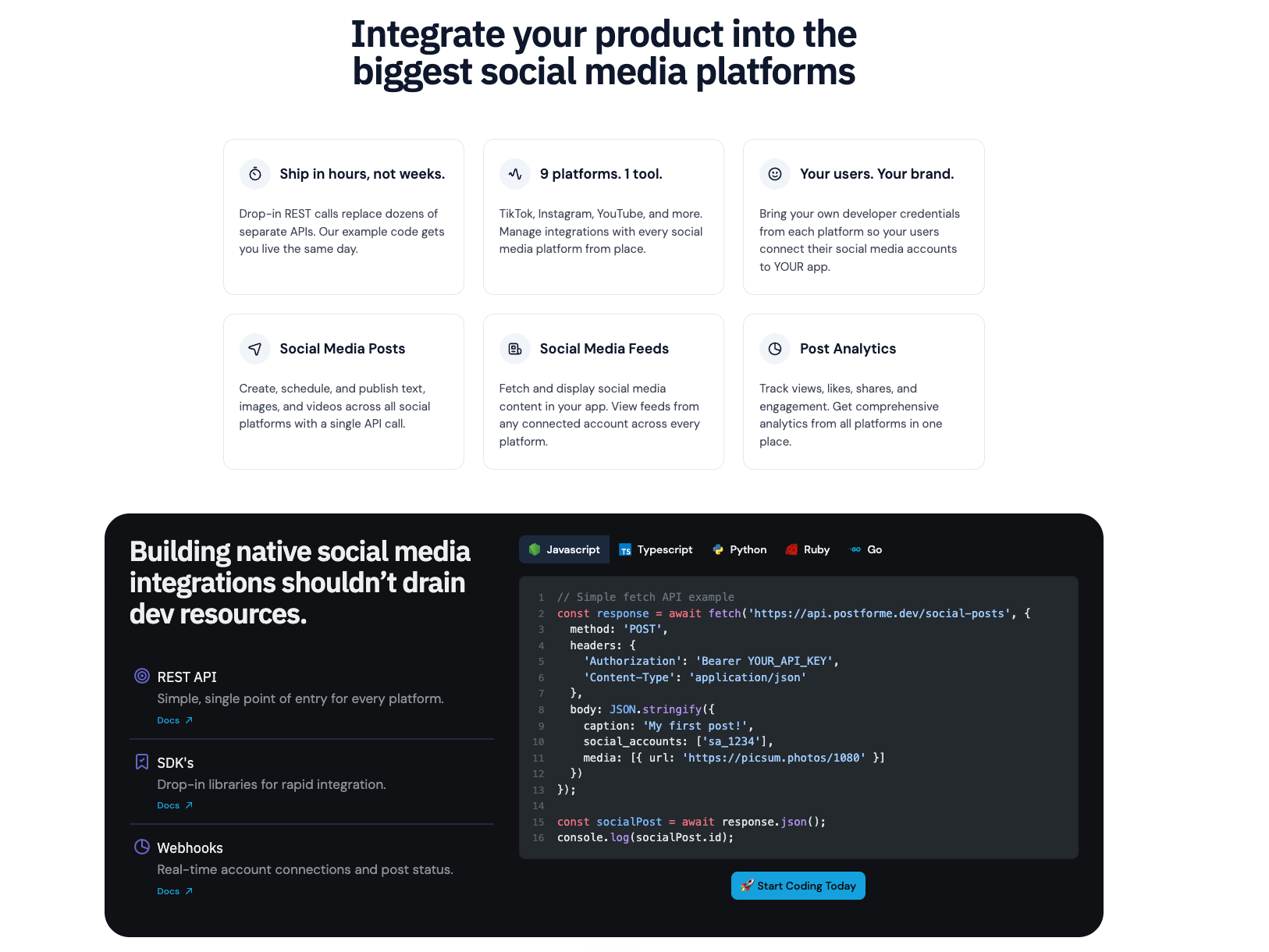
- Platforms Supported: 11 (Instagram, Facebook, LinkedIn, TikTok, X, Threads, Bluesky, Pinterest, YouTube, Google Business Profile, Mastodon).
- Pricing: Free for 1 API key; paid Buffer users receive 5 API keys.
- Best For: Creators, builders, and teams already utilizing Buffer for social media management who seek to automate scheduling workflows, content ideation, or channel management from their custom tools.
- Analysis: Buffer’s API, recently rebuilt from the ground up with a focus on GraphQL, developer-friendly tooling, and AI-tool readiness, provides a robust solution. Its primary appeal lies in seamless integration for existing Buffer customers, offering a single authentication flow tied to their connected channels. This is particularly useful for internal automation, content pipeline creation from CMS, or personal content operating systems. The inclusion of an MCP (Multi-platform Communication Protocol) server enables AI tools like Claude or ChatGPT to directly interact with Buffer for scheduling and content workflows, positioning it strongly for the burgeoning AI-driven content creation space. The generous free tier makes it accessible for individual developers and small projects, allowing for experimentation and low-volume automation.
2. Ayrshare
- Platforms Supported: 13+ (Instagram, Facebook, X, LinkedIn, TikTok, YouTube, Pinterest, Reddit, Telegram, Snapchat, Google Business Profile, and more).
- Pricing: Premium starts at $149/month; Business starts at $499-$599/month (often cited for 30 social profiles).
- Best For: Companies and agencies requiring a mature, well-supported API that extends beyond publishing to include first-party analytics, comment management, and webhooks.
- Analysis: Ayrshare stands out as one of the longest-running API-first players, offering comprehensive SDKs across multiple languages (Node.js, Python, PHP, C#, Go, Java, Ruby on Rails). Its feature set is expansive, covering not just content publishing but also comment and review management, messaging with auto-responses, advanced analytics, and AI-powered hashtag automation. This breadth of functionality makes it ideal for enterprise-level applications or agencies needing a full suite of social media interaction tools. However, its pricing model, which scales with the number of social profiles, can make it a significant investment for B2C products with thousands of customer accounts, reaching upwards of $770/month for 50 profiles, necessitating careful cost-benefit analysis.
3. Postiz
- Platforms Supported: 30+ (including X, LinkedIn, Instagram, Facebook, TikTok, YouTube, Pinterest, Threads, Bluesky, Mastodon, Discord, Nostr, and Farcaster).
- Pricing: Free for self-hosted deployments; Cloud starts at $29/month for 5 accounts and 400 posts (with a 14-day trial).
- Best For: Developers prioritizing the broadest platform support, full data control, or an open-source codebase for customization and extension.
- Analysis: Postiz distinguishes itself through its open-source nature, with its full source code available on GitHub. This transparency and flexibility allow developers to self-host on various environments (Railway, Docker, private servers), offering unparalleled data control and flat costs at scale. The extensive list of supported platforms, including emerging decentralized networks like Nostr and Farcaster, positions Postiz as a forward-thinking solution for developers keen on future-proofing their integrations. Its integration with no-code automation platforms like n8n and Make.com further enhances its appeal for diverse development workflows, making it a versatile choice for both technical and less technical users.
4. Post for Me
- Platforms Supported: 9 (TikTok, Instagram, Facebook, X, LinkedIn, YouTube, Threads, Pinterest, Bluesky).
- Pricing: $10/month for 1,000 posts; plans scale up to $1,000/month, offering unlimited accounts and API keys.
- Best For: Indie developers and bootstrapped SaaS applications seeking predictable per-post pricing without the