Angie Faith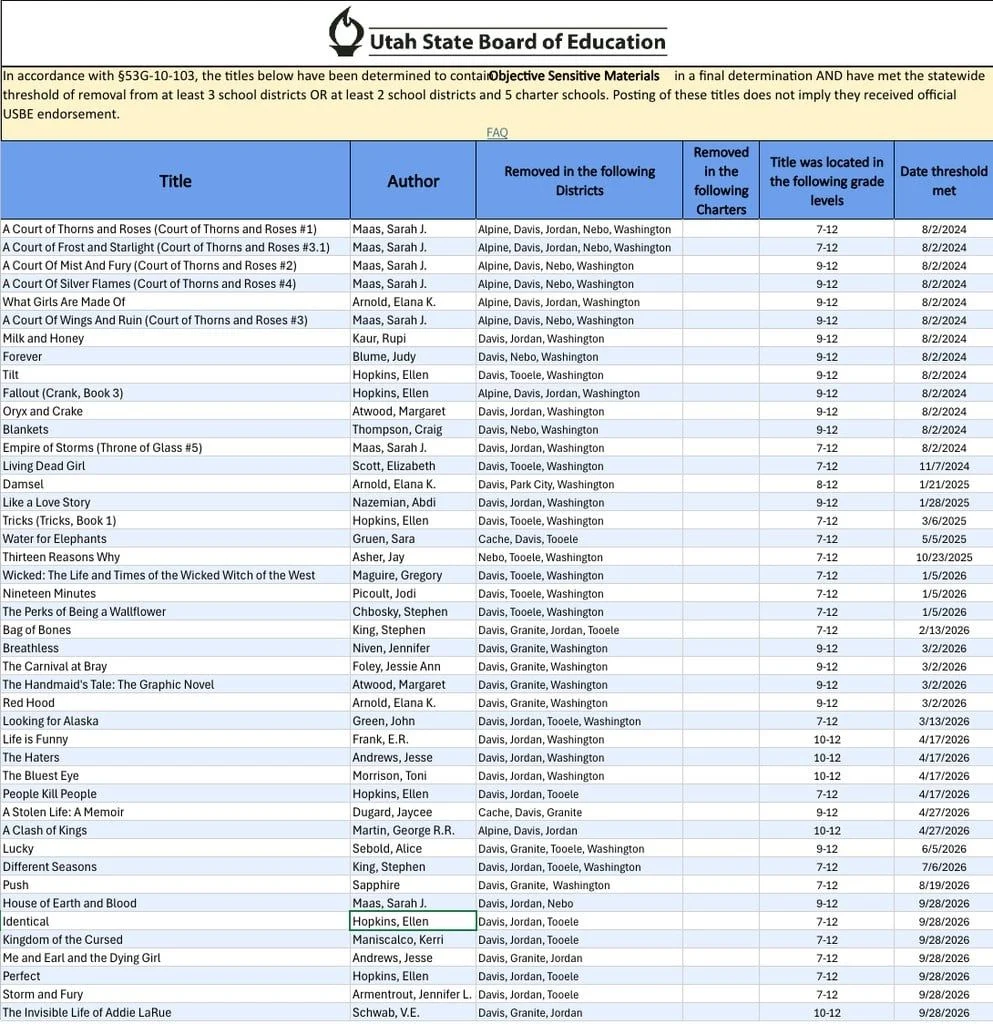
The landscape of public education and First Amendment rights in Utah continues to shift dramatically following the implementation of House Bill 29, a sweeping piece of legislation enacted in July 2024. The law, which established some of the strictest state-level restrictions on reading materials in public schools nationwide, has steadily grown more restrictive. Recent updates to the Utah State Board of Education’s tracking system reveal that the statewide prohibited book list has now expanded to 44 titles.
The mechanism of House Bill 29 strips traditional local authority from individual school boards, compelling all public and charter schools across the state to purge any literature classified under vague definitions of "sensitive material" or "pornographic" once a specific threshold is met. Under the statute, if a book is successfully challenged and removed in at least three public school districts—or two public school districts and five charter schools—it is automatically flagged for statewide removal. The State Board of Education then issues a mandatory directive requiring every public and charter school in Utah to immediately pull the title from circulation and dispose of it.
Data analyzing the growing list indicates a profound demographic trend among the banned works: out of the 44 prohibited titles, 33—or 75 percent—are authored by women. Furthermore, the average publication date of the books on the banned list is 2009, meaning many of these titles have occupied library shelves for nearly two decades. Far from targeting obscure or newly minted controversial texts, the state’s apparatus is systematically removing established works of literature, young adult fiction, and contemporary narratives that have been safely accessible to students for years.
The Illusion of Local Control and the Concentration of Power
When House Bill 29 was debated and ultimately passed by the Utah State Legislature, proponents frequently framed the legislation as a measure designed to enhance parental rights and preserve local control within communities. However, educational advocates, librarians, and civil rights groups have consistently argued that the law achieves the exact opposite. By forcing every educational institution in the state to abide by decisions made in a tiny handful of districts, the legislation centralizes censorship and creates a ripple effect driven by a hyper-active minority of challengers.
Utah comprises 42 distinct public school districts, yet the vast majority of statewide book bans trace their origins back to a remarkably small subset of these administrative bodies. Statistics compiled from state records demonstrate that just two school districts—Davis and Washington—are responsible for the overwhelming majority of the original challenges that triggered statewide bans. Davis School District alone has been linked to 42 of the cumulative bans, while Washington School District accounts for 31. Other districts, such as Jordan and Tooele, have continually added to the tally as their internal review processes catch up with historical records and new challenges are processed.
This narrow concentration of origin points highlights how a localized campaign by highly organized activists can effectively dictate reading restrictions for hundreds of thousands of students statewide, bypassing communities that prefer broader access to literature. The reliance on external, non-governmental review databases—such as RatedBooks and the National Book Rating Index, spearheaded by activist Brooke Stephens—has further institutionalized a standardized, highly conservative rubric for evaluating literature. Controversies have similarly dogged these processes; Davis School District recently faced public scrutiny regarding data access and information security after outside book-banning advocates were granted access to internal library systems. Compounding these transparency concerns, the state recently informed the Davis School Board that public discussion of book ban appeals is not legally required, a ruling critics argue further shields the censorship process from public accountability.

Chronology of a Legislative Crackdown
The timeline of book censorship in Utah accelerated significantly with the introduction of HB 29, transforming the state into a primary battleground in the national culture wars surrounding public education.
- March 2024: The Utah Legislature passes House Bill 29, establishing a retroactive, statewide mechanism for removing books deemed sensitive or pornographic from public school libraries.
- July 1, 2024: HB 29 officially takes effect. The state initiates the enforcement mechanism with an initial batch of 13 banned titles, forcing school districts to audit their collections and notify the Utah State Board of Education of any historical removals that meet the statutory threshold.
- Late 2024 through 2025: As major districts like Davis, Jordan, and Tooele review pending challenges and catalog past removals, the statewide list steadily expands. Individual school districts continue to process local challenges, inadvertently feeding titles into the statewide pipeline.
- June 2026: Investigative reports highlight data access controversies in Davis School District, focusing on the influence of external rating sites and activist networks within the public school infrastructure.
- September 2026: The Utah State Board of Education updates its official spreadsheet, bringing the total number of statewide banned titles to 44. Legal challenges filed against HB 29 move through the court system, though the ongoing litigation has thus far failed to slow the administrative removal of older literary works.
Broader National Context and State-Sanctioned Censorship
Utah is not operating in a vacuum. The legislative strategy of utilizing a statewide, centralized list of prohibited school library books is mirrored in a small number of other states, most notably South Carolina. South Carolina currently maintains a sanctioned list of 21 titles that must be universally removed from all public school districts, making it one of the most restrictive states in the country regarding state-mandated literature bans. However, unlike Utah’s continually growing catalog—which is actively expanding as districts work backward through historical records and process fresh challenges—South Carolina’s state-sanctioned list has remained static since May 2025, largely due to a pending federal lawsuit filed by the American Civil Liberties Union (ACLU) on behalf of school librarians and students.
In Utah, legal challenges have similarly been mounted against HB 29, with civil liberties organizations arguing that the sweeping removal of books violates the First Amendment rights of students and educators alike. Despite these ongoing legal battles, the enforcement mechanism of the law remains fully active. State education officials and supporting lawmakers maintain that the statute is a necessary safeguard to protect minors from age-inappropriate content. Conversely, opponents emphasize that the broad, vague language of the law invites viewpoint discrimination, disproportionately impacting literature addressing race, gender identity, and human sexuality—particularly texts written by women and marginalized authors.
Implications for Students, Educators, and Private Institutions
A notable aspect of House Bill 29—and similar restrictive education laws passed across the United States—is their selective scope. The mandates apply strictly to public and charter schools, intentionally exempting private schools, religious institutions, and homeschool environments. Critics of the law argue this carve-out underscores the partisan and ideological nature of the legislation, noting that families who object to specific reading materials have always possessed the individual choice to direct their own children’s reading habits without imposing sweeping bans on the entire student body.
For public school educators and certified media specialists, the expansion of the banned book list to 44 titles creates a chilling effect within classrooms and libraries. School librarians face mounting professional pressure, with some expressing concern over potential disciplinary actions or administrative fallout if state-mandated removal lists are not meticulously followed. As the Utah State Board of Education continues to process administrative updates and district-level challenges, educational analysts project that the list will grow further. The systematic targeting of decades-old literature signals that the implementation of HB 29 is not merely a reaction to contemporary publishing trends, but a comprehensive rollback of access to historical and diverse viewpoints within Utah’s public education system.