

The modern knowledge worker faces an unprecedented paradox: while access to information has never been easier, the mechanisms for digesting and retaining that information have largely failed to evolve. For decades, the digital landscape has offered an abundance of "read-it-later" applications designed to capture everything from long-form investigative journalism to niche technical newsletters. However, these repositories frequently transform from curated reading lists into digital graveyards, accumulating unread content until the sheer volume induces cognitive paralysis. This widespread phenomenon—often described as digital hoarding or bookmark fatigue—has driven a subset of tech-savvy professionals to move beyond off-the-shelf software, choosing instead to engineer bespoke solutions tailored to their exact psychological and workflow friction points.
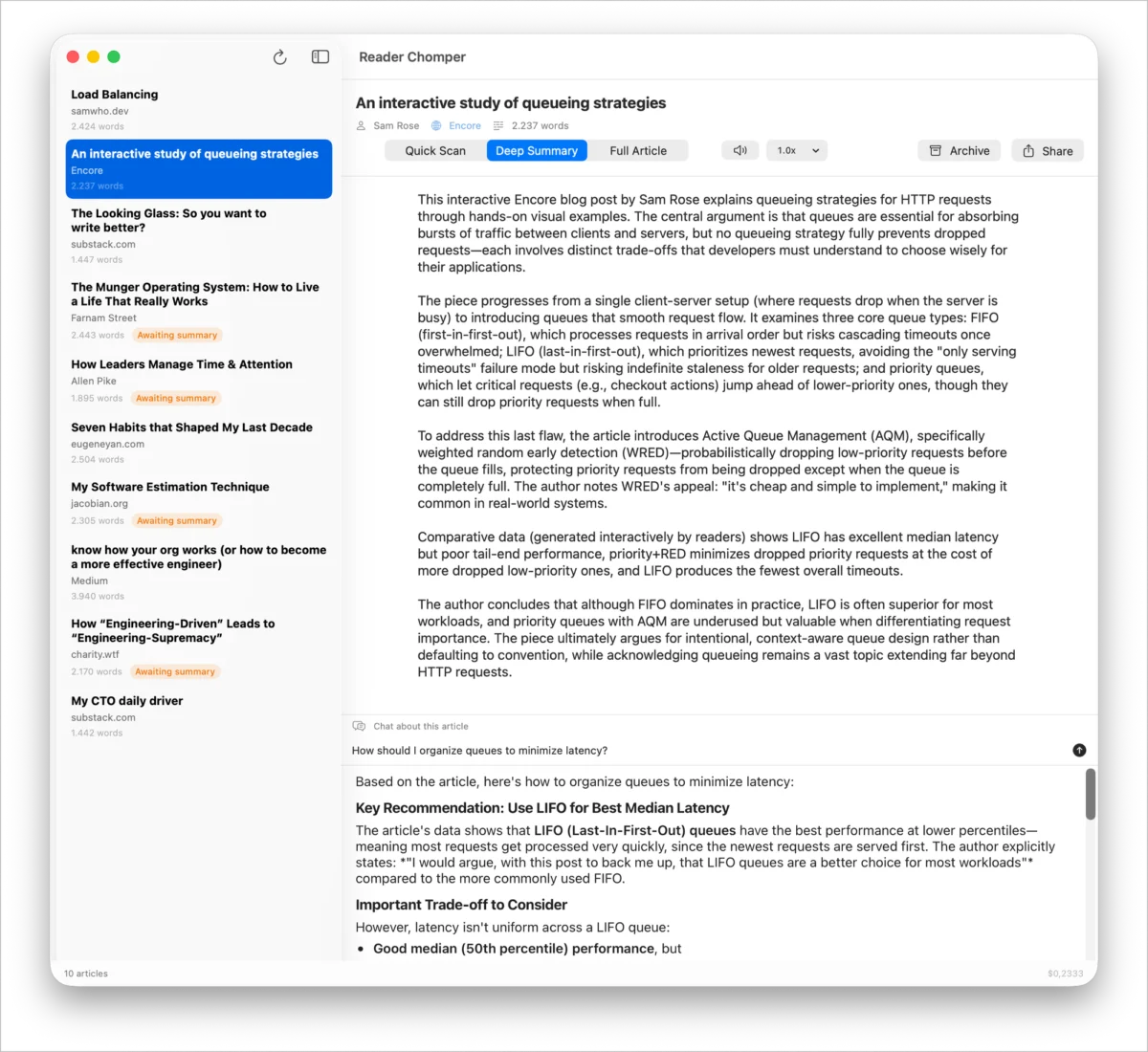
One prominent example of this DIY software movement is Reader Chomper, a native macOS utility developed independently to bridge the operational gaps between content consumption and social media distribution. Built to solve a personal bottleneck involving Readwise Reader, artificial intelligence processing, and the Buffer API, the application represents a growing trend of hyper-personalized productivity tooling. Rather than waiting for major software enterprises to introduce features addressing information overload, independent developers are utilizing modern programming assistants and foundational APIs to construct single-purpose utilities that fundamentally alter how digital media is processed, filtered, and shared across professional networks.

The Anatomy of Digital Accumulation and the Read-It-Later Paradox
To understand the necessity of tools like Reader Chomper, one must examine the systemic failure of traditional read-it-later ecosystems. Since the deprecation of foundational RSS aggregators like Google Reader, users have migrated through various generations of bookmarking services, pocket utilities, and read-later apps. While platforms such as Readwise Reader have successfully centralized articles, highlights, and newsletters into unified interfaces, they inadvertently optimize for collection over comprehension.
Behavioral studies in information management indicate that the psychological barrier to saving an article is remarkably low—often requiring a single click or browser extension tap. Conversely, the cognitive load required to read, synthesize, and contextualize a 3,000-word article is exceptionally high. This fundamental asymmetry creates a compounding deficit: users save hundreds of items under the psychological guise of future productivity, while daily time constraints ensure that the actual consumption rate remains a fraction of the intake rate.
When digital repositories swell past critical thresholds—often cited by users as the point where unread lists exceed several hundred entries—the interface itself becomes a source of anxiety. Opening an application to confront a sprawling, unmanageable queue triggers avoidance behavior. Users frequently close the application without consuming a single word, substituting the act of saving for the act of learning. Furthermore, when valuable insights are successfully extracted, the secondary friction of formatting, summarizing, and distributing those insights to professional networks like LinkedIn or Bluesky creates another bottleneck, frequently resulting in valuable content remaining trapped in private silos.
The Engineering Genesis: "Vibe-Coding" and Functional Integration
Faced with this exact productivity impasse, the creator of Reader Chomper bypassed commercial alternatives and utilized an iterative, intent-driven development process colloquially referred to in software engineering circles as "vibe-coding." By leveraging contemporary large language models to assist in writing Swift code for macOS, the developer constructed a lightweight, native application designed to stitch together three distinct services: Readwise Reader as the backend content repository, an advanced LLM for textual reduction and interactive querying, and the Buffer API for multi-platform social media queueing.
The guiding philosophy behind the application’s architecture was operational minimalism. The software was engineered around a strict programmatic brief: eliminate cognitive friction at the intake stage and establish an automated, frictionless pathway from reading to publishing. By integrating these disparate tools into a single, cohesive macOS interface, the developer effectively created a closed-loop knowledge management pipeline that operates independently of standard web-browser tabs and fragmented dashboard switching.
A Four-Step Operational Framework: Triage, Scan, Deep Dive, and Queue
Reader Chomper structures the content consumption experience into four distinct, sequential phases: triage, quick scan, deep summary and conversational querying, and automated queueing. Each step is deliberately designed to counter specific psychological or technical obstacles inherent in legacy read-it-later workflows.
Step 1: Algorithmic Scarcity Through Controlled Triage
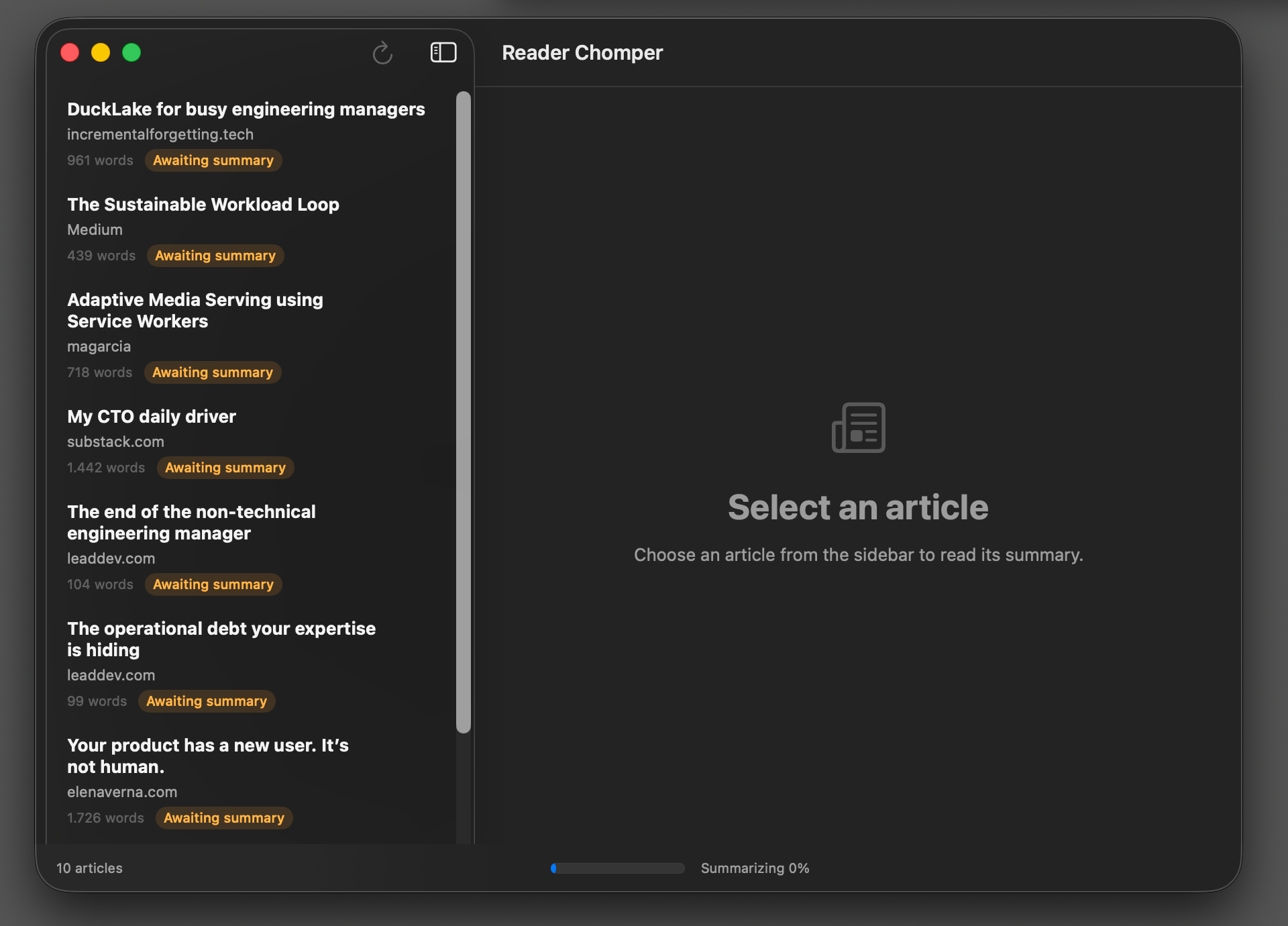
The primary structural innovation of Reader Chomper lies in how it presents data to the user. Rather than exposing the entirety of a user’s unread database—a design choice that historically triggered interface fatigue—the application enforces an artificial constraint. Upon launch, the software fetches precisely ten articles from the apex of the user’s "Later" reading list and halts execution.
To access additional content, the user must explicitly command the application to "Refill." This design choice transforms an endless scroll into a finite, manageable contract. By limiting the visible workload to ten items, the application lowers the psychological barrier to entry, replacing chronic avoidance with manageable, session-based consumption.
Step 2: The High-Density Quick Scan
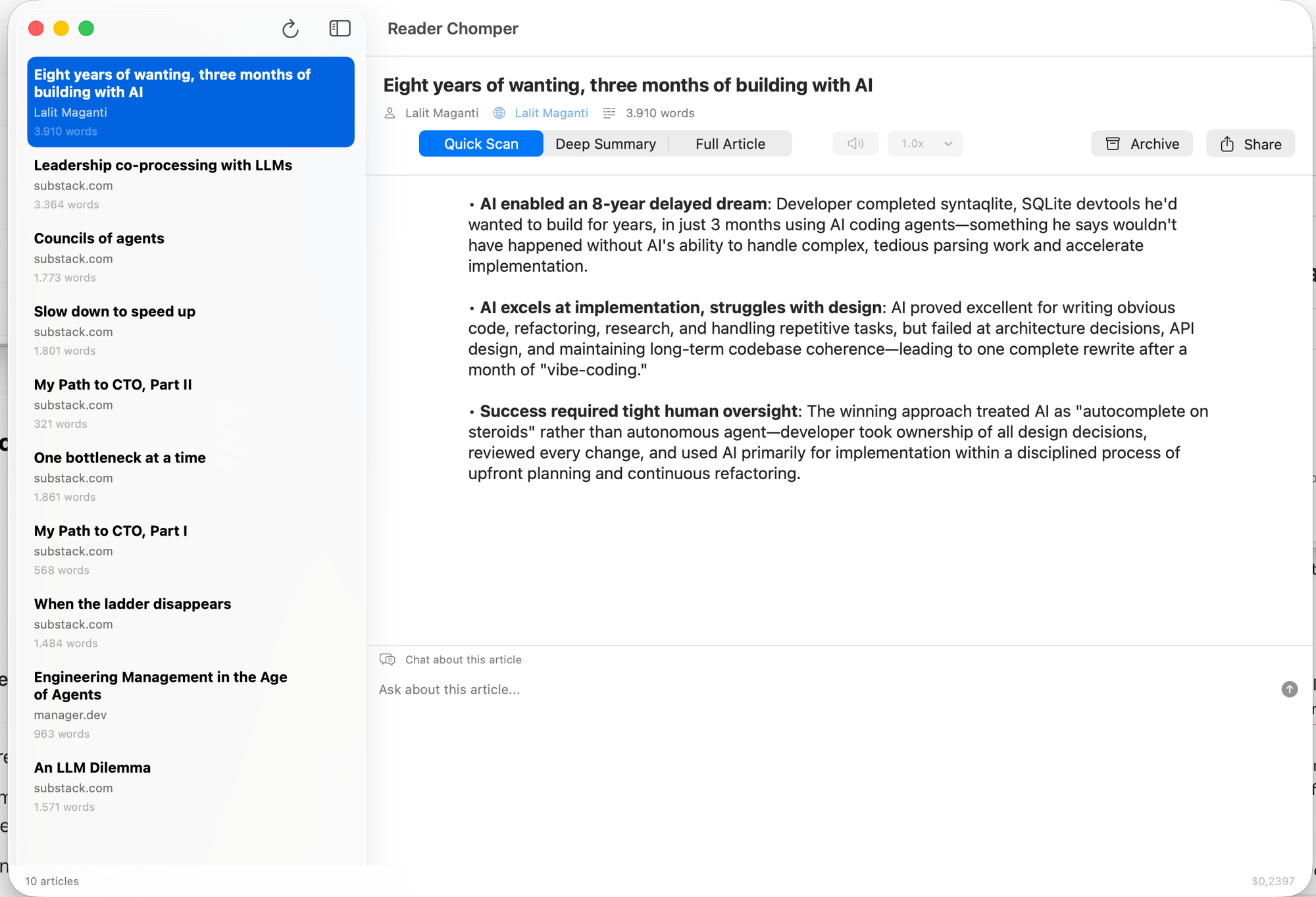
Once an article is selected, Reader Chomper bypasses the traditional requirement of reading text sequentially from top to bottom. Instead, it deploys an artificial intelligence backend to generate a standardized, zero-fluff summary consisting of precisely three bullet points totaling approximately 100 words.
This summary acts as a rapid cognitive filter. For a vast majority of saved articles, these three bullet points provide sufficient context for the user to understand the core argument, extract the necessary data point, and determine whether further investigation is warranted. If the bullet points satisfy the user’s informational need, the article is immediately routed to the archive. This process condenses what was once a 15-minute reading commitment into a 30-second evaluation window, fundamentally altering the user’s velocity through their reading queue.
Step 3: Conversational Synthesis and Contextual Querying
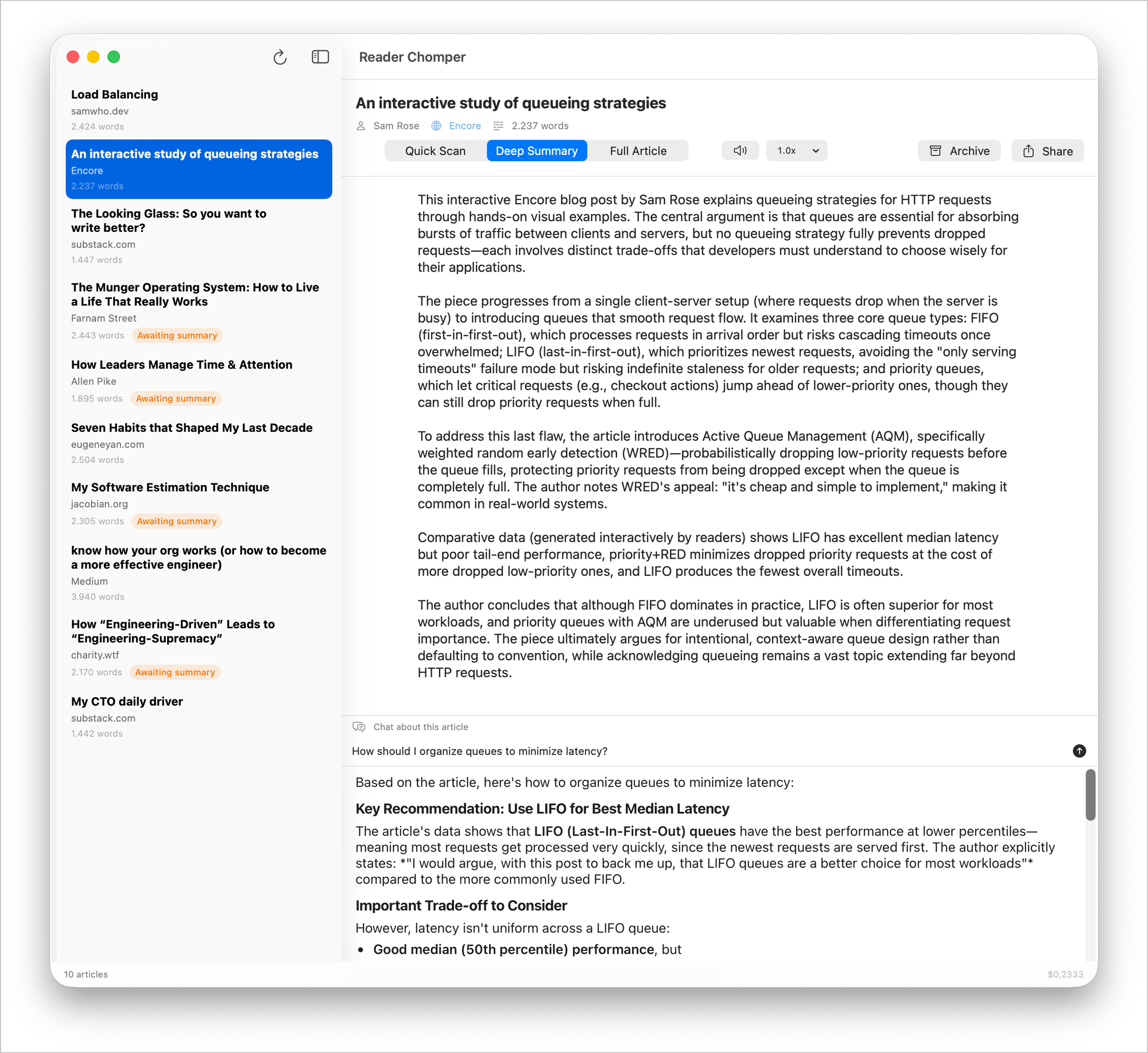
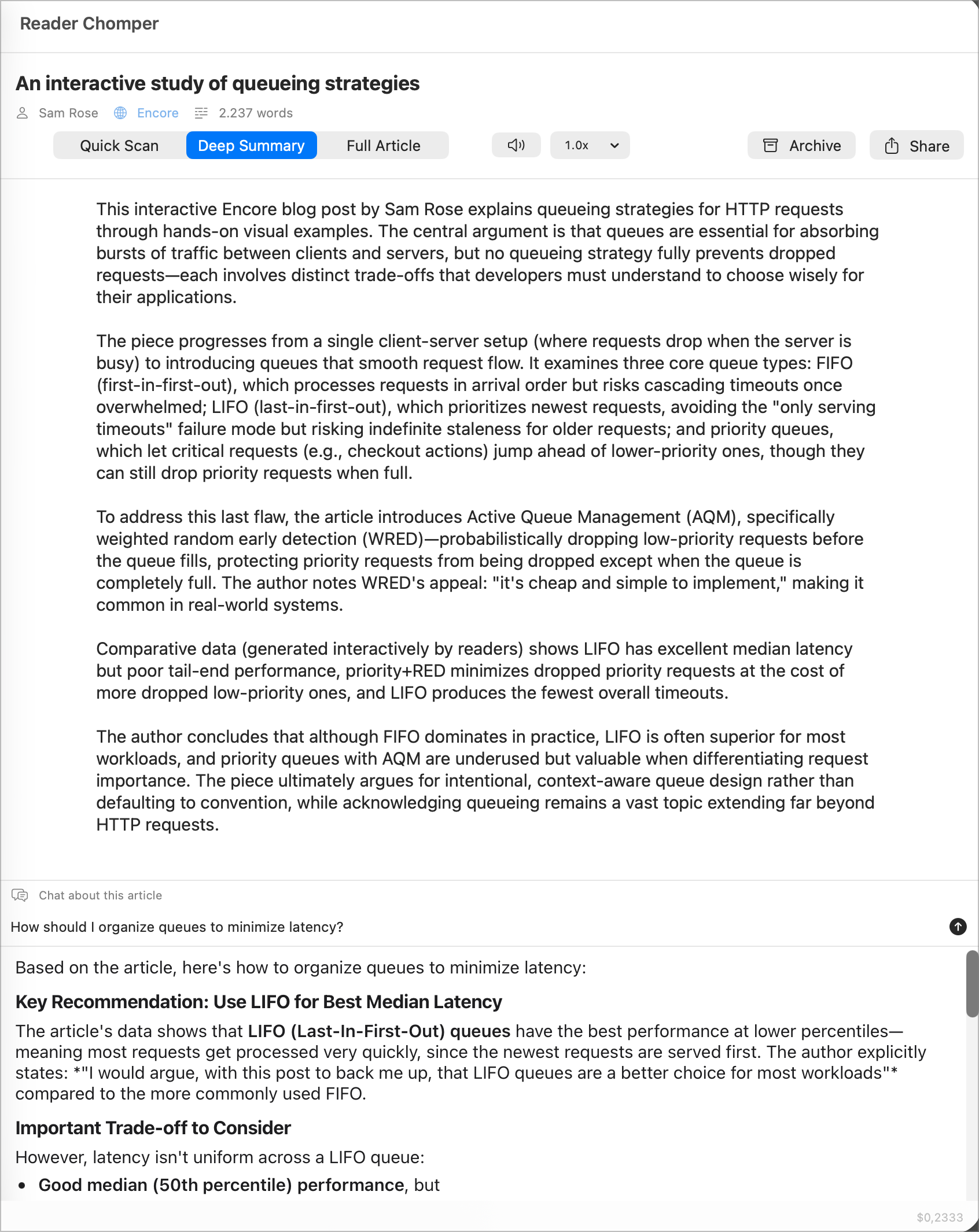
When a quick scan reveals complex or highly specialized subject matter requiring deeper analysis, Reader Chomper offers two secondary pathways. The first is an extended 300-word summary providing a more granular breakdown of the source material. The second—and most frequently utilized—is an integrated conversational chat interface powered by Claude.
This feature allows users to interrogate the source text directly through natural language prompts. For example, when encountering dense industry terminology or unfamiliar technical frameworks (such as emerging data storage architectures like DuckLake), the user can query the system regarding the specific relevance of the concept to their professional domain. The LLM processes the query against the full text of the article and returns contextualized answers within seconds. This capability bridges the gap between passive reading and active comprehension, offering a level of interactive synthesis that traditional document readers have yet to natively incorporate.
Step 4: Streamlined Multi-Platform Distribution via Buffer
The final phase of the Reader Chomper workflow addresses the distribution bottleneck. Historically, sharing an insightful article required copying a URL, switching to a separate application, drafting a commentary from scratch, and manually executing posts across multiple social networks.
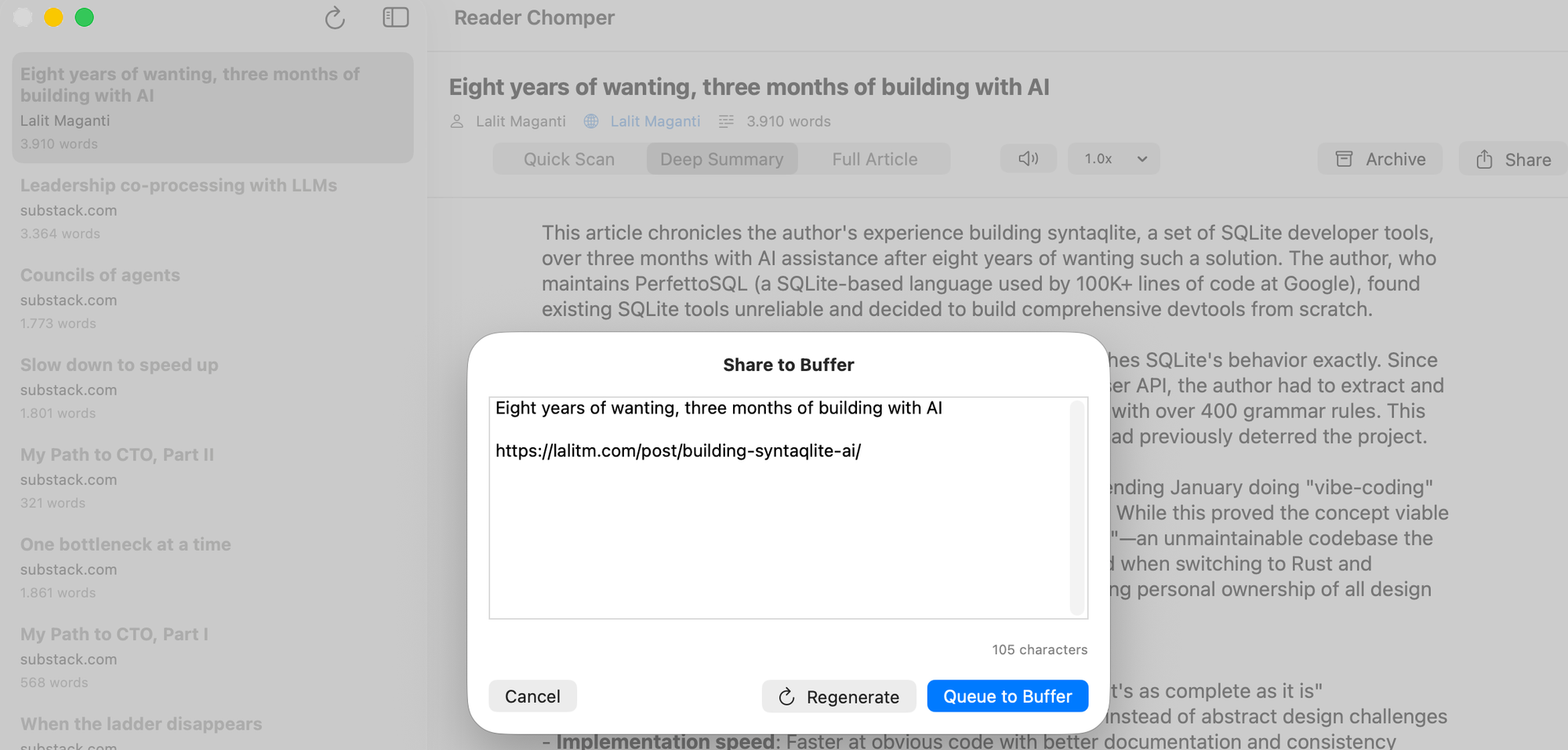
Reader Chomper automates this entire sequence. Upon deciding that an article warrants public discussion—whether identified during the initial quick scan or following an interactive AI chat session—the user selects a sharing option. The application’s underlying LLM instantly drafts a concise, professional blurb capturing the article’s core thesis, paired automatically with the source URL. Users retain editorial control, with the ability to edit the draft or request alternative generations if the tone requires adjustment. A single subsequent click dispatches the finalized post to the Buffer API, which instantly queues the content for distribution across professional channels such as LinkedIn and decentralized networks like Bluesky, while simultaneously archiving the source article in the background.
Industry Implications and the Rise of Bespoke Productivity Tooling
The development and deployment of applications like Reader Chomper highlight a broader shift in how knowledge workers interact with personal productivity software. For over a decade, the software-as-a-service (SaaS) market has consolidated around massive, generalized platforms designed to cater to the widest possible demographic. However, these monolithic solutions frequently introduce feature bloat and structural rigidities that fail to accommodate specialized, high-velocity workflows.
By lowering the barrier to custom software creation through advanced language models, developers can now construct highly specialized utility applications tailored to their precise cognitive patterns. This trend suggests a future where personal software stacks are increasingly modular and self-authored, with off-the-shelf platforms serving primarily as back-end data repositories rather than primary user interfaces.
Furthermore, the integration of conversational AI into daily reading habits points toward a permanent evolution in knowledge consumption. As the volume of digital publishing continues to accelerate, human readers are increasingly reliant on algorithmic triage and interactive synthesis to maintain domain awareness. Tools that successfully combine frictionless data ingestion, automated summarization, and direct publishing channels are likely to set the benchmark for professional knowledge management systems in the years ahead.