Muhammad Hendra
Inner calm is far more than a transient state of peace achieved after a yoga session or a relaxing massage; it represents a profound ability to disengage from attachments and impulsive reactions to life’s myriad events, thereby fostering an enduring sense of ease and mental clarity. This fundamental capacity, increasingly recognized within the burgeoning field of mindfulness, empowers individuals to navigate the complexities of contemporary existence with greater equanimity and strategic insight. It is an understanding rooted in the principle of impermanence—the inherent, ever-changing nature of our thoughts, emotions, and desires—which, when grasped, becomes a potent tool for emotional regulation.
The Science of Serenity: Understanding Emotional Transience and Mindfulness
At its core, inner calm, when approached as a mindfulness skill, hinges on recognizing that "this too shall pass." This adage is not merely a comforting platitude but a scientifically supported observation of emotional dynamics. Modern neuroscience, particularly through the work of researchers like Dr. Jill Bolte Taylor, author of My Stroke of Insight, has shed light on the physiological lifespan of emotions. Taylor posits the "ninety-second rule," suggesting that an emotion, from its initial trigger to its full physiological expression and subsequent dissolution, typically lasts no more than 90 seconds. This brief, intense burst is a purely biochemical and neurological event, a cascade of hormones and neurotransmitters.
The critical insight from this rule is that the prolonged experience of negative emotions—lasting for hours, days, or even years—is not due to the inherent longevity of the emotion itself, but rather our cognitive engagement with it. We feed these transient physiological responses with narratives, interpretations, judgments, and a continuous loop of thoughts about the event that triggered them. For instance, a momentary flush of anger might last only seconds in its raw form, but our rumination on the injustice, the perceived slight, or the anticipated consequences can sustain the feeling indefinitely, morphing it into resentment, bitterness, or anxiety.
Mindfulness practices aim to interrupt this cycle by cultivating the ability to observe emotions without immediate reactivity or entanglement in narrative. This involves a conscious "stopping" to allow the emotion to move through the body, creating mental space to understand its underlying message rather than suppressing or bypassing it with forced positive thinking. By forming an "alliance" with our feelings, we can uncover what they are attempting to communicate—perhaps highlighting unmet needs, drawing attention to new environmental information, or signaling a protective instinct. This non-judgmental observation facilitates emotional processing and prevents the emotional hijacking that often precedes regrettable actions.
The Paradox of Pursuit: When Seeking Calm Creates More Turbulence
Ironically, the quest for inner calm can often become a source of further distress, a phenomenon that highlights a peculiar psychological paradox. True inner calm is frequently achieved not by striving for it, but by letting go of the desire for it—a veritable catch-22. This counterintuitive dynamic is starkly illustrated by the experience of individuals grappling with anxiety who turn to practices like meditation with a strong expectation of immediate relief.
Consider the case of a client, as detailed in recent mindfulness literature, who sought meditation to alleviate his chronic anxiety and improve sleep. His initial sessions, particularly body scan meditations designed to foster somatic awareness, paradoxically intensified his anxiety. Instead of finding peace, he became acutely aware of his internal restlessness, which only deepened his frustration and exacerbated his sleep problems. His expectation that meditation should make him calm and help him sleep created a powerful resistance to his actual experience, trapping him in a cycle of disappointment.
This common scenario underscores the "three hindrances" often encountered in mindfulness practice:

- Running in circles (a restless mind): The incessant mental chatter and inability to settle.
- Pulling (striving to achieve a specific state): The active pursuit of "calm" or "sleep," which creates tension.
- Pushing (frustration with the current state): Resistance to discomfort, restlessness, or any experience that deviates from the desired outcome.
The resolution to this paradox lies in cultivating acceptance. For the anxious client, freedom came when he learned to accept his restless mind, rather than fight it. This acceptance softened the "pulling" of striving and the "pushing" of frustration, allowing a subtle ease to emerge even in the presence of sleeplessness. This shift in attitude ultimately paved the way for the very peace and sleep he had initially sought, demonstrating that letting go of the attachment to a particular outcome is often the prerequisite for its manifestation. This principle extends beyond meditation to all aspects of life: letting go of specific outcomes does not imply apathy or evasion but rather a deep understanding that emotions, like all phenomena, arise and dissolve naturally.
Navigating the Inner Landscape: Practices for Cultivating Tranquility
Cultivating inner calm is an active art, often described as stopping, looking, and letting go. This deliberate process serves the dual purposes of healing and achieving clarity, manifesting as both physical composure and mental tranquility. In the body, composure translates to relaxed muscles and an overall sense of ease, a stark contrast to the restlessness and tension that often accompany the absence of inner calm. Mentally, inner calm creates a spaciousness, an ability to hold all experiences—pleasant or unpleasant—without attachment or resistance. This mental spaciousness is crucial for cognitive flexibility and emotional resilience.
The practices for developing inner calm draw heavily from ancient contemplative traditions, now validated by contemporary psychological and neuroscientific research. Key among these are:
- Breath Awareness: Simple yet profoundly effective, focusing on the breath anchors the mind in the present moment and directly influences the autonomic nervous system. Slow, deep, conscious breathing activates the parasympathetic nervous system (PPNS), which is responsible for the body’s "rest and digest" response, counteracting the "fight or flight" response of the sympathetic nervous system. Regular practice can lower heart rate, blood pressure, and muscle tension.
- Body Scan Meditation: This practice involves systematically bringing attention to different parts of the body, noticing sensations without judgment. It enhances interoception (awareness of internal bodily states) and helps individuals recognize and release physical tension often held unconsciously.
- "Noting" or "Labeling": As emotions or thoughts arise, one mentally labels them (e.g., "thinking," "worrying," "sadness," "anger"). This simple act creates a slight cognitive distance from the experience, engaging the prefrontal cortex and preventing the automatic, reactive cascade of an emotional hijack. It allows for observation rather than immersion.
These practices, when consistently applied, gradually re-wire neural pathways, strengthening the connections between the prefrontal cortex (the seat of rational thought and executive function) and the amygdala (the brain’s emotional processing center). This enhanced communication is vital for fostering emotional intelligence and maintaining composure in challenging situations.
Confronting the Primal Brain: Inner Calm as a Shield Against Amygdala Hijack
Much of human life, particularly in the modern era, is characterized by perceived threats—to identity, career, relationships, or social standing. While these are rarely existential threats in the same vein as encountering a predator in the wild, our ancient brains often respond as if they are. This triggers the primal fight-flight-freeze response, an automatic and unconscious evolutionary mechanism designed for immediate survival. However, in the context of contemporary psychological and social stressors, this reflexive reaction is often unhelpful, hindering the very clarity and creativity needed to resolve complex problems.
The phenomenon known as "amygdala hijack," popularized by emotional intelligence expert Daniel Goleman, vividly illustrates this disconnect. The amygdala, a small almond-shaped structure deep within the brain, serves as the brain’s alarm system, constantly scanning the environment for threats. When a perceived threat is detected—be it a genuine physical danger or a harsh criticism—the amygdala bypasses the rational prefrontal cortex and sends an immediate, urgent signal to release stress hormones like adrenaline and cortisol. This rapid biochemical surge prepares the body for an emergency response: blood flow is diverted from internal organs to the limbs, heart rate accelerates, and senses sharpen. Crucially, the prefrontal cortex, responsible for higher-order thinking, planning, and executive decision-making, temporarily shuts down. There is no time for nuanced analysis when facing what the brain perceives as a life-threatening situation.
During an amygdala hijack, an individual’s IQ is said to temporarily drop by ten to fifteen points. This explains the common experience of regretting words spoken in anger ("What was I thinking when I said that?") or the inability to recall details during a panic ("Why can’t I find my keys?"). Rational thought is compromised, as is memory. Furthermore, a continuous state of fight or flight, induced by chronic modern stressors, takes a significant toll on the body’s integrity, impairing essential systems like immunity and digestion.
Cultivating inner calm is a crucial step in preventing these amygdala hijacks. By employing practices like breath awareness, we can slow the escalation of emotions, allowing the parasympathetic nervous system to reassert itself. This restoration of balance enables the prefrontal cortex to regain its optimal function, restoring clarity of thought even in highly charged situations. The act of "noting" or "labeling" emotions also serves this purpose, creating a cognitive pause that re-establishes healthy communication between the prefrontal cortex and the amygdala. This deliberate intervention allows individuals to move beyond knee-jerk reactions, fostering opportunities for learning, improved understanding, and the replacement of tension with harmony in relationships and broader life contexts. Inner calm, therefore, stands as a cornerstone for building true resilience.
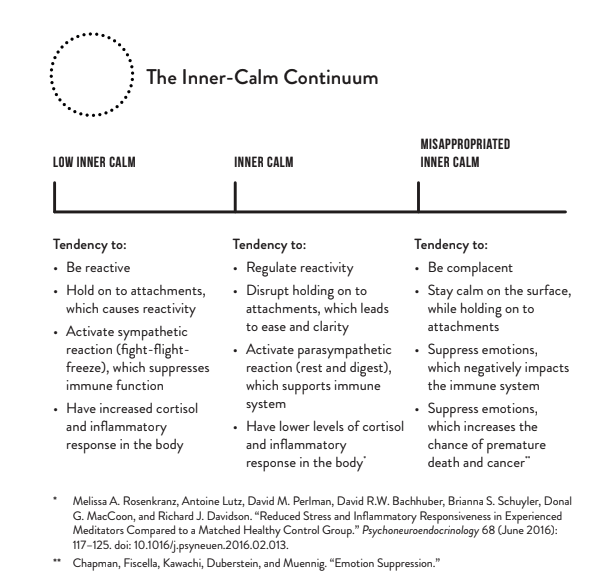
The Continuum of Calm: Assessing and Strengthening Your Capacity
Inner calm is not a fixed trait but a skill that can be developed and strengthened, regardless of one’s inherent temperament or current life circumstances. The journey begins with heightened self-awareness: paying close attention to when one feels calm versus agitated. This observational phase extends to noticing the specific causes and conditions that either promote or hinder states of calm. Is it certain environments, interactions, thoughts, or physical sensations that trigger restlessness? Conversely, what practices, people, or places facilitate a sense of tranquility?
By consistently engaging in this self-inquiry, individuals can begin to identify patterns and cultivate a habit of consciously calming the mind and body. This process is akin to strengthening a muscle; the more frequently one exercises the capacity for calm, the more quickly and easily it can be accessed in moments of stress or reactivity. Research in neuroplasticity supports this, showing that consistent mindfulness and meditation practices can lead to measurable changes in brain structure and function, including increased grey matter in areas associated with emotional regulation and self-awareness. Over time, what once required deliberate effort becomes a more automatic, default response, allowing for greater flexibility and adaptability in navigating life’s challenges.
Integrating Calm: Daily Practices for Sustained Well-being
The power of inner calm lies not only in its profound impact during moments of crisis but also in its potential to transform daily life through consistent, even brief, practices. As the poet David Whyte eloquently states, "Rested, we care again for the right things and the right people in the right way." This underscores the rejuvenating power of mindful pauses.
Integrating "micro-practices" throughout the day can significantly enhance overall well-being and resilience. One such practice is the "One-Minute Rest," a simple yet effective technique:
- Stop: Pause whatever you are doing, even for a moment.
- Check-in with your body: Bring your awareness to your physical sensations. Notice any tension, discomfort, or ease.
- Breathe: Take a few deep, conscious breaths, allowing your shoulders to drop and your body to soften.
- Empty your cup: Mentally release any immediate tasks, worries, or distractions, creating a brief space of mental quiet.
- Make space for what matters: Re-engage with your activity or conversation from a place of renewed intention and presence.
Practicing this one-minute rest several times a day can serve as a vital reset, preventing the accumulation of stress and fostering sustained clarity. It can be easily integrated into various settings—before a meeting, between tasks, during a commute, or even within family interactions. Encouraging its practice within teams or communities can also foster a shared sense of presence and reduce collective stress, leading to more productive and harmonious collaborations. The cumulative effect of these small, deliberate pauses is a gradual but significant increase in one’s baseline level of inner calm, enabling a more responsive, less reactive engagement with the world.
Conclusion: Inner Calm as a Cornerstone of Modern Resilience
In an increasingly fast-paced and demanding world, the cultivation of inner calm transcends a mere personal preference; it emerges as an essential skill for personal fulfillment, effective leadership, and global impact. It is the bedrock upon which genuine resilience is built, offering a pathway to navigate modern complexities with clarity, creativity, and compassion. By understanding the impermanence of emotions, letting go of the paradoxical desire for calm, and actively engaging in practices that re-wire our primal responses, individuals can move beyond fleeting moments of peace to embody an enduring state of equilibrium. This profound shift, as articulated in works like Shalini Bahl Milne’s Return to Mindfulness: Disrupting Default Habits for Personal Fulfillment, Effective Leadership, and Global Impact, is not about suppressing the human experience but about engaging with it more fully, more consciously, and ultimately, more freely. The journey toward inner calm is a continuous process of learning, releasing, and returning to the quiet strength within, empowering us to respond to life with wisdom rather than reaction.