Cintya Tara Annisa
The landscape of high-end manual coffee equipment is witnessing a significant technical shift with the introduction of the Molo Mill, a manual grinder designed specifically to incorporate large-format flat burrs into a portable, hand-operated form factor. Launched on the Kickstarter crowdfunding platform by industrial designer Wilson Reniers, the Molo Mill seeks to address a specific niche in the specialty coffee market: the demand for the flavor profile of commercial-grade flat burrs without the requirement of an electrical power source. While the manual grinder market is currently saturated with conical burr options, the Molo Mill joins an elite and small group of devices, such as the Pietro and the Normcore V2, that utilize flat burr geometry.
The project, which is currently in its final stages of funding, represents an ambitious attempt to bridge the gap between commercial espresso performance and the tactile, ritualistic experience of manual brewing. By integrating 58mm flat burrs—a size typically reserved for professional-grade electric espresso grinders—the Molo Mill aims to provide the grind uniformity and particle distribution curves that are highly sought after by "Third Wave" coffee enthusiasts and professional baristas alike.
Technical Specifications and Mechanical Engineering
At the core of the Molo Mill’s design is a set of 58mm flat burrs. In the coffee industry, the distinction between conical and flat burrs is a matter of significant debate and preference. Conical burrs, found in the vast majority of hand grinders, are prized for their efficiency and ability to produce a "bimodal" particle distribution, which often adds body and texture to espresso. However, flat burrs are frequently preferred for their ability to produce a more uniform, "unimodal" grind, which enhances clarity, sweetness, and flavor separation, particularly in light-roast filter coffees and modern espresso styles.
The Molo Mill utilizes a vertical burr alignment, a design choice that mirrors the configuration of the Pietro grinder. Vertical alignment is strategically employed to minimize "retention"—the amount of coffee grounds that remain trapped inside the grinding chamber between uses. By allowing gravity to assist the exit of the grounds, the device aims to achieve "zero retention," ensuring that the dose of beans entered into the hopper equals the output in the catch cup.
To manage the physical torque required to rotate 58mm flat burrs by hand, Reniers has implemented a side-mounted cranking mechanism. Unlike traditional top-handle grinders where the user applies force in a horizontal circle, the Molo Mill’s side-crank allows the user to anchor the device to a countertop with one hand while using a more ergonomic vertical rowing motion with the other. The mechanism features a complex internal gearing system. This system serves two purposes: first, it offsets the axis of rotation to prevent the user’s hand from striking the work surface; second, it provides a gear ratio that reduces the physical resistance of the grind, making the process of manual flat-burr grinding more accessible to the average user.
Design Philosophy and Aesthetic Inspiration
The aesthetic and tactile elements of the Molo Mill are heavily influenced by high-end horology, specifically the engineering of professional diving watches. The exterior features a prominent adjustment dial that governs the distance between the burrs. This dial is engineered to provide "haptic feedback," a series of tactile clicks that allow the user to feel each incremental change in grind size. This design is an intentional homage to the unidirectional rotating bezels found on diving watches, emphasizing precision and mechanical reliability.
Sustainability was also a primary consideration in the selection of materials. The Molo Mill is constructed from a combination of recyclable metals and biodegradable accents. The main body and structural components are fashioned from aluminum and stainless steel, ensuring durability and a premium weight. To contrast these industrial materials, the design incorporates compostable wood finishes on the handle and base accents.
The product is slated for release in three distinct colorways to cater to different kitchen aesthetics:
- Molo Metal: A brushed stainless steel finish paired with dark wood accents.
- Molo Blanco: A matte white finish complemented by light-colored wood.
- Molo Noir: A monochromatic all-black version for a minimalist industrial look.
Market Context and Competitive Landscape
The manual coffee grinder market has undergone a revolution over the last decade. Brands like Comandante, 1Zpresso, and Timemore have perfected the conical burr hand grinder, reaching a point of diminishing returns in terms of grind quality for that specific burr geometry. Consequently, the "final frontier" for manual grinding has become the integration of flat burrs.
Flat burrs are notoriously difficult to implement in hand-held devices for two reasons: size and resistance. A flat burr requires a larger diameter to be effective, which increases the overall footprint of the grinder. Furthermore, the surface area of flat burrs creates significantly more friction than conical burrs, making them harder to turn manually.
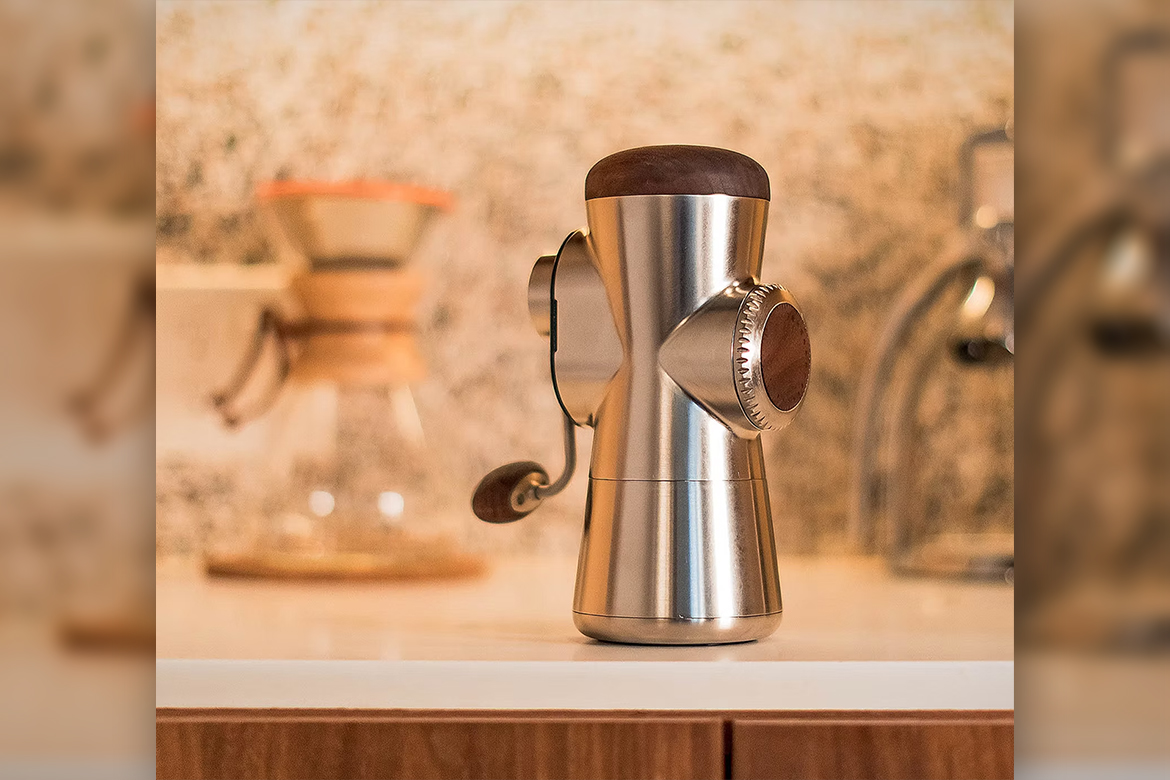
The Molo Mill enters a market where its primary competitor is the Pietro, an Italian-designed vertical flat burr grinder. While the Pietro has set the standard for this category, it has been criticized by some for its unconventional ergonomics and its "book-like" shape. The Molo Mill attempts to refine this concept by offering a more traditional, albeit large, cylindrical profile and a geared transmission to ease the manual labor involved. Weighing in at approximately 3.5 pounds (1.58 kg) and standing over 9 inches tall, the Molo Mill pushes the definition of "portable," positioning itself more as a "desktop manual grinder" than a travel-friendly tool.
Crowdfunding Status and Chronology
The Molo Mill was introduced to the public via Kickstarter, a common path for boutique coffee hardware where the costs of tooling and manufacturing high-precision parts are substantial. As of the current reporting period, the campaign has approximately 11 days remaining.
The financial trajectory of the campaign is as follows:
- Funding Goal: $30,000 USD.
- Current Status: Approximately $20,000 USD raised.
- Backer Incentives: Early supporters can secure the unit for $350 USD, which represents a 20% discount from the projected Manufacturer’s Suggested Retail Price (MSRP) of $437.50 USD.
- Projected Timeline: If the funding goal is met by the deadline, the production phase will commence throughout 2026, with the first units expected to be delivered to backers in January 2027.
The three-year lead time from the end of the campaign to delivery reflects the complexities of manufacturing high-tolerance coffee equipment. Developing a geared transmission that can withstand the stresses of daily coffee grinding while maintaining the alignment of 58mm burrs requires extensive prototyping and quality control.
Industrial Implications and Analysis
The emergence of the Molo Mill is indicative of a broader trend in the global coffee industry: the "prosumer" movement. Home consumers are increasingly willing to invest in equipment that was once reserved for commercial environments. The willingness of the market to support a $400+ manual grinder suggests that there is a significant demographic of coffee drinkers who value the sensory and mechanical process of brewing as much as the final beverage.
From an engineering standpoint, the Molo Mill represents a move toward "modular" or "user-serviceable" design. By using 58mm burrs, the device potentially allows users to swap out the stock burrs for aftermarket options, such as those produced by SSP Lab. This compatibility with the wider ecosystem of espresso modifications could make the Molo Mill a favorite among the "tinkerer" community within the coffee world.
However, the success of the Molo Mill hinges on its ability to overcome the inherent challenges of crowdfunding. The coffee industry has seen several high-profile crowdfunding projects face significant delays or failures due to the difficulties of scaling production. The Molo Mill’s ambitious use of multiple gears and high-precision alignment means that any manufacturing variance could lead to "burr rub" or mechanical failure. The January 2027 delivery date suggests that the creator, Wilson Reniers, is taking a cautious approach to the production timeline, allowing for rigorous testing.
Broader Impact on the Specialty Coffee Community
If the Molo Mill reaches its funding goal and successfully delivers its first units, it will validate the market for high-end, geared manual grinders. This could encourage other manufacturers to explore non-traditional burr geometries in manual formats. Furthermore, it highlights the growing intersection between industrial design and culinary arts.
For the end-user, the Molo Mill offers a solution to a specific problem: how to achieve "end-game" grind quality in environments without electricity—be it a remote cabin, a professional competition stage, or a minimalist home kitchen. While its weight and size may limit its utility as a travel grinder for backpackers, its stability and output quality position it as a serious contender for those who view manual grinding not as a chore, but as an essential part of the specialty coffee experience.
As the campaign enters its final week and a half, the coffee community will be watching closely to see if this marriage of horological precision and coffee science finds the necessary support to move from a design concept to a physical reality. The Molo Mill represents a bold bet on the idea that even in an increasingly automated world, there is a place for high-precision, human-powered machinery.