
The social media management platform Buffer has officially rolled out its much-anticipated "Buffer Home" page in June 2026, marking the most significant overhaul to its user experience since a comprehensive visual redesign earlier this March. This strategic introduction addresses long-standing challenges in user activation and feature discoverability, aiming to provide a personalized and intuitive starting point for both new registrants and seasoned professionals navigating Buffer’s expanding toolkit.
For years, Buffer’s user journey began predominantly in its "Publish" section—a queue-centric interface featuring a calendar and a suite of scheduling tools. While highly efficient for experienced users who primarily leverage Buffer for content scheduling and delivery, this entry point often proved disorienting for newcomers. As Brandon Green, a key figure in Buffer’s product development, noted, "We were dropping new users into the ‘existing user’ experience and hoping they’d figure out the rest." This approach, common in many mature SaaS platforms, inadvertently created a barrier to early engagement, hindering the critical "a-ha!" moment that drives sustained product adoption.
The Evolution of Buffer’s User Experience: A Historical Context
Buffer emerged as a pioneering force in social media management, initially gaining traction for its straightforward approach to scheduling posts across multiple platforms. Its core philosophy revolved around simplifying the complex task of maintaining an active social media presence. In its formative years, the product’s lean interface and singular focus on scheduling were its greatest strengths, attracting a user base that valued efficiency and directness. The "Publish" calendar became synonymous with Buffer’s utility, serving as the central dashboard for thousands of users who relied on it daily for their content pipelines.
However, as the social media landscape evolved and Buffer expanded its feature set to include analytics, engagement tools, team collaboration functionalities, and community management, the absence of a unified, guiding home page became increasingly apparent. The product grew in "surface area," with new capabilities often residing behind dedicated tabs, requiring users to actively seek them out. This design, while ensuring modularity, inadvertently obscured the full breadth of Buffer’s offerings, particularly for those not already familiar with its comprehensive ecosystem. Industry data suggests that a significant percentage of new users abandon SaaS platforms if they cannot quickly grasp the core value proposition and navigate key features within the first few sessions. Studies by companies like Intercom and Appcues often highlight that user activation rates can increase by 15-25% with effective onboarding flows that guide users to relevant features.
Addressing the "Activation Problem": A Strategic Imperative
For several years leading up to this launch, Buffer’s internal analytics highlighted user retention as the primary growth opportunity. Extensive investments were made in features designed to encourage repeat usage, such as "streaks" for consistent posting habits, goal-setting functionalities, and targeted lifecycle email campaigns. These initiatives, coupled with a general refinement of the product’s aesthetics and performance throughout 2025, yielded positive returns in user stickiness. Yet, a persistent "activation problem" remained.
User activation, in the context of SaaS, refers to the moment a user first experiences the core value of a product – the "a-ha!" moment – leading them to commit to its continued use. For Buffer, this meant helping users understand how the platform served as a comprehensive social media toolkit, not just a scheduler. While new features and improved workflows were developed to facilitate this realization, users first needed to discover and engage with these tools.
The company’s primary solution for onboarding new users for over two years was a welcome checklist. Statistically, this checklist offered a modest improvement in activation rates. However, its limitations were significant: it was frequently dismissed, covered only a fraction of Buffer’s capabilities, and applied a one-size-fits-all approach. A solo creator, an agency managing multiple client accounts, and a developer exploring Buffer’s API all received the same generic four-step guide, irrespective of their distinct needs and objectives. This lack of personalization was a critical flaw, as contemporary UX research consistently demonstrates the superior effectiveness of tailored onboarding experiences. Research from the User Experience Professionals’ Association (UXPA) indicates that personalized onboarding can boost user satisfaction by up to 30% and reduce churn rates in the critical initial weeks.
Buffer Home: A Personalized Gateway to Productivity
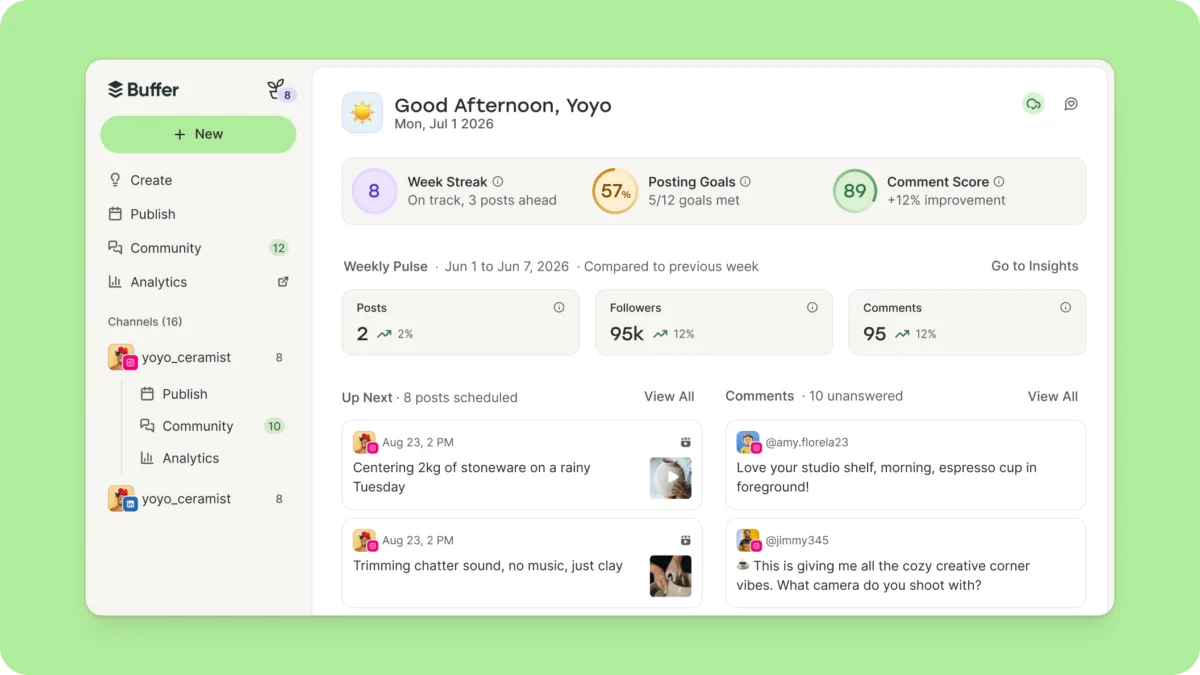
The newly launched Buffer Home page is designed to fundamentally alter this initial experience. Its primary objective is to replace the static welcome checklist with a dynamic, engaging page that meets users precisely where they are in their journey.
For new users, landing on Buffer Home after initial onboarding now presents a curated set of "setup cards." These cards are intelligently tailored to reflect the user’s declared profile – whether they identify as a solo creator, an agency, or a developer with specific interests like API integration. This personalized guidance aims to accelerate the path to the "a-ha!" moment, directing users to the most relevant features and actions based on their stated goals. For instance, a solo creator might be prompted to connect their primary social channels and explore content templates, while an agency user might be guided toward team collaboration features and client management tools. Buffer is currently A/B testing this personalized onboarding flow with new signups, underscoring its commitment to data-driven design and continuous improvement. This experimental approach ensures that product decisions are validated by real-world user behavior rather than assumptions.
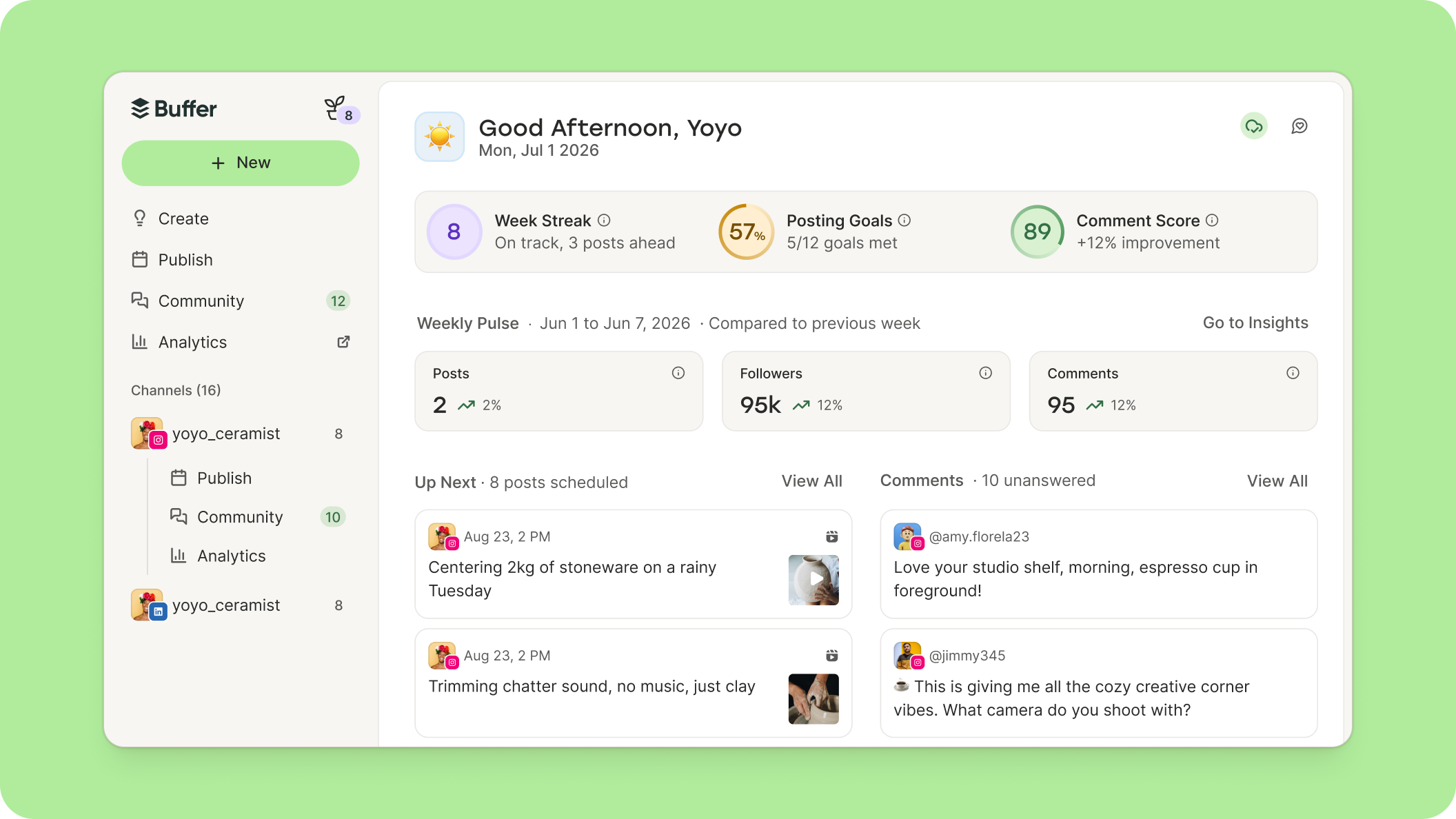
For existing users, Buffer Home serves a different yet equally valuable purpose. It acts as a succinct, actionable overview of their social media operations, providing a snapshot of critical information before diving into specific tasks. This includes a clear display of upcoming posts, any comments requiring a response, and a summary of their recent posting habits. Crucially, every element on the Home page is clickable, transforming it into a dynamic launching pad rather than a passive dashboard. Users can instantly navigate from a comment notification directly to the engagement tool, or from an upcoming post summary to the publishing calendar, minimizing clicks and streamlining workflows.
In its initial Version 1, the existing-user iteration of Buffer Home is intentionally minimal. The product team acknowledges a vast array of potential features that could be surfaced – deeper analytics, granular team activity logs, AI-driven content suggestions, or trending topics. However, in line with modern agile development principles, most of these were deliberately omitted. This lean approach allows Buffer to ship a valuable core experience, gather real usage data, and iterate based on genuine user feedback, rather than attempting to predict the "perfect" page from the outset. This strategy is echoed across the tech industry, where companies prioritize rapid deployment of minimum viable products (MVPs) to learn and adapt quickly.
Statements from Leadership and Industry Perspective
Brandon Green articulated the strategic intent behind Buffer Home: "Our goal with Buffer Home is not to add more complexity, but to unlock the existing power of Buffer by presenting it in a more intuitive and personalized way. We want to ensure that every user, regardless of their experience level, can quickly find value and seamlessly navigate our comprehensive set of tools."
A spokesperson for Buffer’s product management team added, "This launch represents a pivotal step in our ongoing commitment to user-centric design. We believe that by providing a truly personalized entry point, we will significantly reduce the time-to-value for new users and streamline daily workflows for our seasoned professionals, ultimately enhancing overall productivity and satisfaction."
Industry analysts have largely welcomed Buffer’s strategic move. "The introduction of a dynamic, personalized home page is a timely and essential evolution for Buffer in an increasingly competitive social media management market," commented Sarah Jenkins, a lead analyst at TechInsights. "It aligns with broader trends in personalized user experiences across SaaS platforms, where discoverability and an accelerated path to value are critical differentiators. This positions Buffer well to attract new users while simultaneously deepening engagement with its existing base." Jenkins further suggested that this move could set a new benchmark for user onboarding within the social media management sector, prompting competitors to re-evaluate their own initial user experiences.
The Broader Strategic Vision: Unlocking Future Growth
Buffer Home is more than just a new landing page; it is a foundational component of Buffer’s ambitious product roadmap for the coming year. The company has articulated plans to overhaul its analytics and insights features, further develop its "Community" functionalities, and significantly enhance its capabilities for teams managing complex social media strategies.
In this context, Buffer Home is poised to play a crucial role in ensuring that each of these future developments, and indeed all essential social marketing tasks, are effortlessly discoverable and actionable. For example, consider a contributor within a marketing agency responsible for drafting posts that require editorial review. In the previous interface, identifying and acting on review feedback could involve three to four clicks. Buffer Home is envisioned to surface these important review comments directly, allowing contributors to address them with a single click, dramatically improving workflow efficiency for team-based operations. This direct access to actionable insights and tasks is critical for large organizations, where reducing friction in collaborative processes can lead to substantial time and cost savings.
The strategic genius of Buffer Home, as highlighted by its product leadership, lies in its ability to introduce almost no new capabilities (yet). All the elements it surfaces – posts, comments, templates, goals – existed within Buffer prior to this launch. What has fundamentally changed is how users encounter these elements. Buffer’s extensive growth over the years meant that many valuable features were hidden behind specific tabs, discovered only by users actively seeking them out. The Home page flips this paradigm, progressively revealing the product’s depth and breadth based on the user’s individual journey and evolving needs, rather than presenting a bewildering array of options from the outset.
Market Context and Competitive Landscape
The social media management software market is robust and highly competitive, populated by a diverse range of players including Hootsuite, Sprout Social, Later, Agorapulse, and numerous niche solutions. In this crowded space, differentiation often comes down to user experience, specialized features, and pricing. Buffer has historically carved out a niche for its clean interface and focus on ease of use. This latest update reinforces that positioning by making the entire platform more accessible and personalized.
The move toward personalized dashboards and intelligent onboarding is a trend observed across the SaaS industry, as companies recognize that a seamless initial experience is paramount for user retention and long-term growth. By adopting this approach, Buffer is not only catching up to modern UX best practices but is also positioning itself to lead in creating a more intuitive and user-centric social media management environment. This could prove particularly attractive to small businesses and individual creators who often lack the resources for extensive training and need tools that are immediately productive.
Implications for Users and the Future of Social Media Management
The implications of Buffer Home are far-reaching. For users, it promises a significant enhancement in satisfaction and loyalty, as the platform becomes more intuitive and responsive to their specific needs. New users will likely experience a faster "time-to-value," leading to higher activation rates and reduced early churn. Existing users will benefit from a more streamlined workflow, with critical information and actionable tasks presented upfront, saving time and reducing cognitive load.
For Buffer as a company, this strategic pivot is expected to drive increased feature adoption across its diverse toolkit, potentially leading to higher average revenue per user (ARPU) through greater utilization of premium features. It also strengthens Buffer’s competitive standing by offering a superior onboarding and ongoing user experience, making it a more compelling choice in a crowded market.
Looking ahead, Buffer Home lays the groundwork for even more advanced, potentially AI-powered, dynamic dashboards. As Buffer continues to develop its analytics and community features, the Home page could evolve to offer proactive insights, personalized content suggestions, and intelligent task prioritization, further solidifying its role as a central hub for comprehensive social media management. The emphasis on user feedback, as evidenced by the A/B testing and public roadmap, indicates a commitment to continuous iteration based on real-world needs.
In conclusion, Buffer Home represents a pivotal moment in Buffer’s product evolution, shifting from a feature-centric interface to a user-centric experience. By strategically unlocking existing functionalities through intelligent personalization and streamlined navigation, Buffer aims to empower its diverse user base to achieve their social media goals more efficiently and effectively. The launch of Buffer Home in 2026 is not merely an aesthetic update but a foundational change designed to foster deeper engagement, enhance productivity, and propel Buffer into the next phase of its growth trajectory within the dynamic landscape of social media management. Users eager to contribute to its development are encouraged to visit Buffer’s public roadmap or engage directly with the product team on platforms like LinkedIn.