rifanmuazin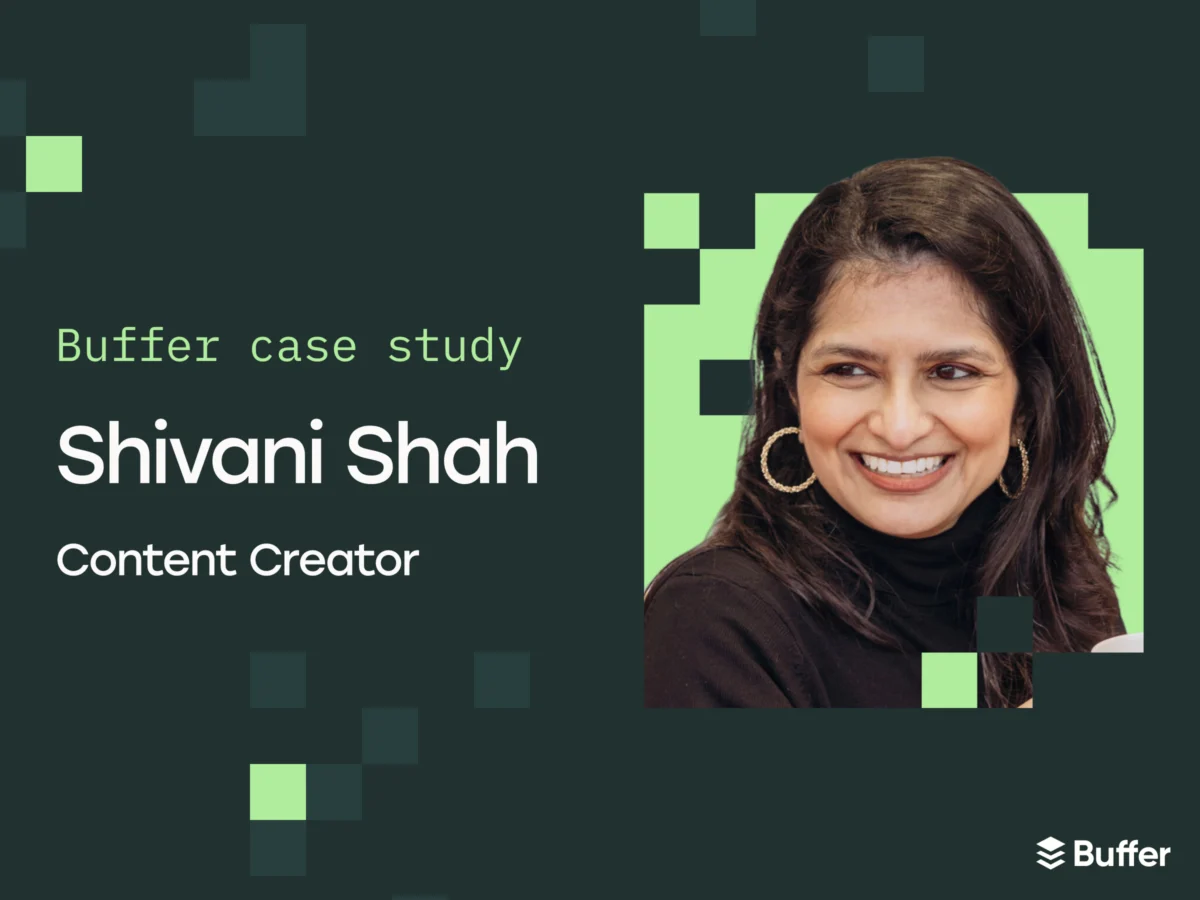
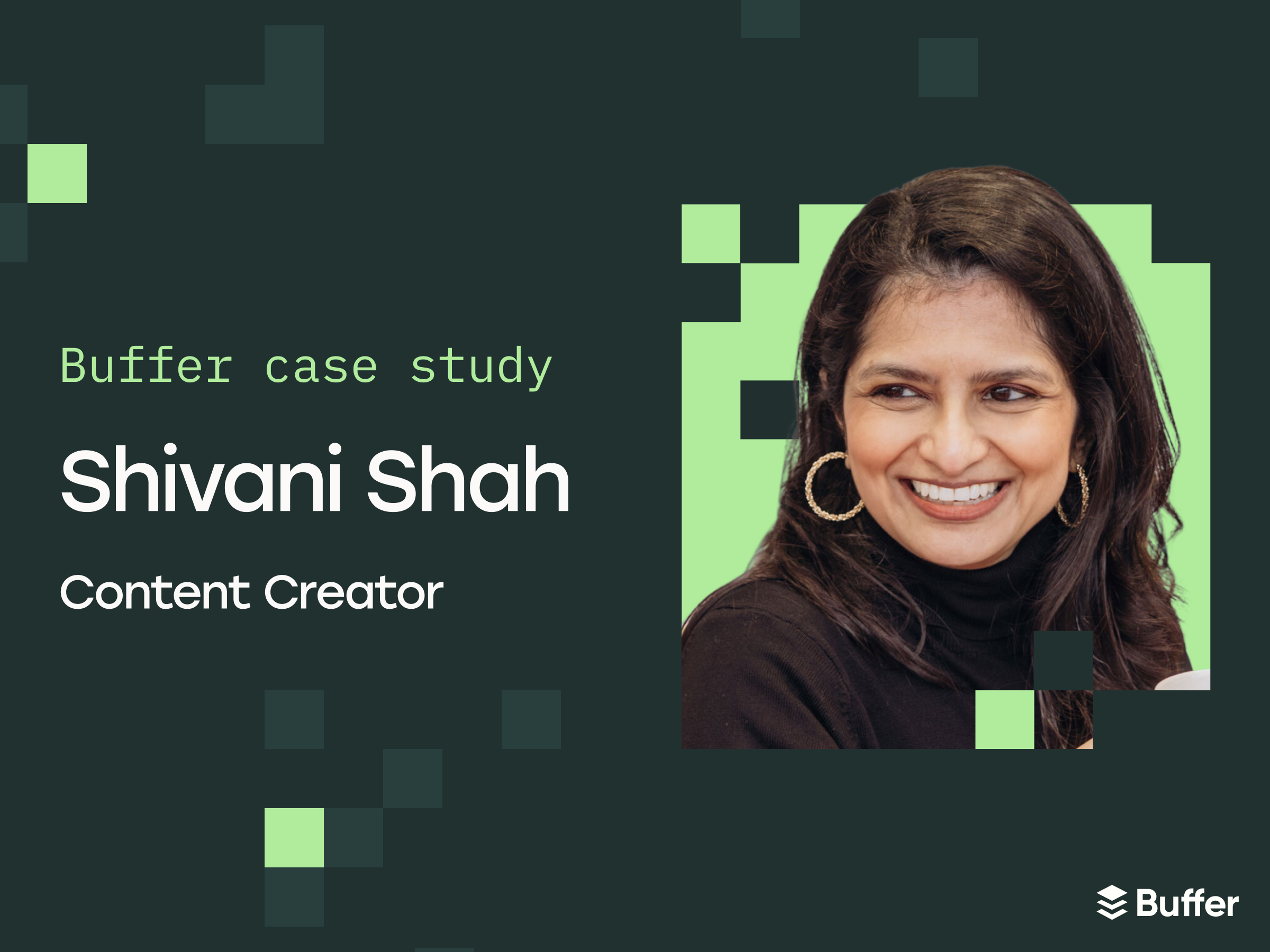
Shivani Shah, a prominent freelance professional, has meticulously crafted a bespoke ecosystem of automated tools and AI-powered solutions, fundamentally transforming her operational efficiency and strategic content management. Her approach, deeply rooted in a "keyboard-first" and "automate wherever possible" philosophy, exemplifies a growing trend among independent professionals who are leveraging cutting-edge technology to gain a competitive edge in a dynamic market. This strategic adoption of automation, culminating in the development of sophisticated tools using artificial intelligence and API integration, highlights a significant shift towards hyper-personalized productivity solutions without requiring traditional coding expertise.
The Foundation of Efficiency: A Deep-Seated Automation Ethos
Shah’s journey into advanced automation began long before her engagement with application programming interfaces (APIs). Her daily workflow on her Mac is a testament to her unwavering commitment to streamlining tasks. Tools like Hazel, a Mac folder-automation utility, are indispensable, instantly categorizing incoming invoices into designated folders upon download, eliminating manual sorting errors and saving precious time. Similarly, Alfred, her preferred keyboard-driven launcher, allows her to access any file or application through keyword searches, bypassing the need to navigate Finder, a seemingly small efficiency gain that cumulatively contributes to hours saved annually.
Beyond these off-the-shelf solutions, Shah has demonstrated a knack for creating custom efficiencies. A prime example is her personalized Shortcut, designed to generate her entire annual folder structure with a single click. This innovation, which names 14 folders according to the financial year, directly addresses a previous pain point: the annual, error-prone manual creation of these folders every April. Her proactive approach extends to her personal life, where she developed a swim tracker app, driven by a desire for a more enjoyable and less "goal-oriented" experience than existing options. This inherent drive to build and customize solutions for specific needs laid the groundwork for her more ambitious ventures into API integration.
The burgeoning freelance economy, which saw over 59 million Americans freelancing in 2021, according to a report by Upwork and Freelancers Union, thrives on efficiency and self-reliance. For professionals like Shah, time is a finite and valuable resource. Automating repetitive administrative tasks not only frees up time for core client work but also minimizes human error, ensuring consistency and professionalism. Data from various productivity studies suggest that automation can save small business owners and freelancers several hours per week, translating into significant financial and competitive advantages. Shah’s initial suite of automations perfectly aligns with this critical need for streamlined operations in a self-managed career.
The Catalyst: Discovering the Power of APIs
The pivotal moment for Shah came when she encountered Buffer’s team actively showcasing user-built solutions leveraging their API on LinkedIn. Buffer, a leading social media management platform, provides an API that allows developers and increasingly, non-developers, to extend its functionality and integrate it with other services. This exposure ignited a spark of possibility for Shah, despite her complete lack of prior experience with API development. "I can do this. It may not be easy, but I can do it," she recalls thinking, reflecting a characteristic blend of determination and practical optimism. This decision marked a significant leap from utilizing existing automation tools to actively building custom integrations, moving her from a sophisticated user to an innovative creator.
The accessibility of APIs has democratized technology, enabling individuals and small businesses to tailor software solutions to their precise requirements without needing to build entire applications from scratch. This "citizen developer" movement, supported by user-friendly API documentation and the rise of AI-powered development assistants, is reshaping how non-technical professionals interact with and enhance their digital toolkits.
Crafting an Accountability Partner: The Friday Morning Slack Bot
Shah’s first major project involving the Buffer API addressed a critical aspect of her freelance marketing strategy: consistent LinkedIn engagement. Her goal is to post on LinkedIn twice a week, a commitment she takes seriously given its role as a primary channel for client acquisition. The challenge was maintaining this consistency and easily tracking her progress without having to manually check multiple platforms. She envisioned a system that would provide a weekly recap directly within Slack, her primary communication hub for clients.
The inspiration for this tool stemmed from a habit cultivated during her time working in-house on a content team. Every Friday, the team would share their weekly accomplishments and upcoming agenda in Slack, fostering transparency and mutual support. Shah sought to replicate this accountability for her solo freelance practice, but critically, without the manual effort of typing out updates or extracting data from Buffer or LinkedIn. She wanted the API to automatically assemble this recap.
Her development process was remarkably straightforward, thanks to the advent of conversational AI. Shah turned to Claude, an advanced AI assistant, and presented it with Buffer’s API documentation. Her prompt was simple: "Can I build a Slack workflow that recaps my week?" Claude’s affirmative response initiated a collaborative development journey, guided by step-by-step instructions from the AI. This "no-code, just conversation" approach allowed Shah, a self-described non-developer, to navigate the complexities of API integration.
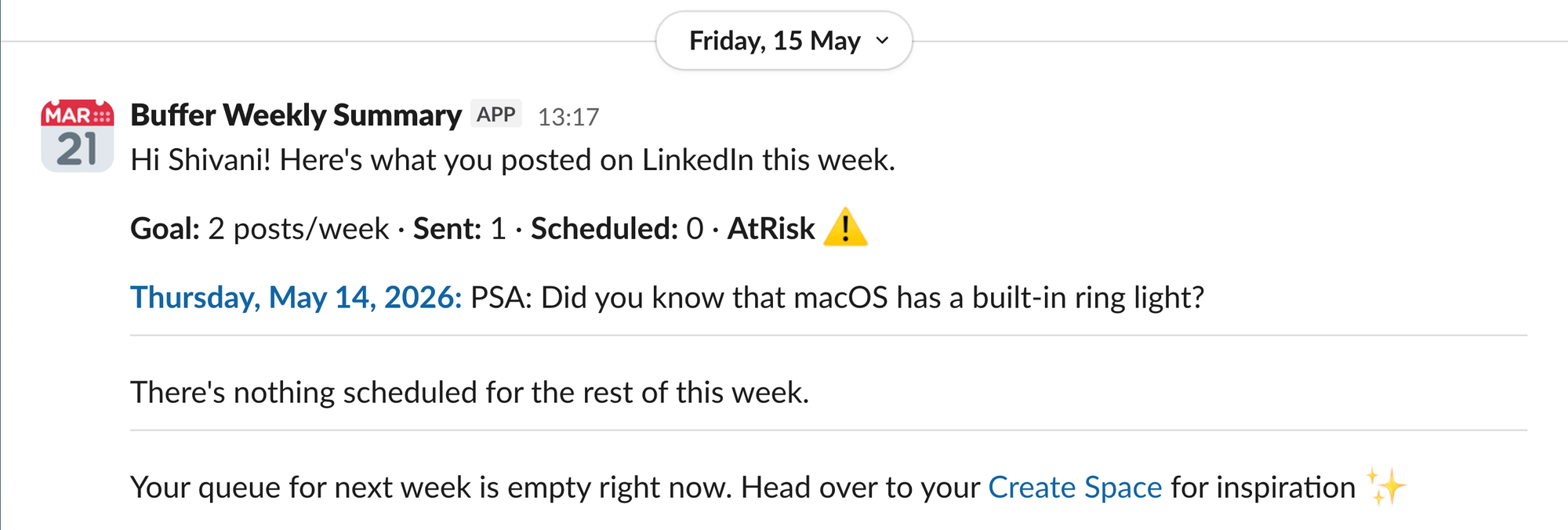
The result is a highly effective Slack message that arrives precisely at 10:30 a.m. every Friday. This message provides a comprehensive overview of her LinkedIn activity for the week, including:
- The number of LinkedIn posts published.
- Whether she has met her two-post weekly goal, with statuses like "on track" or "at risk" based on Buffer’s backend calculations (e.g., one post published and one scheduled means "on track").
- A preview of posts scheduled for the current and upcoming weeks, each accompanied by a direct link back to the post within Buffer.
- A proactive alert if her content queue for the following week is empty, along with a direct link to her Buffer Create Space to facilitate immediate content scheduling.
This automated check-in has transformed her weekly review process. "I get excited every time I see a new message in Slack," Shah enthuses, highlighting the personal satisfaction derived from a system that works so seamlessly it becomes an almost magical presence. The Slack bot serves as an objective accountability partner, reinforcing her marketing discipline and ensuring she remains proactive in her client acquisition efforts.
A Personal Command Centre: The LinkedIn Content Library & Analyzer
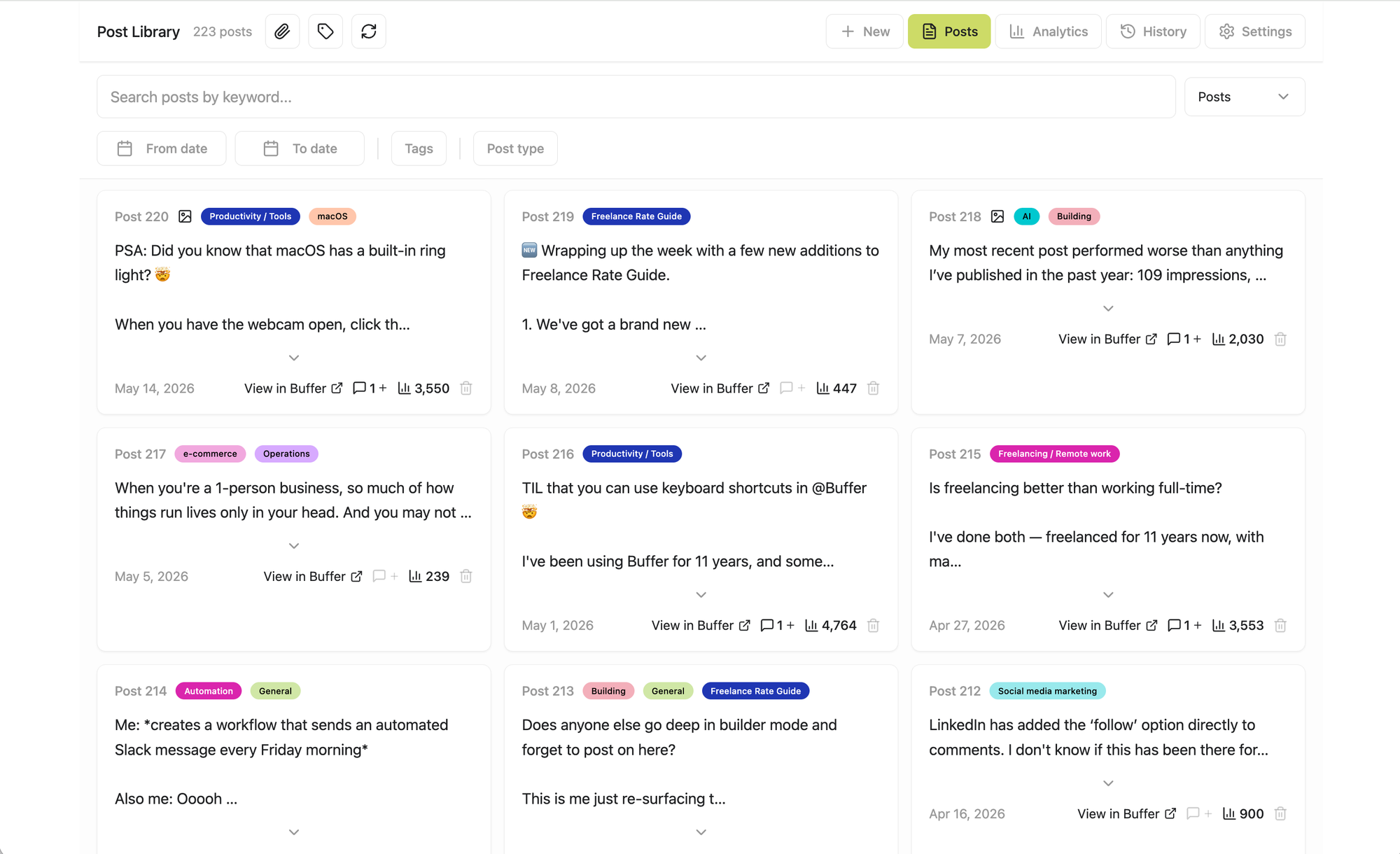
Beyond weekly accountability, Shah recognized a deeper need for strategic content analysis. Having posted on LinkedIn for years, her Buffer "create space" was filled with nascent ideas and fragmented thoughts. The challenge was to systematically review her past content, identify patterns, and extract data-backed insights to inform future strategy. This led to her second major project: the LinkedIn Content Library & Analyzer.
For this endeavor, Shah utilized Lovable, a platform that enables AI-assisted application building. She initially pulled her last 100 posts from Buffer’s API into Lovable, then leveraged the platform to backfill an additional 50 older posts, creating a comprehensive archive dating back to 2023. The app automatically syncs new posts every time it’s opened, ensuring the library remains current.
The LinkedIn Content Library & Analyzer addresses several critical pain points for content creators:
- Comprehensive Search: The app allows Shah to search across all her past posts and associated notes by keyword, making it effortless to retrieve specific content or topics.
- Advanced Filtering: Posts can be filtered by tags and date ranges, enabling focused analysis on particular campaigns or time periods.
- Personalized Annotations: Shah can add her own comments and observations to any post, enriching the data with qualitative insights.
- AI Chat for Strategic Analysis: This feature has emerged as the most valuable component. Shah can select specific posts or her entire library and pose questions to the integrated AI, such as "What topics do I post about most?" or "Are there any gaps in my content?" The AI analyzes the selected content and provides data-driven answers. Crucially, the chat history is saved, allowing her to revisit and continue past analytical threads.
Before settling on Lovable, Shah explored alternative solutions. Integrating Zapier with Notion was considered, but its inability to import historical posts meant starting from scratch, which was a significant drawback. Claude Code was another option, but technical limitations at the time prevented her from connecting it to the API via her VS Code extension. Lovable’s ability to ingest her entire backlog of posts and provide a robust, interactive interface made it the ideal choice. "The library solves my problem of not being able to search for my own posts," Shivani states, "But the chat has become much more valuable than I expected." This underscores the transformative power of AI in not just organizing data, but also in extracting actionable intelligence from it.
No Code, Just Conversation: The Rise of the Citizen AI Developer
Shivani Shah’s achievements are particularly noteworthy because both the Slack bot and the Lovable app were built by someone with no prior API experience and without writing traditional code from scratch. Her methodology for the Slack bot involved pasting Buffer’s API documentation into Claude and verbally describing her desired outcome. Claude, in turn, provided step-by-step guidance, effectively acting as a technical co-pilot. She refined the Slack message format, utilized Slack’s Block Kit Builder for layout, and connected the various components through conversational prompts. "Claude literally walked me through everything," she affirms. "It really wasn’t that hard."
The development process for the Lovable app was similarly streamlined. Shah describes it as "more AI coding or vibe coding than no-code." Instead of interacting with a traditional WYSIWYG editor or writing lines of code, she simply conversed with Lovable, articulating her requirements. The platform then translated her natural language instructions into a functional application, iteratively building and refining it based on her feedback. This conversational approach to development dramatically lowers the barrier to entry for complex technical projects, empowering individuals like Shah to become "citizen developers" who can tailor digital tools to their exact specifications. This trend aligns with industry forecasts predicting a significant rise in citizen development, with Gartner projecting that 80% of technology products and services will be built by non-technical professionals by 2024.
Continuous Evolution and Future Aspirations
Since their initial deployment, Shivani Shah has continued to enhance her custom applications. The Lovable app now incorporates analytics alongside her posts and chat functionalities. While not yet fully automated – she currently uploads CSV files of LinkedIn data and manually inputs metrics like saves, sends, reposts, and follower counts – the AI chat seamlessly integrates this data into its analysis, generating content ideas inspired by her top-performing posts. She has also added a "save-to-Buffer" feature, enabling her to instantly transfer promising content ideas surfaced by the AI chat directly into her Buffer Create Space queue for future scheduling.
Looking ahead, Shah has a clear roadmap for further development. Her primary wish list includes automating the analytics portion of her Lovable app, contingent on Buffer’s API eventually supporting direct data retrieval, which would eliminate the need for manual CSV uploads and data entry. She also aims to integrate specific columns from her Buffer Create space into her Friday Slack message, allowing her to brainstorm next-week’s content ideas directly within Slack.
Perhaps her most ambitious aspiration is to make her custom LinkedIn Content Library & Analyzer publicly available. Currently, it serves as a powerful personal tool, but Shah recognizes its broader utility. "I would have loved to make this app available to people," she states, envisioning it as a valuable asset for any content creator seeking a searchable archive and analytical insights into their own digital footprint. This vision underscores the potential for highly personalized, AI-driven tools to evolve into widely adopted solutions, demonstrating the power of grassroots innovation.
Broader Implications and the Future of Work
Shivani Shah’s journey is a compelling case study in the democratization of technology. It illustrates how readily available APIs, coupled with sophisticated AI assistants, are empowering non-developers to build custom solutions that were once the exclusive domain of professional software engineers. This paradigm shift has profound implications for:
- Freelancers and Small Businesses: It levels the playing field, enabling independent professionals to build highly efficient, tailored workflows that can rival those of larger organizations with dedicated tech teams. This can lead to increased productivity, better client management, and more effective marketing strategies.
- The "Citizen Developer" Movement: Shah’s experience validates the growing trend of citizen development, where business users with little to no coding experience can create applications using low-code/no-code platforms and AI tools. This movement is critical for bridging the gap between business needs and IT capabilities, accelerating innovation across industries.
- The Role of AI in Productivity: AI’s ability to understand natural language and assist in complex technical tasks, as demonstrated by Claude and Lovable, is fundamentally changing how individuals interact with technology. It transforms development from a specialized skill into a conversational process, making advanced tools accessible to a much broader audience.
- Hyper-Personalization of Tools: Shah’s custom solutions highlight the growing demand for tools that perfectly fit individual workflows, rather than relying on generic, one-size-fits-all software. This trend is likely to drive further innovation in customizable platforms and AI-driven personal assistants.
- Competitive Advantage: In an increasingly competitive freelance market, the ability to automate routine tasks and gain deep insights from personal data provides a significant strategic advantage. It allows freelancers to focus on high-value work, client relationships, and creative output, rather than administrative overhead.
Shivani Shah’s success story serves as an inspiring blueprint for how individuals can leverage the current technological landscape to enhance their professional lives. By embracing automation and conversing with AI, she has not only solved her own operational challenges but also demonstrated a powerful pathway for others to extend the capabilities of existing platforms like Buffer to perfectly align with their unique working styles.
Buffer’s API is now available, inviting more innovators like Shivani Shah to explore, create, and build personalized solutions, further blurring the lines between user and developer and ushering in a new era of personalized productivity.