rifanmuazin
The social media API landscape has undergone an unprecedented surge in activity over the past year, marking a significant evolution in how digital platforms interact and how content creators, businesses, and developers manage their online presence. What was once a niche for dedicated programmers has broadened into a dynamic ecosystem, driven by the increasing demand for automation, data analytics, and the burgeoning capabilities of artificial intelligence. This rapid expansion has seen numerous contenders emerge, most less than two years old, all vying to provide streamlined access to the fragmented world of social media networks.
The core problem these unified APIs aim to solve stems from the inherent complexity of individual social network APIs. Platforms like Meta (Instagram and Facebook), X (formerly Twitter), LinkedIn, TikTok, YouTube, Pinterest, Threads, and Bluesky each offer their own native application programming interfaces. While generally free to use (with X being a notable exception due to its pay-per-use model), each native API presents unique login flows, rate limits, data formats, and often idiosyncratic "quirks." For a developer or an application seeking to publish content across multiple channels, this translates into building and maintaining a minimum of eight separate integrations—a substantial, ongoing challenge given the frequent updates and changes implemented by these major platforms.

Unified social media APIs abstract away this complexity, acting as a single intermediary layer that translates requests into the specific formats required by each underlying social network. This "multiplug" approach simplifies development, reduces maintenance overhead, and allows applications to interact with numerous platforms through one consistent interface. This consolidation is particularly appealing to indie developers building specialized tools, marketing agencies managing dozens of client accounts, and large enterprises seeking to integrate social media functionalities into their broader digital strategies. The diversity in these offerings means that the "best" social media API is not a universal truth but rather a function of specific project requirements, desired polish, and budgetary considerations.
The Emergence of AI and Model Context Protocol (MCP) Servers
A pivotal development driving the current API boom is the rapid integration of artificial intelligence, particularly AI agents. Traditionally, developers write code in languages like Python or JavaScript to call APIs directly, handling authentication, data formatting, response parsing, and error management. However, the paradigm shifts when working with AI agents, such as those built with Claude or Cursor. Here, the agent isn’t necessarily executing line-by-line integration code but rather is given access to tools and instructed, often in plain language, to utilize them.
This is where Model Context Protocol (MCP) servers become critical. An MCP server provides a standardized interface that allows AI agents to "call" these tools—including social media APIs—without requiring custom integration code for every single one. Essentially, an MCP server sits in front of a social media API, exposing its functionalities in a format that an AI agent can inherently understand and leverage. For developers "vibe-coding" with AI tools, an MCP server is instrumental in enabling an agent to post to social networks autonomously, eliminating the need for manual wrapper code development. While less critical for traditional app development, the presence of an MCP server signals future-proofing for potential AI agent integration, making it a significant consideration in the current market.
Key Players in the Unified Social Media API Market: An In-Depth Analysis
The market for unified social media APIs is characterized by diverse offerings, each with distinct strengths tailored to different user segments.
Buffer: Reliability and Polish for Diverse Builders
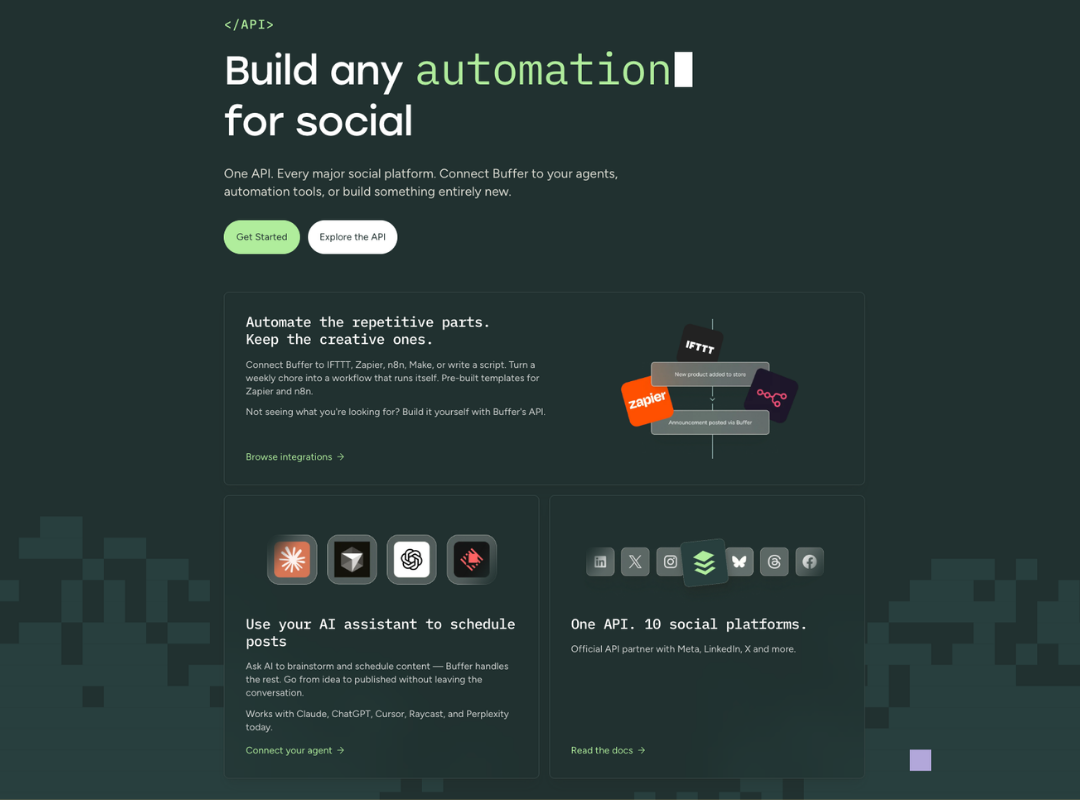
Buffer’s API stands out as a robust option from an established brand with over 15 years of social media integration expertise. It supports 11 platforms, including Instagram, Facebook, LinkedIn, TikTok, X, Threads, Bluesky, Pinterest, YouTube, Google Business Profile, and Mastodon. Utilizing GraphQL for modern data querying, Buffer’s API focuses on post creation, scheduling, content ideas, and basic account/channel metadata. It offers a free tier with one API key and up to five for paid users. The recent rebuilding efforts have prioritized documentation, AI-tool readiness, and developer-friendly tooling, including a Command Line Interface (CLI) for scriptable, version-controllable automation. For non-developers, Buffer provides ready-made integrations with N8N, Zapier, and Make, facilitating plug-and-play automation. Its open MCP server is a significant advantage for AI agent builders. Buffer’s role as an official partner to major social networks underscores its dependability, and its existing web dashboard provides a valuable UI for users alongside API-driven workflows. A current limitation is the absence of social media analytics via the API, though this is a planned future enhancement. Buffer caters effectively to a broad audience from indie developers to no-code builders seeking a reliable, well-supported platform.
Ayrshare: Enterprise-Grade Solutions with Advanced Analytics
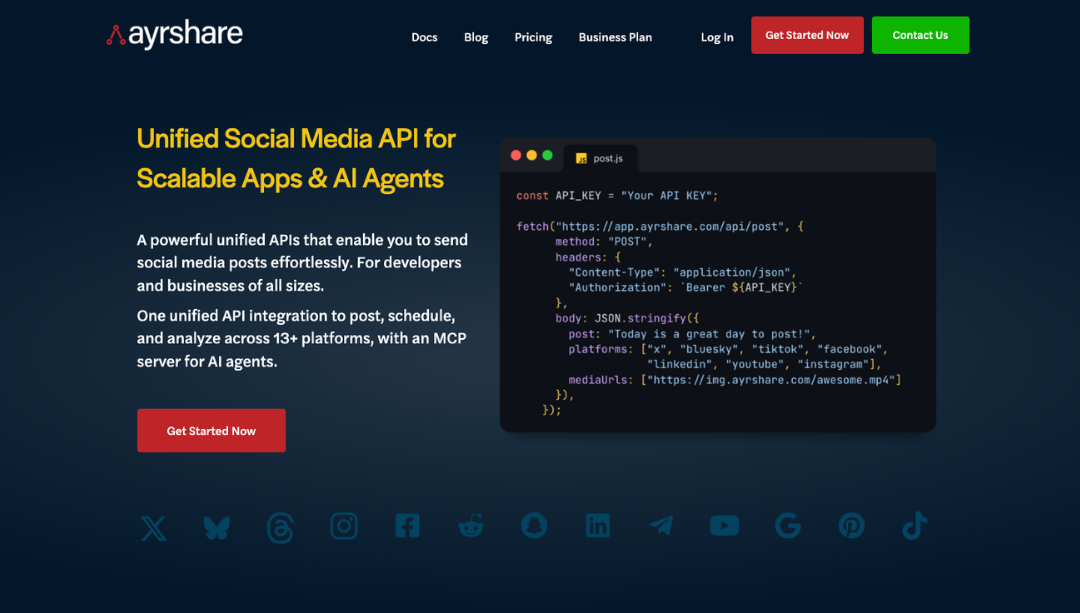
Ayrshare positions itself as a mature solution for agencies and enterprise teams, supporting over 13 platforms including Reddit, Telegram, and Snapchat, in addition to the mainstream networks. Its comprehensive Software Development Kits (SDKs) for Node.js, Python, PHP, C#, Go, Java, and Ruby on Rails offer the widest language coverage in the market. Beyond core publishing, Ayrshare excels in advanced features such as comment and review management, messaging with auto-responses, and sophisticated analytics. This extensive feature set justifies its premium pricing, starting at $149/month for Premium and $499-$599/month for Business tiers, which can escalate quickly for high-volume users. While a free tier exists, it is limited, primarily serving as a testing ground. Its focus on granular analytics and comprehensive management makes it ideal for agencies handling numerous client profiles where in-depth insights and DM handling are paramount. However, a notable limitation, as of May 2026, is the absence of an MCP server, which might deter AI agent developers.
Postiz: Open-Source Flexibility and Decentralized Network Coverage
Postiz emerges as a strong open-source contender, offering unparalleled platform coverage with over 30 networks, including mainstream giants and decentralized platforms like Nostr, Farcaster, and Mastodon. This breadth makes it the most comprehensive API for developers keen on engaging with emerging social media ecosystems. Postiz offers both a free self-hosted version, allowing developers full data control and deployment flexibility (e.g., on Railway or via Docker), and a cloud version starting at $29/month. The API supports post creation, media uploads, and integrations with no-code tools like n8n and Make. While it offers limited MCP server capabilities, its open-source nature means developers can tailor and extend its functionalities as needed. The trade-off for self-hosting, however, includes the responsibility for uptime, scaling, and adapting to platform API changes, which can be resource-intensive.

Upload-Post: Strong Newcomer with Open-Source MCP
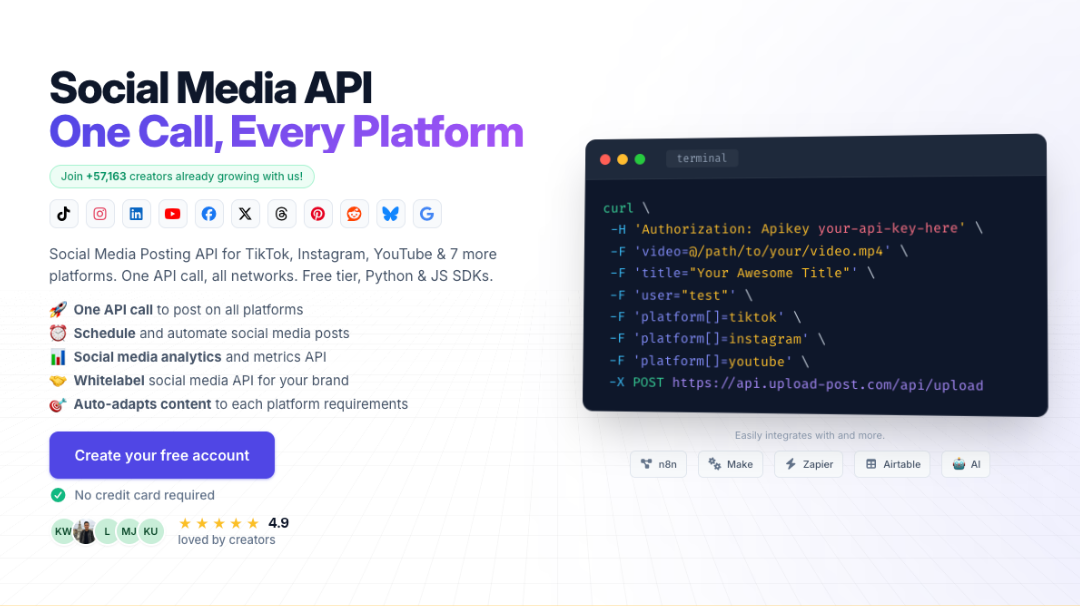
Upload-Post is a compelling newcomer, providing an API-first solution with Python and JavaScript SDKs and a user base exceeding 30,000. It supports 10 platforms, covering mainstream networks like TikTok, Instagram, YouTube, LinkedIn, and X. A key differentiator is its open-source MCP server, hosted on GitHub, offering over 40 tools for AI agents. This makes Upload-Post an attractive option for developers integrating Claude, Cursor, or similar AI agents into publishing workflows. It provides a generous free tier allowing 10 uploads per month, suitable for initial experimentation, with paid plans starting at $16/month. While its platform list is narrower than Postiz for decentralized networks, its strong AI agent support and free tier make it a valuable option for solo builders.
Zernio: Specialized in Paid Campaign Management
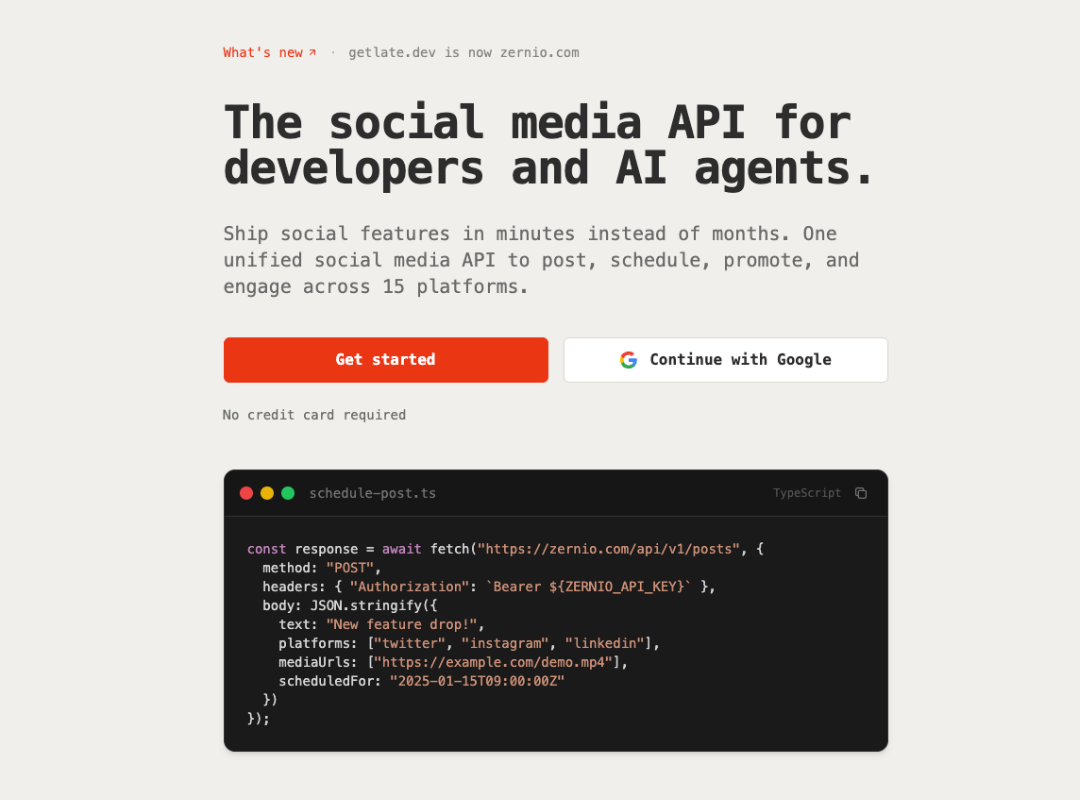
Zernio (formerly Getlate.dev) targets indie developers and AI agent builders with a flat starting price of $19/month. It supports 15 platforms, uniquely including various ad platforms such as Meta Ads, TikTok Ads, Google Ads, Pinterest Ads, LinkedIn Ads, and X Ads. This focus makes it the sole API on this list tailored for managing both organic and paid content campaigns, offering significant value for those primarily concerned with advertising. Zernio also provides a dedicated MCP server alongside its REST API, facilitating integration with AI agents like Claude or ChatGPT for automated campaign management. As a newer entrant, its community base is smaller compared to more established players.
Phyllo: Deep Dive into Creator Data and Analytics
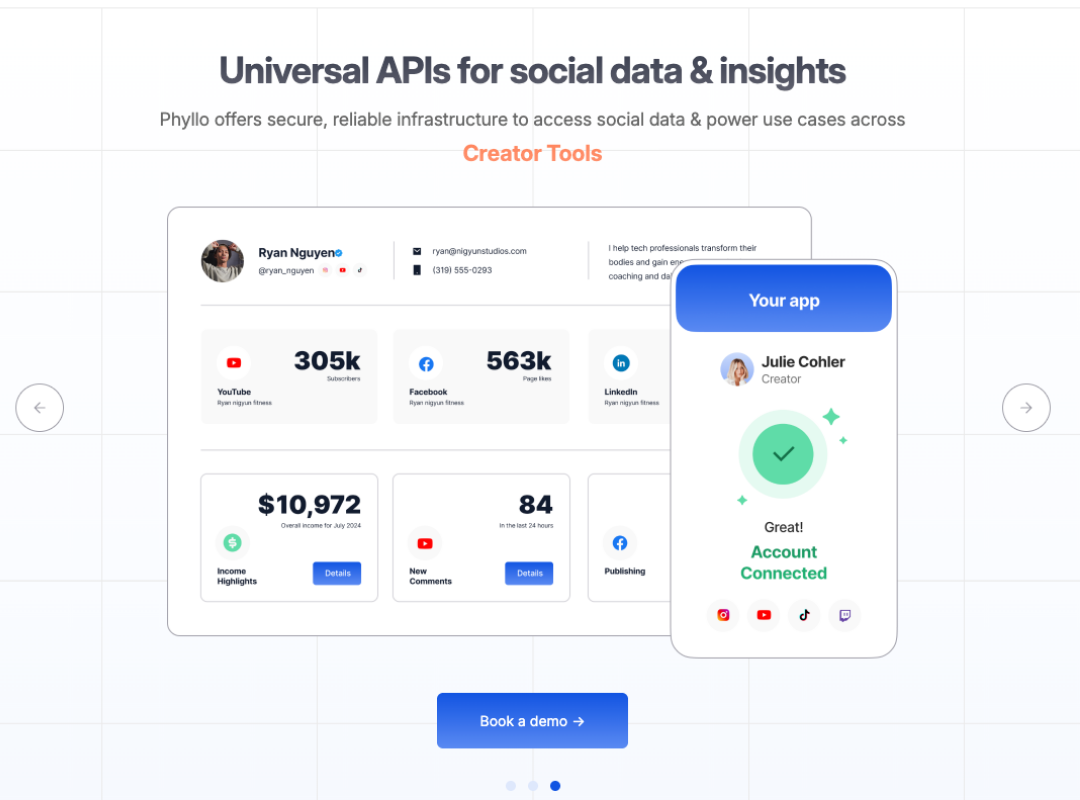
Phyllo occupies a distinct niche, focusing exclusively on creator data rather than content publishing. It offers a "Universal API for social data & insights," connecting to over 20 platforms, including YouTube, Instagram, TikTok, and Twitch, along with other long-tail creator platforms. Phyllo enables the retrieval of audience demographics, engagement statistics, content performance metrics, and earnings data (where available) directly from creator profiles. This makes it indispensable for building creator marketplaces, influencer analytics tools, or any application requiring real-time, authenticated audience data. However, its pricing is custom and sales-gated, which can be a barrier for indie developers. Crucially, Phyllo cannot be used to publish content and must be paired with a publishing API for comprehensive social media management.
Post for Me: Predictable Per-Post Pricing for Indie SaaS
Post for Me distinguishes itself with a pricing model based on post volume rather than profile count, offering plans from $10/month for 1,000 posts up to $1,000/month, all including unlimited accounts and API keys. This model is particularly beneficial for indie SaaS products or applications with many low-activity user accounts, as it avoids unexpected costs associated with per-profile fees. It supports 9 mainstream platforms, including TikTok, Instagram, Facebook, X, LinkedIn, YouTube, Threads, Pinterest, and Bluesky. While predictable, high-volume accounts might find per-post pricing less economical than flat-rate alternatives. A current limitation is the absence of an MCP server.
Outstand: Flexible Pay-As-You-Go Publishing
Outstand offers a unique pay-as-you-go pricing model at $0.01 per post, covering 10 platforms. This approach can be highly cost-effective for low-volume side projects or proof-of-concept builds, potentially undercutting flat-rate paid plans. However, for high-volume products, the cumulative cost can quickly become substantial, necessitating careful comparison against subscription-based or self-hosted options. Outstand prioritizes simplicity and immediate utility for sporadic publishing needs. It currently does not offer an MCP server, limiting its utility for advanced AI agent integrations.
Genviral: AI-Native Content Generation and Publishing
Genviral is explicitly designed for AI-generated content workflows, offering a full content pipeline across 6 platforms (TikTok, Instagram, YouTube, Pinterest, LinkedIn, Facebook). Its API facilitates the generation of AI slideshows, management of image packs, creation of reusable templates, rendering of final assets, and tracking of analytics. Unique features include a TikTok draft mode for adding trending sounds before publishing. Built around an OpenClaw integration with over 42 commands for AI agents, Genviral is ideal for products where the core function involves AI generating and then publishing content. Pricing is custom and usage-based, requiring direct engagement with sales. Its smaller platform coverage and specialized focus on AI generation mean it might be excessive for users solely seeking programmatic scheduling of existing content.
PostEverywhere: All-Inclusive Plans with Integrated AI
PostEverywhere offers an "all-inclusive" model with predictable monthly plans starting at $19/month for 10 accounts, 50 AI credits, and unlimited posts across 7 platforms (Instagram, X, LinkedIn, Facebook, TikTok, YouTube, Threads). Higher tiers offer more accounts and AI credits. All plans include full API access and generous rate limits (60 requests/min, 1,000/hr, 10,000/day). The built-in AI image generation adds significant value, making it a comprehensive package for users wanting both publishing and AI content creation capabilities within a fixed budget. However, its platform coverage is narrower compared to some competitors, and AI credits are limited at lower tiers, potentially pinching heavy users of image generation. It also lacks an MCP server.
Strategic Considerations for API Adoption
Choosing the right social media API involves a nuanced evaluation of several strategic factors beyond just platform coverage and price.
- Scalability and Reliability: For applications requiring high uptime and consistent performance, the API’s underlying infrastructure and the vendor’s track record are crucial. Established brands like Buffer, with years of experience and direct partnerships with social networks, often offer greater reliability.
- Data Control and Privacy: Self-hosted solutions like Postiz provide maximum control over data, which is vital for organizations with strict privacy requirements. Cloud-based solutions require trust in the vendor’s data handling policies.
- Future-Proofing with AI: The presence and quality of an MCP server are increasingly important for developers looking to integrate advanced AI agents into their workflows, enabling more sophisticated automation and content strategies.
- Beyond Core Publishing: Some APIs offer additional functionalities like detailed analytics, comment management, direct messaging, or ad campaign integration. These features can significantly reduce the need for multiple disparate tools.
- No-Code and Low-Code Integrations: For non-developers or those seeking rapid prototyping, robust integrations with platforms like Zapier, Make, or n8n are invaluable, allowing complex workflows to be built without extensive coding.
- Cost Model Alignment: Whether an application requires predictable monthly costs, scales linearly with usage, or benefits from a free tier for development, aligning the API’s pricing model with the project’s financial structure is essential.
- Community and Support: Access to developer documentation, community forums (like Discord servers), and responsive support teams can drastically improve the development experience and troubleshooting process.
The Future Landscape of Social Media APIs
The trajectory of social media APIs points towards deeper integration with artificial intelligence, further simplification of complex tasks, and an increasing emphasis on niche and decentralized networks. Industry analysts suggest that the demand for unified APIs will continue to grow as businesses strive for greater efficiency and automation in their digital marketing efforts. The continuous evolution of social media platforms themselves, coupled with ongoing changes to their native APIs, ensures that unified API providers will remain vital intermediaries. The challenge for these providers will be to maintain pace with platform updates, enhance AI capabilities, and ensure robust security and data privacy in an increasingly complex digital environment. As AI agents become more sophisticated, their reliance on standardized protocols like MCP servers will only intensify, making such features a competitive differentiator.
Ultimately, the expanding social media API market offers a wealth of options, reflecting the diverse needs of its users. From open-source flexibility and niche advertising management to enterprise-grade analytics and AI-native content generation, the choice hinges on a thorough understanding of project requirements, technical preferences, and strategic objectives. For those not building developer-facing software but merely seeking to manage and schedule posts, traditional social media management tools often provide a code-free alternative, addressing a similar need through a user interface rather than programmatic access. However, for those ready to build, automate, and innovate at scale, the unified social media API is an indispensable tool in the modern digital toolkit.