
 Ali Ikhwan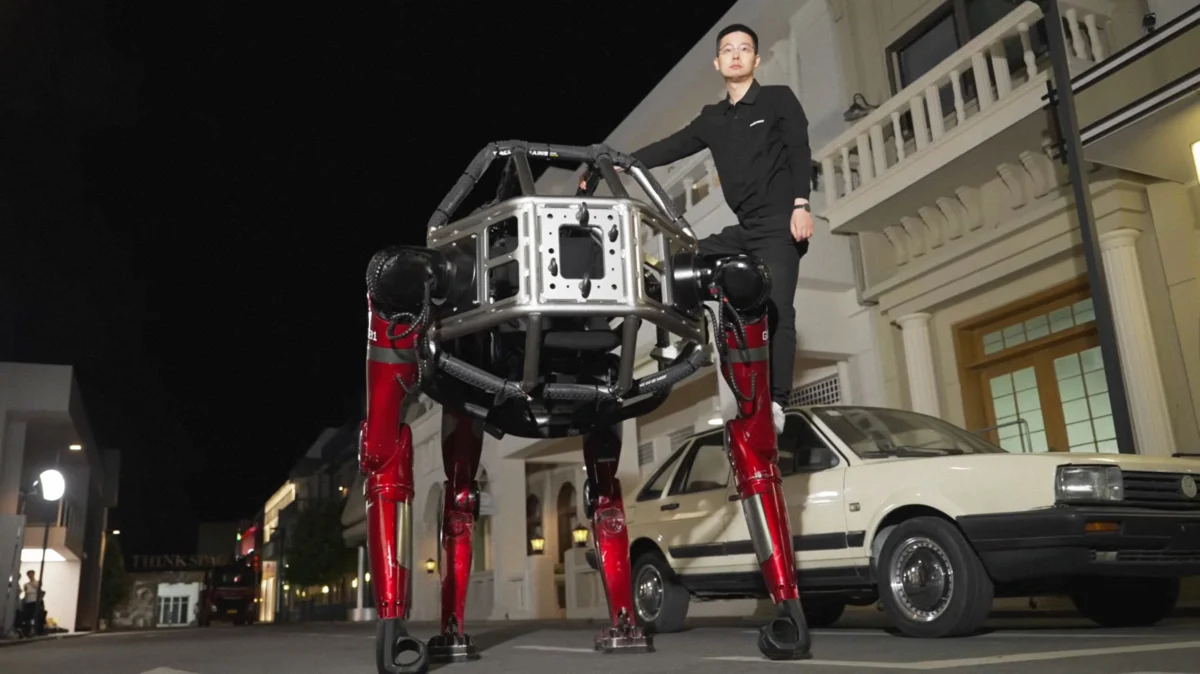
Unitree Robotics, a Hangzhou-based pioneer in consumer and research-grade robotics, has officially entered the heavy-duty mecha market with the debut of the GD01, a massive, pilotable, and transforming robotic platform. Historically recognized for its agile quadruped robots and affordable humanoid models, the company’s latest revelation represents a significant departure from its established product lines. The GD01 is not merely a scaled-up version of previous iterations but a multifunctional machine capable of walking, crawling, and performing high-impact tasks, such as breaching structural barriers. The announcement, confirmed by Unitree as a legitimate commercial offering rather than a conceptual demonstration, signals a new era in the intersection of personal transportation, industrial utility, and entertainment-focused robotics.
A New Frontier in Pilotable Robotics
The formal introduction of the GD01 was accompanied by a high-production video presentation featuring Unitree founder and CEO Xingxing Wang. In a symbolic gesture of the human-machine interface, Wang is seen interacting with the robot before ascending into its central cockpit. Unlike traditional enclosed industrial machinery, the GD01 features an open-air "belly" or pilot station, allowing for direct visibility and a unique operator experience. The presentation emphasizes the robot’s physical presence, characterized by its striking red-and-black aesthetic and robust, multi-jointed limbs.
Safety and ethical usage were highlighted as primary considerations during the launch. A formal disclaimer released alongside the promotional material urged users to operate the machinery in a "Friendly and Safe manner." This caution reflects the inherent power of the GD01, which was demonstrated in subsequent footage. In a controlled test environment, the robot was shown operating autonomously—without a human pilot—to demolish a wall constructed of cinder blocks. The sheer force required for such a feat underscores the high-torque actuators and structural reinforcement integrated into the GD01’s design.
Technical Specifications and Functional Versatility
The GD01 distinguishes itself through its "transforming" capabilities. While primarily a bipedal walker, the robot is engineered to contort its frame into a "crabwalk" or quadrupedal position. This involves the robot bending backward and utilizing its upper limbs for locomotion. While this configuration places a human pilot in a supine position looking toward the sky, it provides a lower center of gravity and increased stability for navigating uneven terrain or confined spaces.
Key technical attributes of the GD01, as inferred from Unitree’s developmental history and the product reveal, include:

- High-Torque Actuation: Unitree has built its reputation on the development of proprietary M-series motors. The GD01 likely utilizes a scaled-up version of these high-performance servos to manage the significant weight of the chassis and a human operator.
- Hybrid Control Systems: The robot supports both manual piloting and autonomous task execution. This dual-mode functionality allows it to serve as a recreational vehicle or a remote-controlled industrial tool.
- Structural Durability: The demonstration of wall-smashing indicates a chassis composed of high-strength alloys, designed to withstand kinetic impact and environmental stress.
- Wireless Synchronization: Building on technology showcased at recent televised events, the GD01 is expected to feature advanced wireless communication protocols, allowing multiple units to operate in tandem or be managed via a centralized AI-driven fleet management system.
The Evolution of Unitree: From Quadruped to Colossus
Unitree Robotics was founded in 2016 and quickly rose to prominence by challenging the dominance of Western robotics firms like Boston Dynamics. The company’s trajectory has been defined by rapid iteration and a focus on commercial accessibility.
- 2017–2021: Unitree focused on quadrupeds such as the Laikago, Aliengo, and the Go1. These robots were marketed to researchers and tech enthusiasts, priced significantly lower than their competitors.
- 2022–2023: The company transitioned into the humanoid market with the H1 and G1 models. The G1, in particular, became a viral sensation due to its $16,000 price point—a fraction of the $150,000 to $200,000 typically required for similar US-made platforms.
- 2024: The reveal of the GD01 marks the company’s third major pivot. By moving into the "mecha" space, Unitree is targeting a niche that sits between traditional robotics and heavy machinery.
This progression is supported by Unitree’s mastery of the Chinese hardware supply chain. Based in Hangzhou, the company benefits from proximity to world-class manufacturing hubs, allowing for the rapid prototyping and mass production of complex components like planetary gear reducers and LiDAR sensors.
Economic Disruptors: The Hangzhou Advantage
The primary competitive advantage for Unitree remains its pricing strategy. In the global robotics market, cost has traditionally been the highest barrier to entry. US-based firms often rely on bespoke components and low-volume production runs, leading to exorbitant retail prices. In contrast, Unitree utilizes China’s vast industrial ecosystem to source materials and manufacture at scale.
Market analysts note that the GD01’s entry into the market could disrupt sectors beyond just robotics. If Unitree can maintain its trend of offering hardware at 10% of the cost of Western equivalents, the GD01 could become a viable tool for construction, disaster relief, and specialized logistics. Furthermore, the company’s hardware is designed to be "AI-ready," meaning researchers can easily deploy their own neural networks and reinforcement learning programs onto the robot’s onboard computers, making the GD01 a potential testbed for large-scale AI physical interaction.
Global Competitive Landscape and Regulatory Considerations
The debut of a "wall-smashing" pilotable robot inevitably raises questions regarding regulation and safety. While the GD01 is currently marketed as a feat of engineering and a high-end commercial product, its potential for dual-use—both civilian and industrial—will likely draw the attention of international regulators.
In the United States and Europe, the deployment of large-scale autonomous or pilotable robots is subject to stringent occupational health and safety standards. Unitree’s "Friendly and Safe" disclaimer may be the first step in addressing these concerns, but the physical capabilities of the GD01 suggest that its use will be restricted to private property or controlled industrial zones in the near term.

Comparatively, the GD01 enters a market with few direct competitors. Previous attempts at pilotable mechas, such as the Japanese Kuratas by Suidobashi Heavy Industry or the American MegaBots, were largely custom-built projects with price tags in the millions of dollars. Unitree’s move to commercialize this form factor suggests a belief that there is a sustainable market for large-scale, versatile robotic platforms at a more accessible price point.
Strategic Implications for the Future of Industrial and Personal Robotics
The GD01 represents a psychological shift in the robotics industry. For years, the focus has been on "cobots"—small, collaborative robots designed to work safely alongside humans in factories. Unitree’s latest creation moves in the opposite direction, embracing scale, power, and high-impact physical presence.
This development aligns with the Chinese government’s broader strategic goals. The Ministry of Industry and Information Technology (MIIT) has recently outlined plans for China to become a global leader in humanoid robotics by 2025, with a focus on mass production and domestic innovation. Unitree is a centerpiece of this initiative, serving as a proof-of-concept for the rapid commercialization of advanced technology.
For the private sector, the GD01 serves as a signal that the "AI-fueled wealth" of the coming decade may find its expression in tangible, large-scale hardware. As AI companies continue to generate unprecedented capital, the demand for "prestige" technology is expected to shift from traditional luxury goods to advanced robotics. The GD01, with its ability to navigate complex environments and perform high-power tasks, positions Unitree as a lifestyle brand for the technological elite as much as a hardware provider for the industrial sector.
Conclusion and Future Outlook
As Unitree prepares for a potential public offering, the GD01 serves as a powerful marketing tool and a testament to the company’s engineering ambition. While its practical applications in day-to-day life remain to be fully realized, its existence challenges the boundaries of what is commercially possible in robotics. The transition from "adorable" dancing robots to "wall-smashing" mechas reflects a broader trend in the industry: robots are moving out of the lab and into the world, with increasing size, power, and autonomy.
The success of the GD01 will depend on its reliability and the development of software that can manage its complex kinematics. However, Unitree has already achieved its immediate goal: capturing the global imagination and demonstrating that the future of large-scale robotics may very well be designed and manufactured in Hangzhou. Whether as a tool for the next generation of industrial workers or a symbol of status for the tech-wealthy, the GD01 is a clear indicator that the era of the mecha has officially moved from science fiction to the commercial marketplace.







