
 Indra Kusuma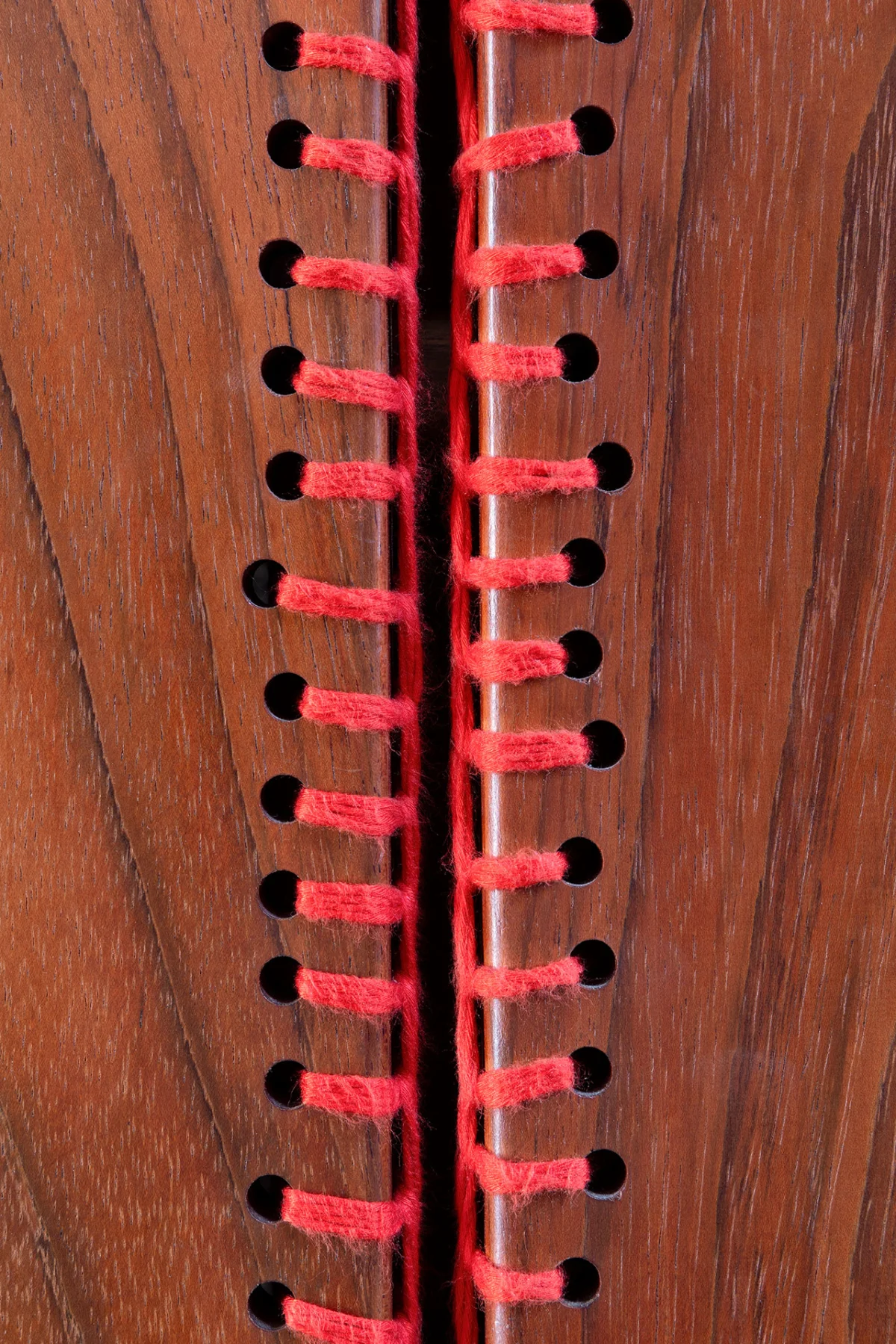
In an era increasingly dominated by mass production and the pursuit of flawless aesthetics, the "Emma In Paraty" cabinet by Treivas Team emerges as a poignant and quietly revolutionary statement in contemporary design. Conceived by founder Olga Treivas, this unique furniture piece transcends mere utility to become a tangible exploration of intuition, childhood wonder, and the profound beauty inherent in imperfection. Crafted with meticulous handwork in São Paulo, Brazil, from lustrous jatobá wood, the cabinet is distinguished by its vibrant red yarn embroidery, which not only provides a striking visual contrast but also embodies a deeply personal and philosophical narrative.
Reclaiming Childlike Experimentation in Adult Design
The impetus behind "Emma In Paraty" stems from a universal challenge: the difficulty adults face in recapturing the spontaneous, childlike experimentation that fuels intuition. Modern life’s relentless pace often stifles this essential muscle, pushing us towards efficiency and predictability. Olga Treivas, through Treivas Team, sought to counteract this trend by creating an object that embraces the "unfussy, organic, and quietly delightful" nature of creative exploration. Her design directly taps into a world of awe, reminiscent of her own childhood memories of embroidery. This approach is not merely nostalgic but a deliberate effort to integrate the purity and honesty of early creative impulses into high-end design, offering a refreshing counterpoint to conventional perfectionism.

The Treivas Team, under Olga Treivas’s leadership, has consistently championed a design ethos that prioritizes authenticity and narrative. While "Emma In Paraty" represents a significant articulation of this philosophy, the studio’s broader portfolio often reflects a sensitive engagement with materials, cultural context, and the human experience. Their projects frequently exhibit a thoughtful blend of traditional craftsmanship with contemporary forms, seeking to create pieces that resonate on an emotional level. Olga Treivas, a prominent voice in Brazilian design, has cultivated a reputation for designs that are both aesthetically compelling and imbued with deeper meaning, often drawing from her personal history and the rich cultural tapestry of Brazil. Her work frequently challenges conventional notions of luxury, advocating for a return to handcrafted quality and designs that tell a story, rather than simply occupying space.
The Craftsmanship: Jatobá Wood and Artistic Embroidery

At the heart of "Emma In Paraty" lies its exceptional craftsmanship and choice of materials. The cabinet is constructed from jatobá wood, commonly known as Brazilian cherry. Jatobá is a highly prized hardwood native to Central and South America, renowned for its incredible density, durability, and striking reddish-brown hue that deepens and develops a rich patina over time. Its fine, interlocked grain contributes to a naturally lustrous finish, making it a favored material for high-quality furniture, flooring, and architectural elements. The selection of jatobá for "Emma In Paraty" speaks to Treivas Team’s commitment to using indigenous, robust, and aesthetically rich materials that carry a sense of place and history. The wood is meticulously finished to enhance its inherent glow, allowing its natural grain to shimmer and adding depth to the piece’s overall presentation.
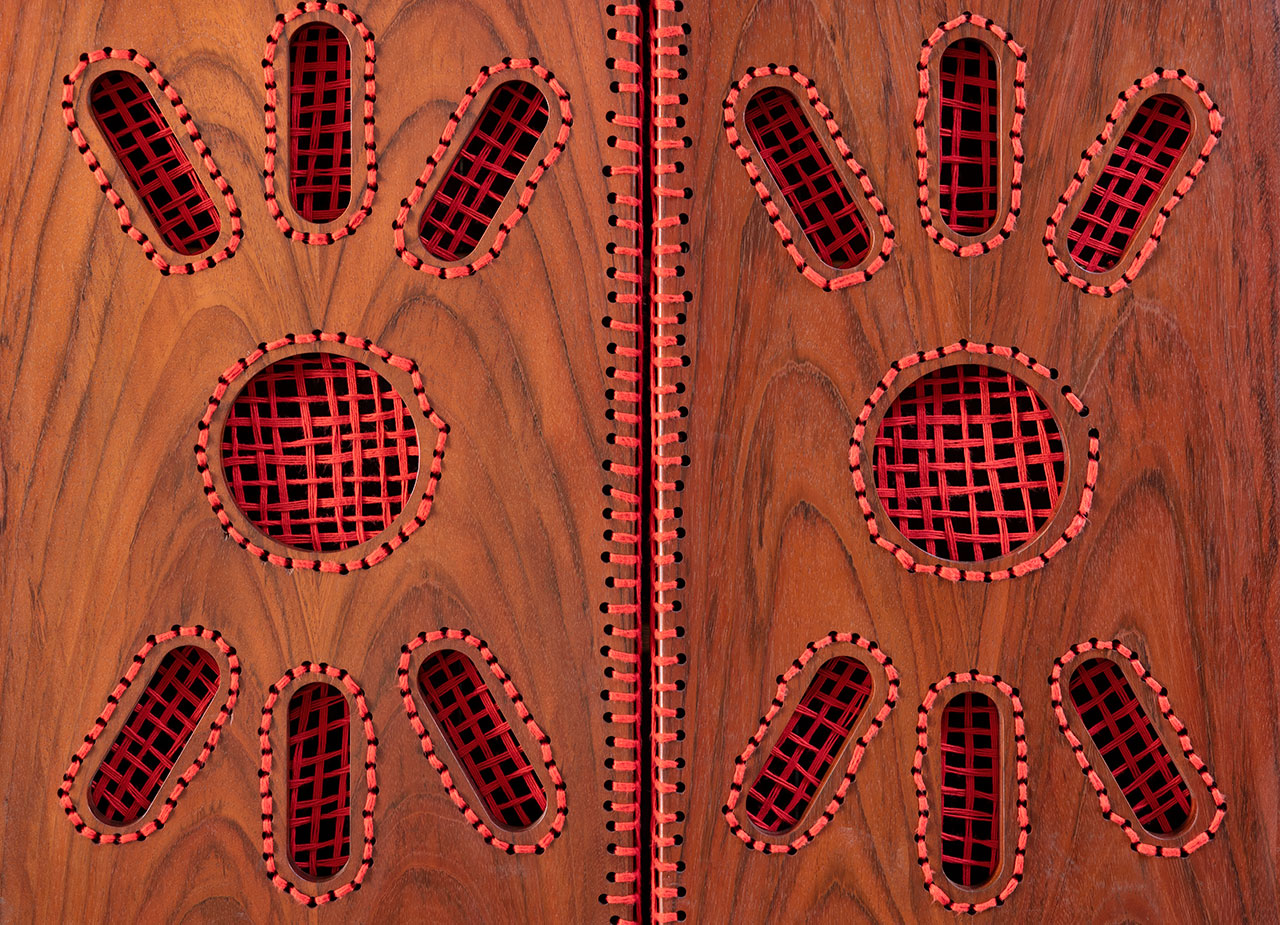
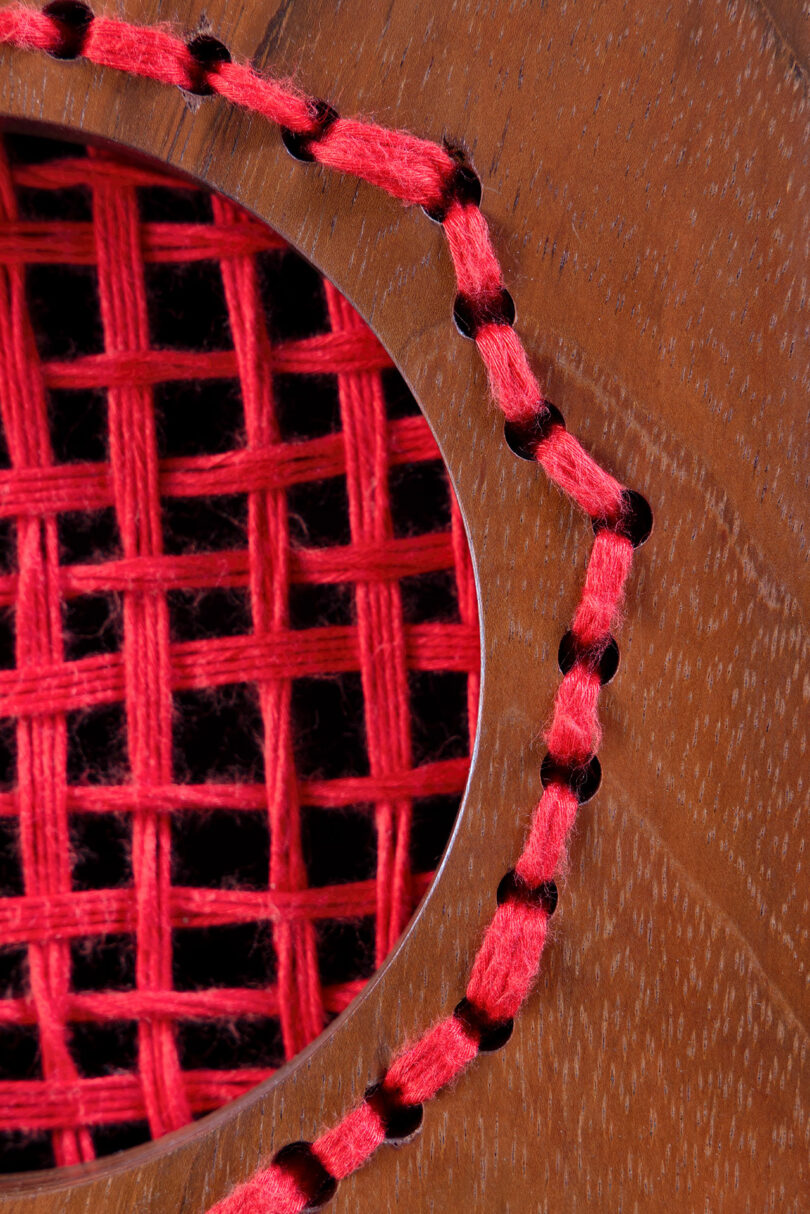
The standout feature, however, is the intricate red yarn embroidery. This element provides a vibrant and unexpected contrast to the deep tones of the jatobá wood, transforming the cabinet from a mere wooden structure into a canvas for textile artistry. The embroidery is not merely decorative; it is integral to the cabinet’s form and function, reminiscent of vintage speaker cabinets where screens allowed sound to escape. In "Emma In Paraty," this analogy is expanded and reinterpreted. The geometric cutouts, including sunburst patterns and a variety of oval and round apertures, are filled with finely woven red yarn, creating a permeable, textured surface. This "weave" plays a significant role in the organic nature of the handwork, blurring the lines between structural integrity and delicate ornamentation. Each embroidery point is individually rendered, ensuring that no two pieces are exactly alike, a testament to the bespoke nature of the creation. The large-scale application of this technique elevates traditional embroidery to an architectural scale, making it a prominent, rather than subtle, design feature.

The Philosophy of Imperfection: "Sol Na Peneira"
Perhaps the most compelling aspect of "Emma In Paraty" is its profound philosophical underpinning, articulated through a reinterpretation of a classic Brazilian idiom. Olga Treivas reveals that the objects have been jokingly, yet meaningfully, dubbed "sol na peneira" (sun in the sieve). This phrase directly challenges the traditional Brazilian saying, "tapar o sol com a peneira," which translates to "to cover the sun with a sieve." The original idiom is used to describe a futile attempt to hide something evident, an unsuccessful effort to conceal a mistake or a truth. It implies a foolish endeavor to mask the obvious.

Olga Treivas’s inversion of this saying – "sol na peneira" – transforms the meaning entirely. Instead of attempting to hide, the design embraces transparency and revelation. By allowing the "sun" (or truth, or imperfection) to shine through the "sieve" (the design, the craft), the piece openly admits and celebrates its inherent irregularities. This philosophy is evident in the visible "missed stitches" and "holes not exactly aligned." Far from being flaws, these elements are celebrated as features, making imperfection the strongest characteristic of the cabinet. This approach is described by Treivas as "honest, naive, and profoundly feminine," creating pieces that are "eye-catching in their sincerity."
This celebration of imperfection resonates with broader movements in design and art, such as the Japanese aesthetic of Wabi-sabi, which finds beauty in transience and imperfection, or the Arts and Crafts movement’s emphasis on handmade goods over industrial uniformity. In a world striving for digital perfection and machine-like precision, "Emma In Paraty" serves as a powerful reminder of human authenticity and vulnerability. It suggests that true beauty often lies not in sterile flawlessness, but in the unique marks of the human hand, the subtle variations that tell a story of creation and effort. This design encourages a more empathetic relationship with objects, inviting observers to appreciate the journey of its making, including its inherent "mistakes." It fosters a sense of connection, reminding us, as Treivas implies, of our shared humanity – "not only do we start at the same place, but we end in the same place, too."
Design Details and Functional Integration
Beyond its profound philosophical core, "Emma In Paraty" is also a meticulously designed piece of furniture that seamlessly integrates aesthetics with functionality. The overall form of the cabinet is elegant and robust, providing ample storage and display opportunities. The dynamic interaction between the rich jatobá wood and the vibrant red yarn creates a visual rhythm that is both energetic and harmonious. The various geometric cutouts, filled with the woven yarn, create a captivating play of light and shadow, adding textural interest and a sense of lightness to the otherwise solid wooden structure.

A notable functional detail is the shelf nestled in the bottom section of the cabinet. This shelf echoes the "cheeky style" of the main cabinet body, extending the embroidery downwards and integrating it into the lower structure. This design choice creates a cohesive visual flow and provides a dedicated space for display or storage. The bright red yarn on the shelf acts as a "warm spot to rest objects," forming a "physical hem of space." This thoughtful integration means that even the functional elements contribute to the overall artistic statement, making the cabinet not just a storage unit, but a curated stage for cherished possessions. The open, woven nature of some panels suggests a deliberate choice for items to be partially visible, or for the piece to serve as a subtle room divider, allowing glimpses through its intricate patterns.
The tactile interaction between the wooden borders and the yarn will evolve over time, offering a continuously unfolding aesthetic experience. The wood will deepen in color, and the yarn may subtly shift, telling a story of use and age. This inherent humanity in the material and its handcrafted assembly is part of the long-term joy the piece promises to its owner.

Inspiration from Childhood and Broader Implications
The deeply personal nature of "Emma In Paraty" is further underscored by its direct inspiration from Olga Treivas’s childhood. She recalls memories of "yarn tangled among construction pieces in a cupboard drawer," a vivid image of spontaneous creativity and discovery. This memory serves as a direct link to the "childlike experimentation" and "intuition" that the piece aims to evoke. It grounds the sophisticated design in a universal experience of play and nascent creativity, making it relatable and emotionally resonant.

The unveiling of "Emma In Paraty" by Treivas Team carries several significant implications for contemporary design and craftsmanship. Firstly, it champions the enduring value of handmade objects in an increasingly automated world. Each piece, being one of a kind, stands as a testament to the artisan’s skill and dedication, a stark contrast to the uniformity of industrial production. This aligns with a growing global appreciation for bespoke furniture and artisanal crafts, where consumers seek unique pieces with narratives and provenance. Data from market research consistently shows an increasing demand for handcrafted, sustainable, and culturally rich products, particularly in the luxury and high-end design sectors. "Emma In Paraty" perfectly positions itself within this niche, appealing to collectors and connoisseurs who prioritize artistry and authenticity over mass appeal.
Secondly, the cabinet challenges the prevailing design paradigm that often equates quality with perfection. By deliberately embracing irregularities and celebrating the human touch, it encourages a re-evaluation of aesthetic standards. This philosophical stance contributes to the broader "slow design" movement, which advocates for thoughtful, sustainable, and meaningful design processes that prioritize longevity and emotional connection over fleeting trends.

Thirdly, the project highlights the rich potential of cross-cultural dialogue in design. By reinterpreting a Brazilian idiom and drawing from local materials and traditions, Treivas Team creates a piece that is both deeply rooted in its specific cultural context and universally appealing in its message about humanity and authenticity. This fusion of local heritage with a global design philosophy positions "Emma In Paraty" as a significant contribution to the ongoing evolution of international design discourse.
In conclusion, "Emma In Paraty" is more than just a cabinet; it is a meticulously crafted artifact that embodies a profound design philosophy. It is an invitation to pause, to observe, and to appreciate the beauty in imperfection, the warmth of the handmade, and the quiet delight of an object that tells a story. Olga Treivas and the Treivas Team have created a truly remarkable piece that not only showcases exceptional skill in woodworking and textile art but also offers a timely reminder of our shared humanity and the enduring power of intuitive, honest design. The piece stands as a vibrant beacon for a design future that is both sophisticated and deeply sincere, challenging us to see the "sun in the sieve."

To learn more about Emma in Paraty by Olga Treivas, visit treivas.team.
Photography by Ruy Teixeira.







