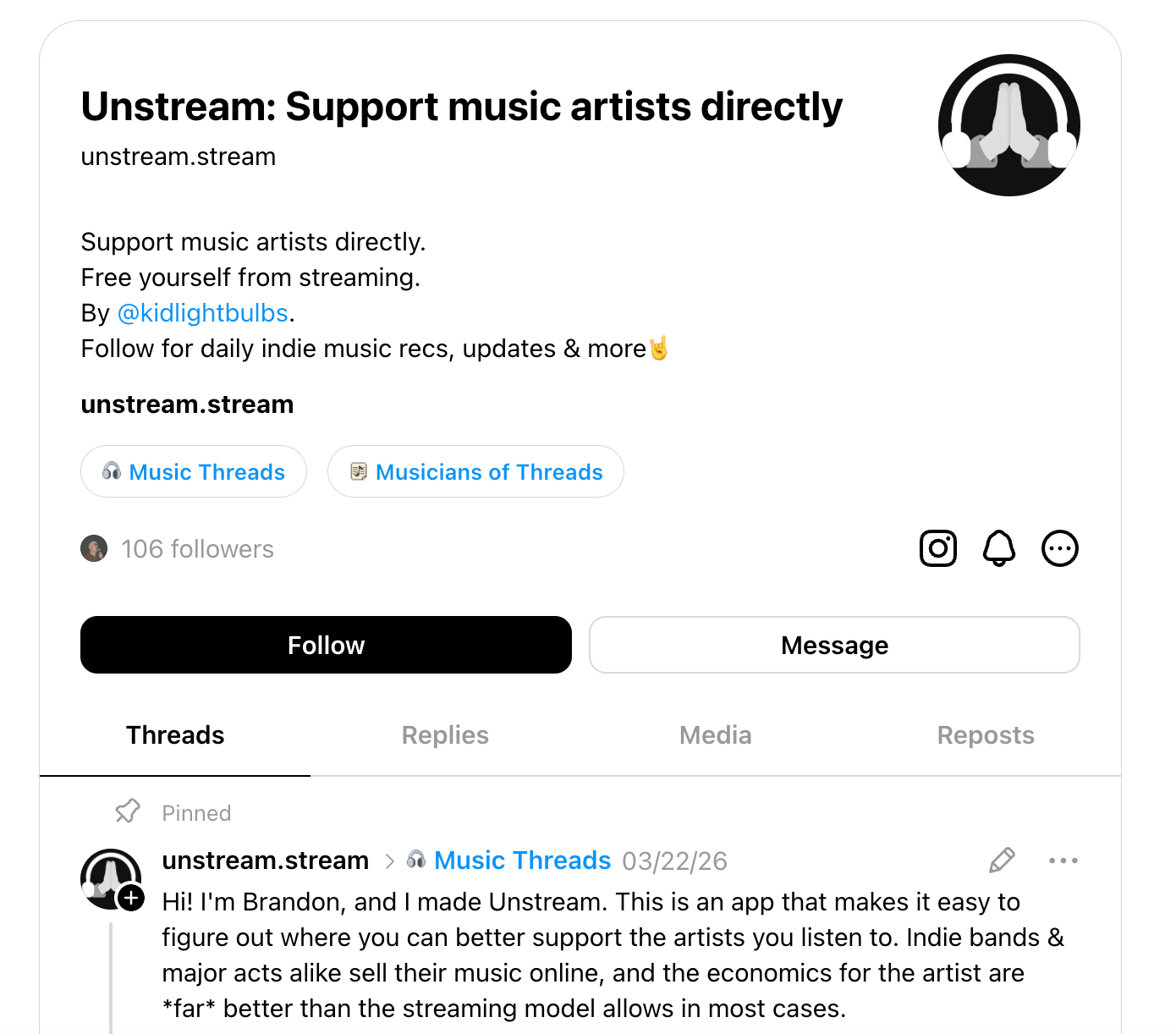
A solo founder behind Unstream, a platform dedicated to empowering music fans to directly support artists beyond conventional streaming applications, has successfully implemented a sophisticated automated content engine. This innovative system leverages existing product data and artificial intelligence to consistently generate 21 social media posts per week across Instagram, Threads, and Bluesky, effectively transforming a once-unsustainable marketing approach into a robust, self-sustaining operation. The initiative addresses a common challenge faced by independent developers: maintaining a strong online presence while prioritizing core product development.
The Genesis of Unstream and its Marketing Conundrum
Unstream, launched last year, emerged from a desire to create more direct and equitable avenues for artist support. In an era dominated by streaming giants where artists often receive minimal royalties, Unstream aims to connect fans with musicians through alternative platforms, enabling more substantial financial contributions. The project’s initial development was rapid, with the first iteration materializing over a single weekend. However, the subsequent focus on iterative improvements and technical refinements inadvertently pushed marketing efforts to the periphery.
The founder’s initial marketing strategy, candidly described as "impulse posting," involved spontaneously crafting and disseminating content across platforms like Threads and Instagram whenever an idea struck. While occasionally yielding positive results, this method proved inherently unsustainable. It frequently disrupted the primary workflow of product development, leading to inconsistent online engagement—a critical barrier for organic growth in the competitive social media landscape. This common predicament for solo founders and small teams underscored the urgent need for a more systematic and less resource-intensive approach to digital outreach.
Unlocking Hidden Content: Product Data as Raw Material

The breakthrough came with the realization that Unstream itself contained a wealth of untapped content. The product’s core functionalities had inadvertently generated two distinct yet highly valuable data pools, alongside a comprehensive log of development progress. These internal resources, initially conceived for product utility, were re-envisioned as the raw material for a dynamic content engine.
The first crucial data pool comprised a meticulously curated database of independent artists. Approximately a month prior to the automation’s conception, Unstream had introduced a feature allowing artists to claim and verify their profiles. This not only enabled musicians to curate their direct support links but also provided the platform with a clean, verified list of 114 active independent artists, complete with diverse avenues for direct fan support. This represented a rich, authentic source for promoting emerging talent.
The second data source involved a larger collection of more established artists. Utilizing an AI-assisted coding environment, Claude Code, the founder developed a script that pulled data from the WikiInfo and MusicBrainz APIs. While initially designed to enhance search engine optimization (SEO) by generating dedicated artist pages on Unstream, this script inadvertently created a vast pool of information on musicians beyond the nascent indie scene. These artists, positioned at a "second- or third-tier" of prominence—not global superstars like Taylor Swift, but widely recognized working musicians—represented a significant demographic whose fans might be unaware of direct support options outside of mainstream platforms. Crucially, the script filtered out inactive artists, ensuring the content highlighted contemporary musicians who could actively benefit from increased support.
A third, almost overlooked, content source was the internal "shipped features log." Every new feature deployed to Unstream was meticulously documented with its description, rollout date, and significance. This log served primarily as an in-app changelog but was also recognized as a continuous stream of relevant updates suitable for social media announcements, provided the time could be found to craft them.
The Technological Ecosystem Powering the Automation
The sophisticated content engine relies on a carefully selected stack of tools, each playing a vital role in the automated workflow:
- Claude Code: Serving as the foundational development environment, Claude Code was instrumental in building Unstream itself, including the scripts that populated the artist databases. Its continued use for the TypeScript automation that assembles social media posts from templates was a natural progression, eliminating context-switching and streamlining development. This highlights a growing trend in software development where AI-assisted tools enhance developer productivity and enable rapid prototyping of complex systems.
- Buffer API: As the central scheduling and publishing hub, the Buffer API receives the generated content and distributes it across Instagram, Threads, and Bluesky. Its robust API capabilities allow for platform-specific customizations, such as assigning Threads posts to the "Music" topic and appending relevant hashtags on Instagram and Bluesky, ensuring optimal visibility and engagement without manual intervention. Buffer’s role underscores the importance of robust social media management platforms in automating multi-channel marketing efforts.
- GitHub Actions: The automation’s orchestrator, GitHub Actions, ensures reliable and hands-off execution. A dedicated action, "schedule weekly social posts," is configured to fire every Monday at 9 a.m. This trigger initiates the TypeScript script, which calculates the upcoming calendar week’s content and proceeds with generation and scheduling. This serverless approach eliminates the need for manual triggers or recurring scheduled tasks, embodying a "set it and forget it" ethos crucial for solo founders.
- iA Writer: While the system operates autonomously, the founder maintains a level of oversight through iA Writer. All generated posts and the upcoming schedule are stored as Markdown files within the project’s repository, allowing for easy review and spot-checks in a distraction-free text editor. This step, though not strictly mandatory for the system’s operation, provides valuable assurance and the opportunity for minor adjustments if needed.
- MusicBrainz: Beyond its role in populating the established artist database, MusicBrainz serves as a critical, large-scale music database. It is utilized to retrieve comprehensive platform links and artist data, ensuring that the content pipeline draws from the same authoritative source as Unstream’s product search functionality. This consistency in data sourcing reinforces the authenticity and reliability of the generated content.
Inside the Automation: Generating 21 Posts Weekly
The automated workflow, initiated weekly by GitHub Actions, is a meticulously choreographed sequence designed for efficiency and content diversity:
Step 1: Strategic Artist Selection
Every Monday at 9 a.m., the TypeScript script begins by selecting six artists for the upcoming week’s content: three from the verified independent artist pool and three from the database of established musicians. The independent artists are drawn from the 114 musicians who have claimed their Unstream profiles, ensuring direct relevance and authenticity. The established artists are sourced from the extensive WikiInfo and MusicBrainz-generated pool, providing broader appeal. To ensure equitable exposure and long-term sustainability, each featured artist is flagged as "promoted." This mechanism prevents immediate repetition, ensuring that an artist will not be featured again until every other artist in their respective pool has had a turn. This intelligent deduplication layer is fundamental to preventing content fatigue and maximizing the utility of the artist databases.
Step 2: Constructing the Seven-Day Content Calendar
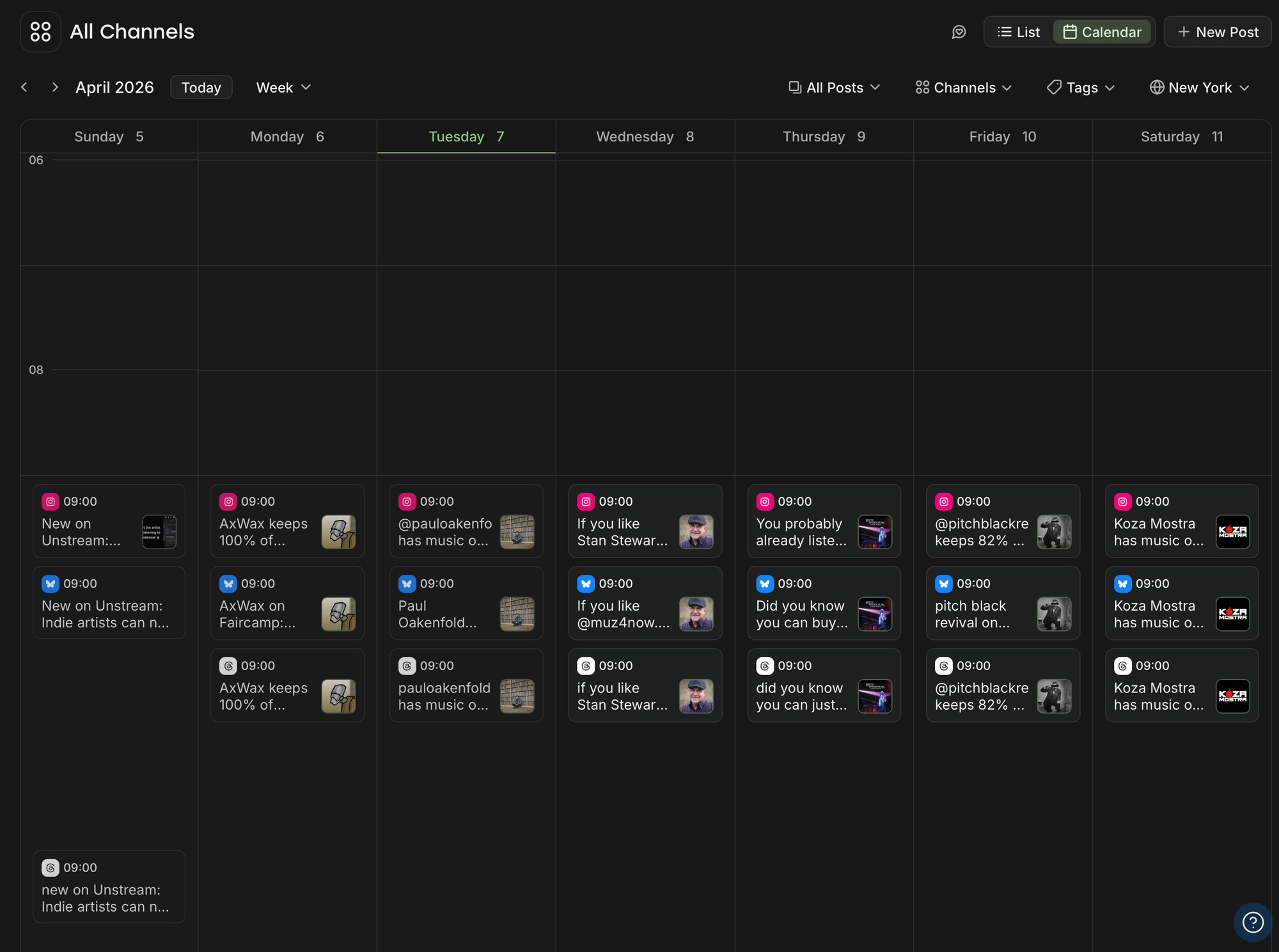
The six selected artists are then systematically organized into a seven-day content schedule, with one artist spotlight post scheduled per day. To maintain variety and audience engagement, independent and established artists alternate daily. The seventh day of each week is specifically reserved for a "feature spotlight," drawing from the aforementioned shipped features log. This structured approach ensures a balanced content diet, promoting both artists and product developments. This seven-day schedule is then replicated and adapted for each of the three target platforms—Instagram, Threads, and Bluesky—culminating in a total of 21 unique posts distributed weekly.
Step 3: Dynamic Post Content Generation
This phase represents the core of the TypeScript script’s heavy lifting. For each scheduled post, the script executes complex business logic: it automatically retrieves relevant artist information, such as Instagram handles if available, and compiles a list of platforms where fans can directly support them. The actual post copy is generated from a set of pre-defined, standard post templates. The messaging is strategically varied based on the artist’s tier:
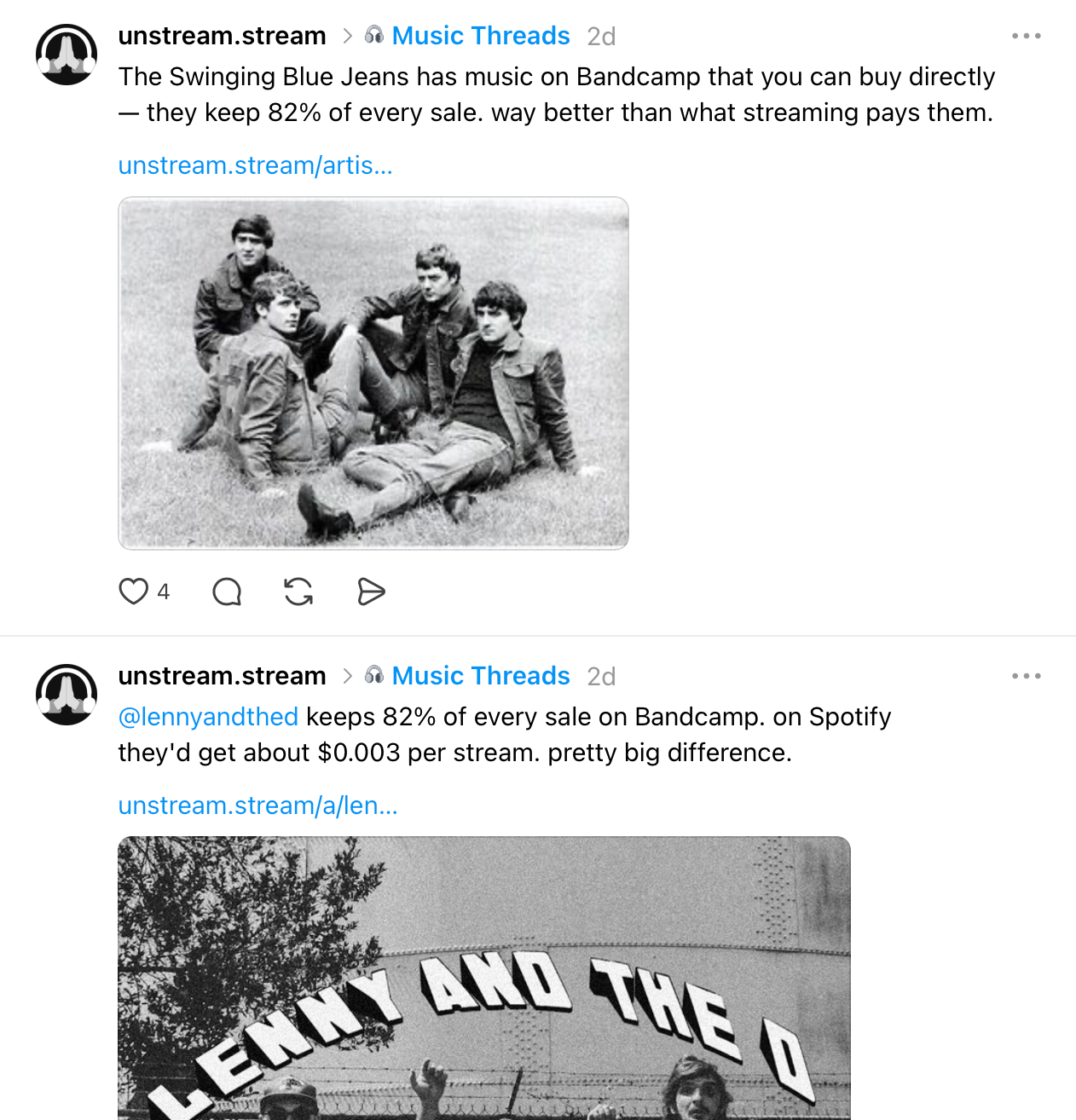
- For indie artists, the copy emphasizes exposure and awareness, inviting users to "check out this artist" and detailing "how you can support them."
- For established artists, the angle shifts to informing fans that artists they "love on Spotify" can be "supported better through these platforms," subtly advocating for direct patronage.
- Feature posts are straightforward, detailing "what’s new and why it matters" within Unstream.
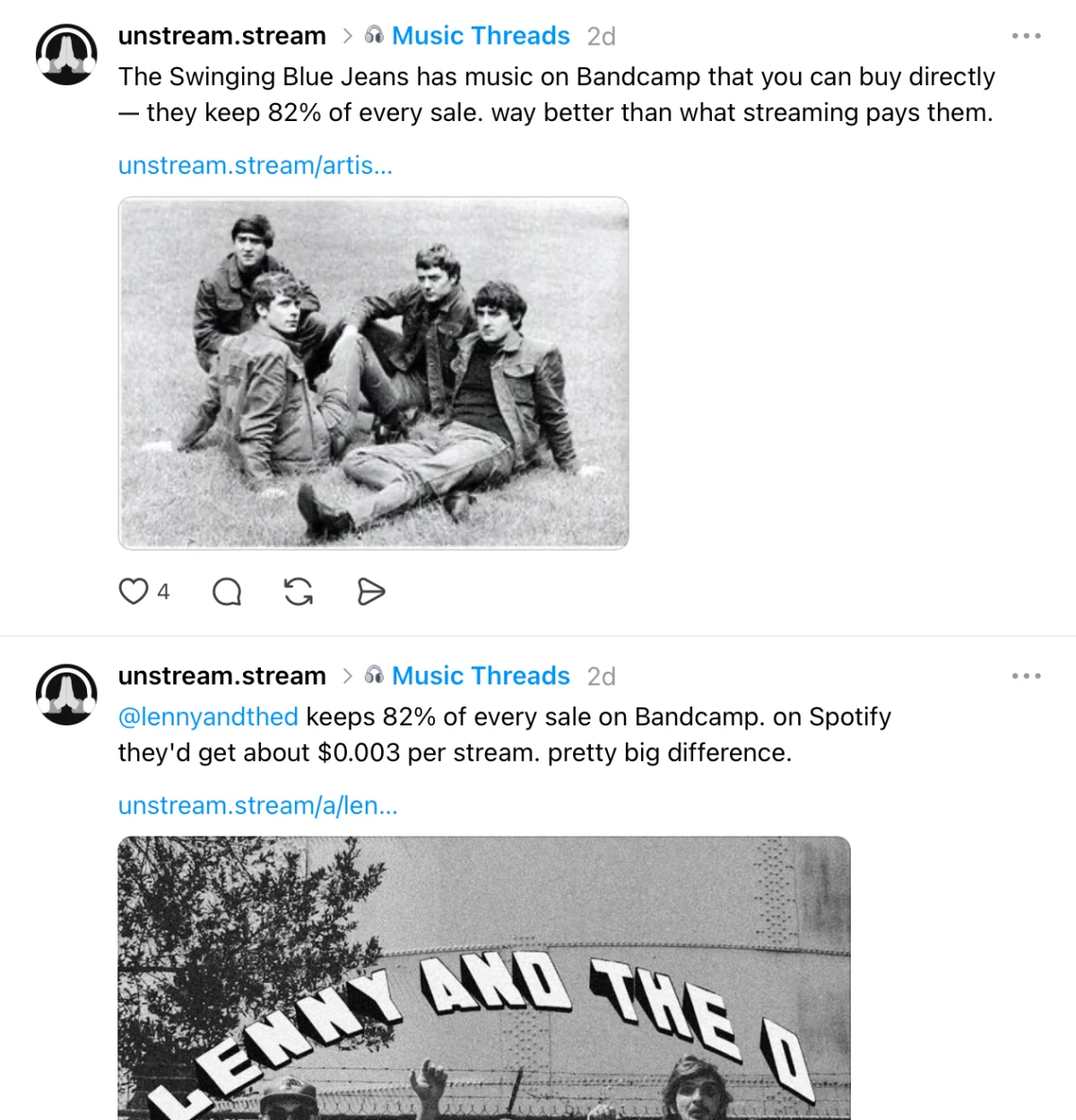
Artist photos are automatically pulled, either from their verified Unstream profiles or directly from the same search API that powers the platform, ensuring visual consistency. Platform-specific formatting is also handled automatically, with relevant hashtags applied for Instagram and Bluesky, and Threads posts categorized under the "Music" topic. The diversity of artists featured, ranging from emerging talents like "Neccos for Breakfast" to renowned composers such as "Steve Reich" and "Bear McCreary," showcases the breadth of the content pool.
Step 4: Seamless Scheduling via Buffer API
Upon completion of content generation, all 21 posts for the week are programmatically written and scheduled through the Buffer API. This ensures that posts land in the Buffer queue, ready for daily publication at 9 a.m. across all three social media platforms. The outcome is a fully populated content calendar in Buffer, requiring no further manual intervention from the founder.
Step 5: The Deduplication Layer for Long-Term Sustainability
The "deduplication layer" is the linchpin of the system’s long-term viability, preventing content stagnation and ensuring a continuously fresh stream of posts. As previously mentioned, every artist featured is flagged as "promoted," ensuring they are not re-selected until all other artists in their pool have been highlighted. Once the entire pool has cycled through, the "promoted" flags are reset, and the cycle recommences. A similar tracking mechanism is applied to the shipped features log: each entry includes a true/false "announced" tracker, which flips to true once the feature has been posted about. When all features have been announced, the entire list resets to false. This intelligent, self-resetting logic ensures that the content engine remains dynamic and relevant indefinitely. Crucially, this system naturally expands with the product; as more indie artists verify their profiles on Unstream and more features are shipped, the content pool grows organically, eliminating the need for manual content feeding and creating a synergistic relationship between product development and marketing.
Cultivating an Authentic Brand Voice with AI
A paramount concern for the founder was ensuring that the automated posts did not sound generic or overtly "AI-generated." The objective was consistency, but only if the content resonated with the founder’s authentic voice and passion for music. To achieve this, a deliberate process was undertaken to "teach" Claude Code the founder’s distinct communication style:
- Long-Form Training: Claude was first trained on the founder’s entire back catalog of published blog posts (from
bgreen.lol), providing a comprehensive understanding of their long-form writing style, analytical approach, and thought processes. - Short-Form Refinement: Subsequently, the last 50 Threads posts were fed into Claude, offering insights into the founder’s concise, conversational, and direct social media voice. This was crucial, as the automated posts would primarily be short-form.
- Tone Synthesis and Guidelines: Claude was instructed to study the tone across both content types, with a bias towards the Threads voice and shorter lengths suitable for social media. The directives emphasized adherence to key talking points related to music, artists, and Unstream.
The culmination of this training was avoice-and-tone.mdfile—a comprehensive set of guidelines describing the founder’s specific approach to discussing music and the Unstream project. Claude then proposed boilerplate templates, which the founder fine-tuned manually to perfection. This meticulous process ensures that while the templates provide structural consistency, the underlying voice guidelines infuse each post with personality, distinguishing it from generic press releases and making it sound like a genuine recommendation from someone passionate about the subject.
Initial Outcomes and Strategic Future Direction
The immediate engagement metrics for the automated posts—a handful of likes and reposts, with Threads posts garnering "a few dozen to a few hundred views"—are acknowledged as modest. However, these figures are viewed within the context of a larger, strategic goal. The primary objective of the automation was not immediate viral success but rather the establishment of unwavering marketing consistency. The transition from sporadic, impulsive posting to a consistent output of 21 posts per week across three platforms, without any additional manual effort, represents a significant achievement. This consistency is recognized as "Step 0" for any organic social media growth strategy, providing the necessary foundation for future engagement and audience expansion.
Crucially, the automation frees the founder to dedicate invaluable time and resources to Unstream’s core product development, rather than being perpetually sidetracked by marketing tasks. The system’s inherent ability to expand its content pool as more artists verify their profiles and new features are shipped ensures that the marketing pipeline grows synergistically with the product itself.
Looking ahead, the founder is already contemplating expanding the system to include TikTok, focusing on posting artist photos. The modular architecture of the current setup means that integrating a new platform primarily involves adding another API call, suggesting a relatively straightforward implementation and demonstrating the scalability of the automated approach.
Broader Implications and Actionable Insights for Developers
The Unstream project offers profound insights and actionable takeaways for any developer, entrepreneur, or small business grappling with consistent marketing, regardless of their specific technological stack.
- Content is Ubiquitous: The fundamental lesson is that valuable content often lies dormant within existing product data. Structured information—be it customer lists, project logs, testimonials, feature roadmaps, or partner directories—can be repurposed as the raw material for a potent content engine. The key is to shift perception and recognize these internal assets as external communication opportunities.
- The Power of the Two-Bucket Approach: The strategy of alternating between content that promotes others (artists) and content that promotes the product (features) is highly effective. This balanced approach prevents a social media feed from becoming a self-serving billboard, instead fostering a community-centric space that provides value to its audience. For a freelancer, this could translate to alternating between client success stories and lessons learned from projects. For a SaaS company, it might involve customer testimonials interspersed with product updates.
- Sustainability Through Deduplication: The intelligent deduplication layer is not merely a technical detail; it is the cornerstone of long-term sustainability. Without the logic to prevent content repetition and ensure a systematic cycle through the entire content pool, any automated system risks running out of fresh material within weeks. This distinction elevates a one-time content batching effort to a perpetually running content engine.
- Voice Guidelines are Non-Negotiable for AI: When leveraging AI for content generation, the establishment of clear, detailed voice and tone guidelines is paramount. Without this critical input, AI-generated content tends to be generic and lacks brand identity. With a well-defined voice file, the automation produces content that genuinely reflects the brand’s personality, sounding like a real person with authentic opinions and enthusiasm.
- Embrace "Good Enough": The philosophy of starting with "good enough" rather than striving for immediate perfection is crucial for solo founders. The primary achievement is consistency—going from zero to a significant volume of daily posts. The system’s ability to improve and expand organically with product growth means that initial engagement numbers, while important, are not the sole measure of success. Consistency builds audience, which then provides a platform for future optimization and growth.
The success of Unstream’s automated content engine serves as a compelling case study for the strategic integration of product data and AI in marketing. It demonstrates that even with limited resources, a thoughtful, automated approach can overcome common marketing hurdles, foster consistent online presence, and allow founders to focus on their core mission: building exceptional products. As Buffer continues to facilitate such innovations, resources like their developer documentation, API guides, and community support channels stand ready to empower the next wave of builders to unlock their own content engines.