
 Ali Ikhwan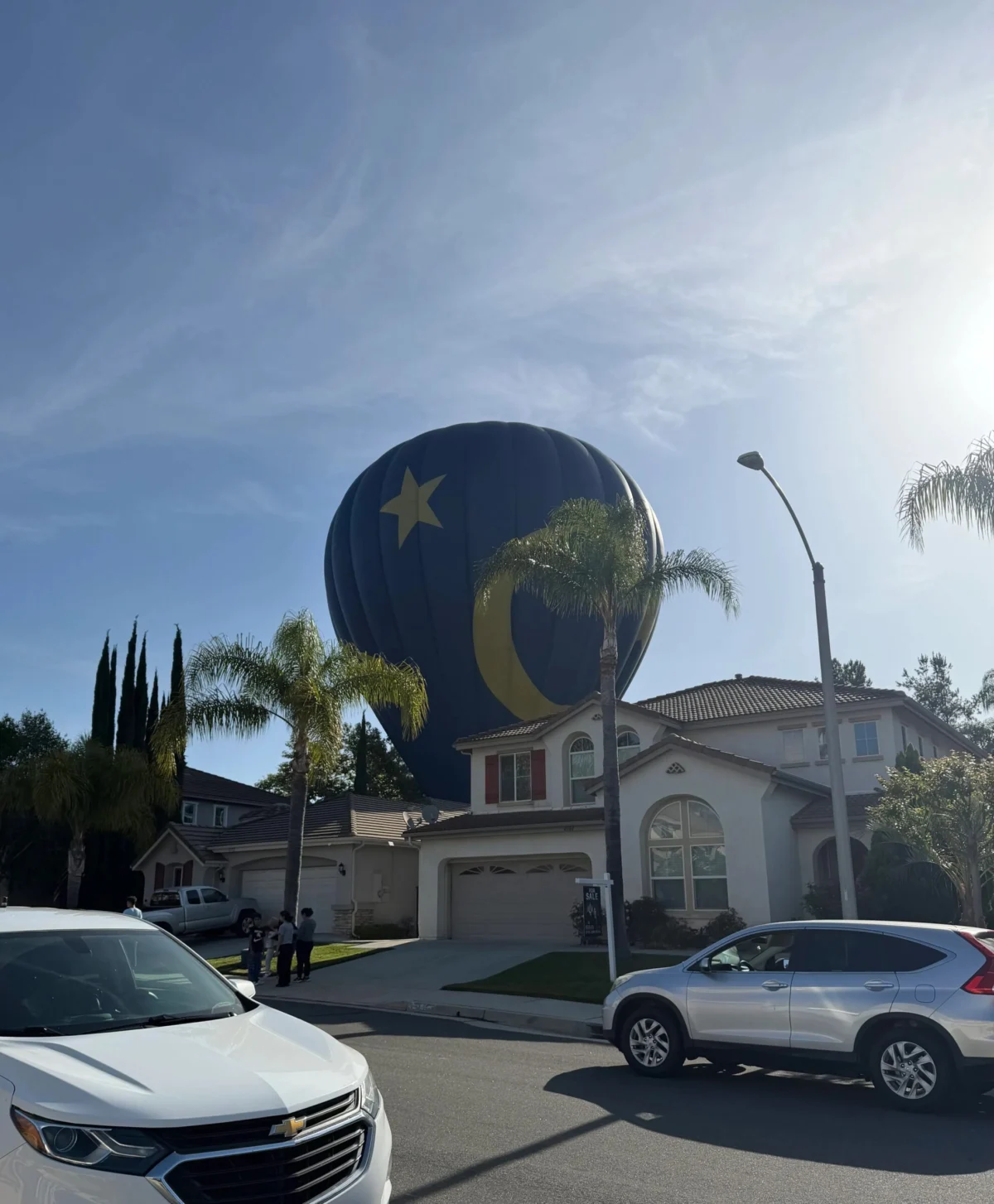
On a clear Saturday morning in Temecula, California, a routine aerial excursion transformed into a viral sensation when a large hot-air balloon made an unplanned landing in the backyard of a local residential property. The incident, captured by both home security systems and passenger smartphones, has sparked a broader conversation regarding the safety protocols, meteorological dependencies, and operational challenges inherent in the sport of hot-air ballooning. While such landings are rare in the industry, the event highlights the critical decision-making processes pilots must undertake when environmental conditions shift unexpectedly.
The balloon, operated by Magical Adventures Balloon Rides, was carrying approximately 10 passengers when it settled gently onto a patch of lawn in a neighborhood owned by Hunter and Jenna Perrin. According to Denni Barrett, the founder and CEO of the company, the landing was not the result of a mechanical failure or pilot error, but rather a strategic response to a rare meteorological phenomenon known as being "becalmed." In aviation terms, this occurs when wind speeds drop to zero across multiple altitudes, leaving the aircraft without the horizontal movement required to reach a traditional landing zone.
The Chronology of the Saturday Morning Incident
The flight began as a standard sunrise tour, a staple of the Temecula Valley’s tourism economy. Pilots typically launch early in the morning when the air is cool and stable. Before the ascent, the flight team conducted their standard "reverse engineering" of the flight path. This involves releasing a small helium-filled "pibal" (pilot balloon) and tracking its ascent with a compass and stopwatch to determine wind speed and direction at various altitudes. Based on this data, the pilot selects a launch site that, under predicted conditions, should lead to a landing in an open field or a designated recovery area approximately one hour later.
However, on this specific Saturday, the predicted winds dissipated entirely. After roughly an hour of flight, the balloon reached a state of stasis at approximately 3,000 feet. For the next 30 minutes, the pilot attempted to find air currents that would carry the vessel out of the residential corridor of Temecula. When it became clear that the balloon was stationary and fuel reserves were reaching a critical threshold for safe maneuvering, the pilot was forced to execute a "precautionary landing."
The descent began shortly after the hour mark of the flight. Navigating a hot-air balloon requires a high degree of precision in vertical control, though horizontal control is entirely dependent on the wind. By venting hot air through the parachute valve at the top of the envelope, the pilot was able to guide the basket into the Perrins’ backyard—a space large enough to accommodate the basket without risking contact between the massive blue nylon envelope and the surrounding structures or power lines.
Technical Analysis of "Becalmed" Conditions and Fuel Management
The primary challenge in hot-air ballooning is the lack of steerage. Unlike fixed-wing aircraft or helicopters, balloons move in a 1:1 ratio with the surrounding air mass. Pilots "steer" by ascending or descending to find different wind layers moving in different directions. When the air becomes "calm all the way up," as Barrett described the conditions on Saturday, the pilot is effectively trapped over a single geographic point.
Fuel management is the secondary critical factor in these scenarios. Hot-air balloons typically carry enough liquid propane to sustain a flight for 60 to 90 minutes, with a safety reserve. On this flight, the 30-minute delay caused by the calm winds meant the pilot was dipping into that reserve. The decision to land in a backyard, rather than waiting for a breeze that might never materialize, is a standard safety procedure designed to ensure the pilot maintains full control over the vertical descent. A landing made with remaining fuel is a controlled maneuver; a landing made after fuel exhaustion is a gravity-defined event that carries significantly higher risks.
Once the basket touched down, the ground crew, which follows the balloon in a "chase vehicle" equipped with GPS tracking, arrived at the residence. Because the balloon could not be deflated in the confined space of the yard without potentially draping over the house or fences, the crew brought additional fuel to the site. The passengers disembarked safely, and the pilot used the fresh fuel to hover the balloon just feet off the ground. Using "drop lines"—long ropes attached to the framework—the ground crew manually towed the inflated balloon from the backyard to a nearby street, where it could be safely deflated and packed.
Safety Records and Regulatory Context
The hot-air balloon industry is regulated by the Federal Aviation Administration (FAA). Pilots must hold commercial pilot certificates to carry passengers for hire, requiring hundreds of hours of flight time and rigorous testing on weather patterns, emergency procedures, and aerostatics. Magical Adventures Balloon Rides has operated in the region for over two decades, previously making headlines for its "Mile High Club" packages, but it maintains a focus on the technical precision of its flights.
Statistically, hot-air ballooning remains one of the safest forms of aviation. According to data from the National Transportation Safety Board (NTSB), balloon accidents are infrequent, and those that do occur are often related to contact with power lines during high-wind landings. The "becalmed" landing in Temecula stands in stark contrast to high-wind incidents; because there was no horizontal velocity, the impact was described by passengers as a "gentle bounce."
In the United States, the FAA’s Part 91 regulations govern general operating and flight rules. While landing on private property without prior permission is generally avoided, aviation law provides pilots with broad discretion during "emergencies" or "precautionary situations" to ensure the safety of the crew and passengers. In this instance, the homeowners, the Perrins, reported that the pilot and crew were professional and that the experience was more of a neighborhood curiosity than a nuisance.
The Economic and Social Impact of the Event
The viral nature of the landing—viewed millions of times across platforms like TikTok, Instagram, and YouTube—highlights the intersection of modern technology and traditional aviation. The presence of high-definition backyard security cameras has made it possible for such rare events to be documented from start to finish, providing the public with a rare look at the logistics of balloon recovery.
From a business perspective, the incident appears to have had a positive impact on the company’s reputation. Barrett noted that despite the unplanned landing, none of the passengers requested a refund. Instead, many expressed interest in flying with the same pilot again, citing his transparency and calm demeanor during the 30-minute stall. This reaction underscores a key psychological component of adventure tourism: customers often value safety and communication over the adherence to a strict itinerary.
Temecula Valley is a premier destination for ballooning in the United States, alongside regions like Albuquerque, New Mexico, and Napa Valley, California. The industry contributes significantly to the local economy, drawing thousands of tourists annually who stay in local hotels and visit the region’s wineries. Events like this, while unusual, reinforce the "adventure" aspect of the industry while demonstrating the efficacy of modern pilot training.
Broader Implications for the Ballooning Industry
The Temecula incident may lead to minor shifts in how ballooning companies communicate with residential areas. As urban sprawl continues to expand into traditionally open flight corridors, the likelihood of balloons interacting with residential neighborhoods increases.
For operators, the incident serves as a case study in "landowner relations." The successful outcome in this case was predicated on the pilot’s ability to communicate with the property owners immediately upon landing and the ground crew’s efficiency in clearing the area. Many ballooning organizations encourage "landowner hospitality" programs, where pilots carry bottles of champagne or gift certificates to offer to property owners whose land they use for landings.
In conclusion, the Saturday morning landing in Temecula was a textbook example of precautionary aviation. By prioritizing fuel management and passenger safety over the desire to reach a standard landing zone, the pilot avoided a potential emergency. The event serves as a reminder that even in an age of satellite-guided navigation and sophisticated weather modeling, aviation remains a discipline that must respect the unpredictability of the natural elements. The "becalmed" balloon of Temecula did not fail its mission; it simply completed it in a more public and localized fashion than originally intended.







