
 Indra Kusuma
As artificial intelligence, spatial computing, and immersive technologies transition rapidly from experimental concepts to integral components of daily life, a profound question has emerged for a diverse array of professionals, including designers, architects, technologists, and cultural institutions: What are the fundamental principles of designing for human beings within an increasingly immersive world? This critical inquiry formed the bedrock of the conversation titled "Immersive Spaces: Technology, Empathy & The Human Experience," a central feature of the Design Dialogues by Design Milk series at Clerkenwell Design Week 2026. The session explored a significant paradigm shift already underway within the design community: moving beyond the creation of spaces that people merely observe, towards crafting environments that individuals emotionally inhabit and actively engage with.
The Evolving Landscape of Immersive Technologies
The acceleration of technological advancements in recent years has set the stage for this transformative discussion. Artificial intelligence, once a domain primarily confined to research labs, now underpins everything from personalized recommendations to complex autonomous systems. Spatial computing, encompassing augmented reality (AR), virtual reality (VR), and mixed reality (MR), is no longer the stuff of science fiction but a burgeoning industry poised to redefine how humans interact with digital content and the physical world simultaneously. Reports from industry analysts indicate a robust growth trajectory for these sectors; for instance, the global AR/VR market is projected to reach hundreds of billions of dollars by the mid-2020s, with AI integration becoming a crucial driver for innovation across countless industries. This rapid evolution means that digital layers are increasingly being superimposed onto, and integrated within, physical spaces, creating a hybrid reality that demands a re-evaluation of design principles.
Historically, design, particularly architectural and interior design, has focused on aesthetics, functionality, and structural integrity. The user experience was often considered in terms of accessibility and visual appeal. However, the advent of pervasive computing and smart environments necessitates a deeper understanding of human psychology, behavior, and emotional responses. Environments are no longer static backdrops but dynamic, responsive entities. From AI-responsive retail environments that adapt product displays based on customer demographics and real-time behavior, to adaptive workplaces that adjust lighting, temperature, and even layout to optimize employee well-being and collaboration, the next generation of spatial design transcends mere aesthetics or efficiency. It is increasingly concerned with understanding and influencing human behavior, evoking specific feelings, fostering active participation, and upholding a new standard of ethical responsibility.
Clerkenwell Design Week 2026: A Nexus for Innovation
Clerkenwell Design Week, established as a leading independent design festival, has consistently served as a vital platform for showcasing cutting-edge design and fostering critical discourse within the global design community. Held annually in London’s design district, the event typically draws tens of thousands of visitors, including architects, designers, developers, and design enthusiasts. The 2026 iteration continued its tradition of anticipating future trends, with the Design Dialogues by Design Milk series specifically curated to delve into the most pressing challenges and opportunities facing contemporary design.

The inclusion of "Immersive Spaces: Technology, Empathy & The Human Experience" within the Design Dialogues lineup underscored the organizers’ commitment to addressing the ethical and experiential dimensions of emerging technologies. Event organizers, in their preliminary statements, highlighted the critical importance of proactive engagement with these themes, stating that "as technology advances at an unprecedented pace, it is incumbent upon the design community to lead the conversation on how these innovations can genuinely enhance, rather than detract from, the human experience. Clerkenwell Design Week 2026 is proud to host discussions that challenge conventional thinking and champion human-centric approaches." This sentiment aligns with a broader industry trend acknowledging that technological prowess must be matched by a deep understanding of its human impact.
"Immersive Spaces": Shifting the Design Paradigm
The central premise of the "Immersive Spaces" discussion posited that as immersive technologies become increasingly embedded within public spaces, workplaces, and cultural environments, the focus of conversation must shift decisively from the novelty of these technologies towards the profound responsibility that accompanies their deployment. The core question is no longer merely about the extent to which a space can become immersive, but rather how intelligently, ethically, and humanely it responds to the individuals navigating through it.
This shift represents a maturation of the discourse around immersive technologies. Early explorations often celebrated the spectacle—the sheer wow factor—of virtual worlds or augmented overlays. However, as these technologies permeate everyday existence, designers are now tasked with moving beyond superficial engagement. They are exploring how AI, spatial computing, and multisensory storytelling can converge to create environments that are not just visually compelling, but also adaptive, empathetic, and emotionally aware. These emergent spaces are envisioned as capable of responding to human behavior, attention spans, mood states, and expressed needs in real time. For example, a cultural institution might deploy an immersive exhibit that subtly alters its narrative or visual cues based on a visitor’s lingering gaze or detected emotional response, thereby deepening participation and fostering personal reflection. Similarly, public installations could become dynamic canvases, shifting their content to align with community events or ambient environmental conditions, creating a sense of shared belonging and contextual relevance.
From Aesthetics to Empathy: The New Design Imperative
The conversation at Clerkenwell Design Week 2026 illuminated why empathy is poised to become one of the most critical design principles of the next decade. Designers are increasingly recognizing that the power of immersive environments lies not just in their ability to captivate attention, but in their potential to foster deeper connections—not only between humans and technology, but crucially, between humans themselves. This evolution challenges creators to think more carefully about the intricate systems they are constructing.
Key questions that permeated the dialogue included:

- How can genuinely inclusive and accessible experiences be created within immersive frameworks, ensuring that technology serves all demographics, including those with diverse abilities?
- What strategies can be employed to encourage reflection, connection, and presence within immersive environments, rather than succumbing to the prevalent risks of distraction and information overload?
- What does it truly mean to design spaces that do not simply capture fleeting attention, but actively support human experience in more meaningful, enriching, and responsible ways?
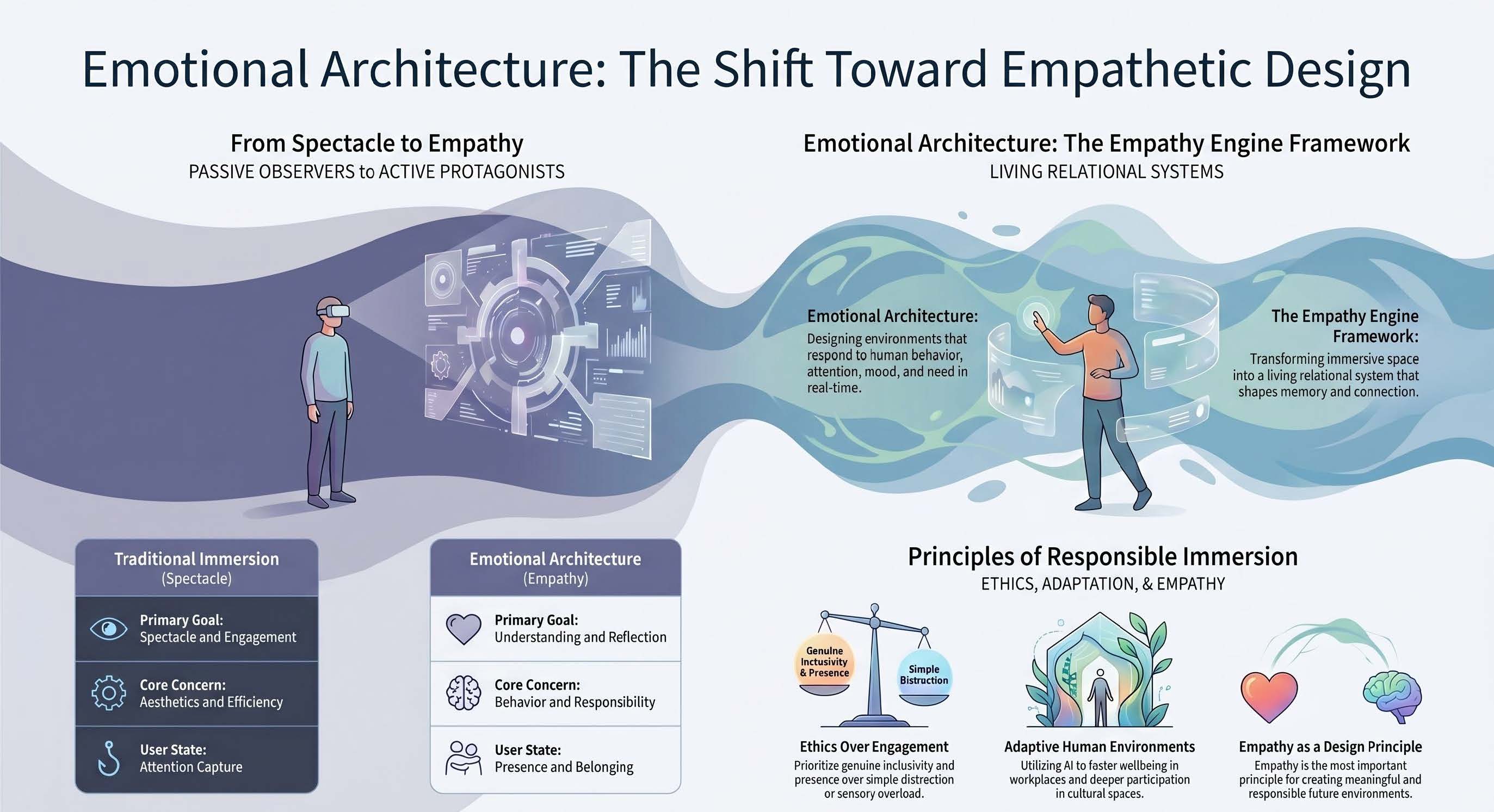
Rather than perceiving immersion as a spectacle in isolation, the discussion explored how these emerging technologies can facilitate the creation of responsive, participatory, and emotionally resonant spaces—environments designed not merely to impress audiences, but to genuinely understand, support, and even nurture them. This approach elevates immersive design beyond a purely technical endeavor, framing it instead as a form of behavioral and emotional architecture. This concept suggests that designers are not just shaping physical forms or digital interfaces, but are actively constructing systems that influence human feelings, actions, and memories.
Adipat Virdi’s Empathy Engine Framework
Central to the "Immersive Spaces" dialogue was the contribution of Adipat Virdi, a prominent voice in the field, who presented his "Empathy Engine Framework" methodology. Virdi argued compellingly that the most impactful immersive experiences are not those that overwhelm participants with technological prowess, but rather those that skillfully reposition people as active participants within meaningful systems of interaction. This framework, developed through extensive work spanning immersive theatre, XR (extended reality), AI-driven storytelling, and spatial experience design, provides a structured approach to operationalizing empathy within designed environments.
The Empathy Engine Framework transforms audiences from passive observers into emotionally and ethically engaged protagonists. Virdi elaborated on how this framework enables designers to systematically integrate empathetic responses into spatial design. This involves collecting and interpreting real-time data on user behavior, emotional cues, and environmental interactions, then using AI and spatial computing to dynamically adapt the environment to individual and collective needs. For instance, in an immersive narrative, the "engine" might detect signs of confusion or disengagement from a participant and subtly alter the narrative path or provide contextual clues to guide them, fostering a sense of agency and understanding. This methodology reframes immersive space not as a mere digital layer superimposed onto existing architecture, but as a living, relational system inherently capable of shaping human attention, influencing behavior, embedding memories, and fostering social connection.
Ethical Considerations and Responsible Immersion
The discussion at Clerkenwell Design Week 2026 was not solely focused on the capabilities of new technologies, but critically examined the ethical responsibilities inherent in their deployment. With AI-generated environments, responsive interfaces, and intelligent spaces rapidly becoming commercially viable, the conversation posed a crucial question: Will the future of immersive design merely optimize engagement and consumption, or can it be leveraged to cultivate understanding, reflection, and a profound sense of belonging?
Participants underscored the need for robust ethical guidelines to govern the development and deployment of immersive technologies. Concerns raised included data privacy (how personal data is collected and used to create responsive environments), algorithmic bias (ensuring AI systems do not perpetuate or amplify societal inequalities), and the potential for manipulative design (where immersive experiences are engineered to influence behavior without user consent or awareness). The consensus was clear: responsible immersion demands transparency, user agency, and a commitment to human well-being above all else. This proactive approach aims to mitigate potential negative consequences, such as digital addiction, social isolation, or the erosion of critical thinking in overly curated environments.
Implications for Future Living and Work
The insights gleaned from "Immersive Spaces: Technology, Empathy & The Human Experience" carry significant implications for the future of various sectors. In urban planning, the concept of "smart cities" could evolve beyond mere efficiency to include emotionally responsive public spaces that adapt to the mood and needs of their inhabitants, fostering stronger community bonds. In education, immersive learning environments could move beyond gamification to create truly empathetic pedagogical tools that respond to individual learning styles and emotional states, making education more personalized and effective. Healthcare could see a rise in therapeutic immersive experiences that help manage pain, anxiety, or rehabilitation, tailored precisely to a patient’s real-time emotional and physical responses.
The workplace, too, stands at the cusp of transformation. Adaptive offices could become not just productive hubs but sanctuaries that dynamically adjust to promote mental clarity, reduce stress, and enhance creative collaboration. Imagine a meeting room that intuitively adjusts its lighting and soundscape based on the energy levels of its occupants, or a personal workspace that offers guided relaxation when detecting signs of stress. This vision suggests a future where our environments are not just tools, but intelligent companions that actively support our holistic well-being.
The Road Ahead: Cultivating Understanding and Belonging
Ultimately, the session "Immersive Spaces: Technology, Empathy & The Human Experience" transcended a mere technical discussion about emerging technologies. It evolved into a profound conversation about the very nature of human experience and the kind of future we collectively aspire to build. It questioned the responsibilities that accompany the design of environments that increasingly think, respond, and even "feel" alongside us.
The enduring message from Clerkenwell Design Week 2026 is a call to action for designers, technologists, and policymakers alike: to prioritize human empathy and ethical considerations at every stage of immersive environment development. By embracing frameworks like the Empathy Engine, and by continuously asking how technology can foster genuine connection and understanding, the design community has the opportunity to shape a future where immersive spaces are not just technologically advanced, but deeply human, contributing to a world where technology enhances our collective sense of belonging and well-being. The challenge and the promise lie in transforming raw technological capability into a force for profound human flourishing.







