The integration of artificial intelligence within contemporary digital content workflows has evolved from a speculative novelty into an established industrial standard. Modern creative professionals, digital marketers, and enterprise content creators increasingly rely on generative models to bridge the gap between conceptual ideation and visual execution. Historically constrained by the dichotomy of expensive stock photography or bespoke graphic design, creators now have access to neural network architectures capable of rendering complex scenes, stylized illustrations, and typographic art within seconds.

However, the proliferation of available software platforms introduces a significant logistical challenge: discerning which generative model best aligns with specific professional requirements. To evaluate the state of the technology, a comprehensive benchmarking study was conducted across nine leading AI image generators: Nano Banana 2, Seedream, Recraft V4 Pro, Midjourney, Adobe Firefly 5, FLUX.2 Pro, Ideogram 3.0, GPT Image 1.5, and Lucid Origin. The evaluation centered on three distinct, commercially relevant use cases—an illustrated sticker sheet, a styled product photograph, and an embroidered typography graphic—providing rigorous qualitative data regarding prompt adherence, stylistic consistency, and technical reliability.
Evolutionary Context of Generative Visual Models
The commercialization of text-to-image synthesis began in earnest during the early 2020s, transitioning from research laboratories to commercial ecosystems at an unprecedented velocity. Over the preceding twelve months, the industry has shifted its primary bottleneck. Previously, technical limitations of the models themselves—such as warped anatomies, nonsensical text generation, and a failure to render coherent physics—hampered utility. Today, the primary obstacle for creators is no longer the capability of the software, but the precision and sophistication of the user’s input prompts.
Early models relied heavily on superficial stylistic descriptors like "photorealistic" or "high resolution," which frequently yielded generic or visually inconsistent results. As foundation models have grown increasingly complex, developers have integrated advanced reasoning capabilities, multi-modal semantic understanding, and specialized training datasets. This technological maturation allows modern architectures to process nuanced spatial relationships, complex multi-object prompts, and highly specific design parameters. Consequently, the competitive landscape has fragmented, with different models optimizing for distinct professional niches—ranging from strict commercial licensing compliance to high-end artistic expression and technical graphic design.
Methodology and Testing Parameters

To establish a controlled testing environment, all models were evaluated using standardized prompts designed to replicate genuine social media and marketing requirements. Rather than utilizing isolated web interfaces for every individual model, the study utilized Leonardo.ai as a central testing hub for models integrated within its ecosystem, while evaluating Midjourney, Recraft, and Adobe Firefly as native, standalone platforms. The most recent commercially available version of each model was utilized.

The evaluation framework focused on three specific visual assets:

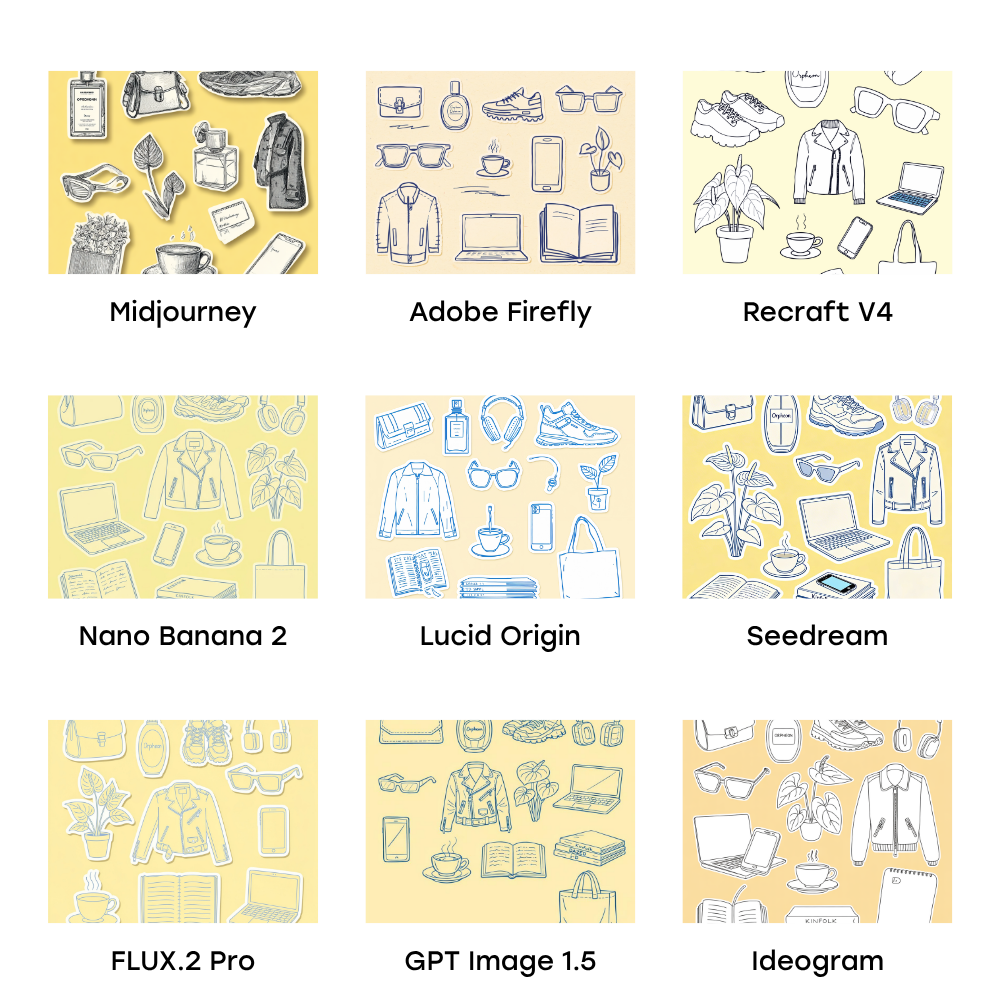
- An illustrated sticker sheet featuring thirteen distinct, highly specific objects (including a structured clutch, a specific perfume bottle, trail running sneakers, and transparent headphones) rendered in a minimalist, single-color line art style on a designated background color.
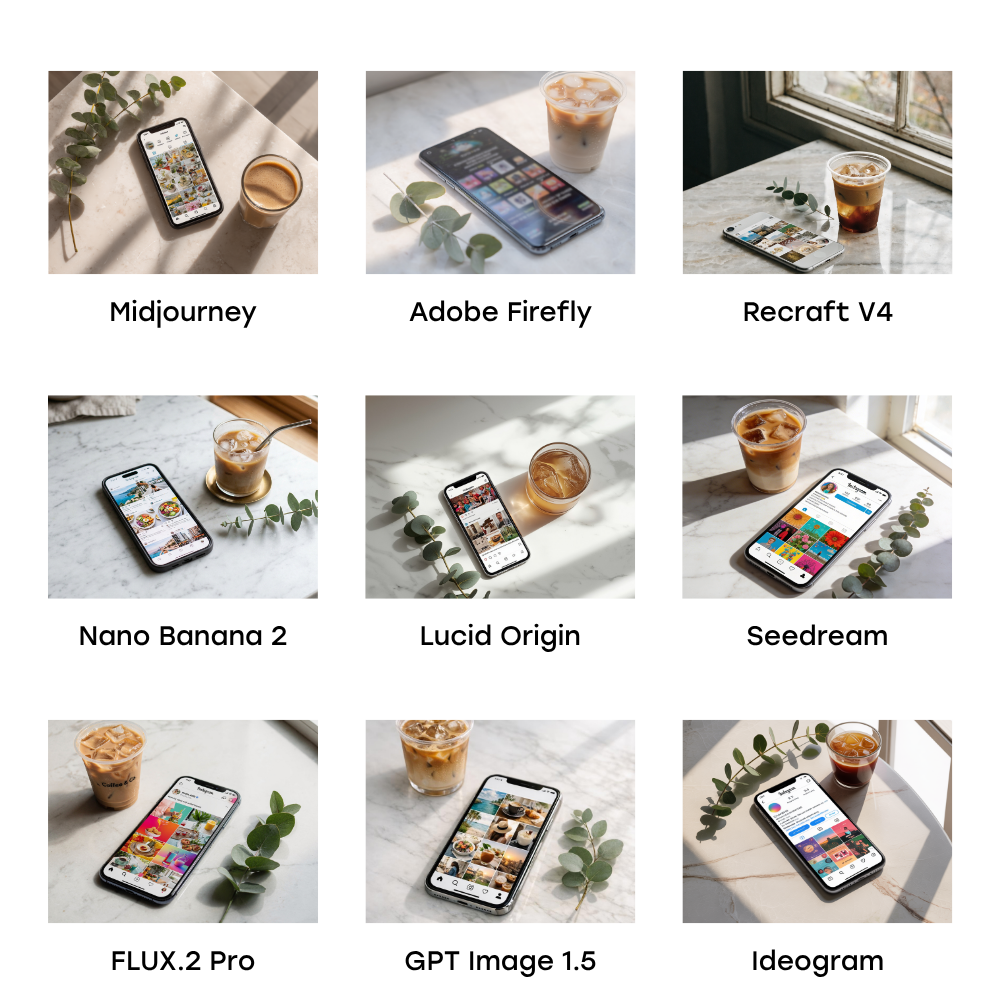
- A photorealistic product flat lay depicting a modern smartphone displaying a social media feed, accompanied by an iced beverage and botanical elements on a marble surface.
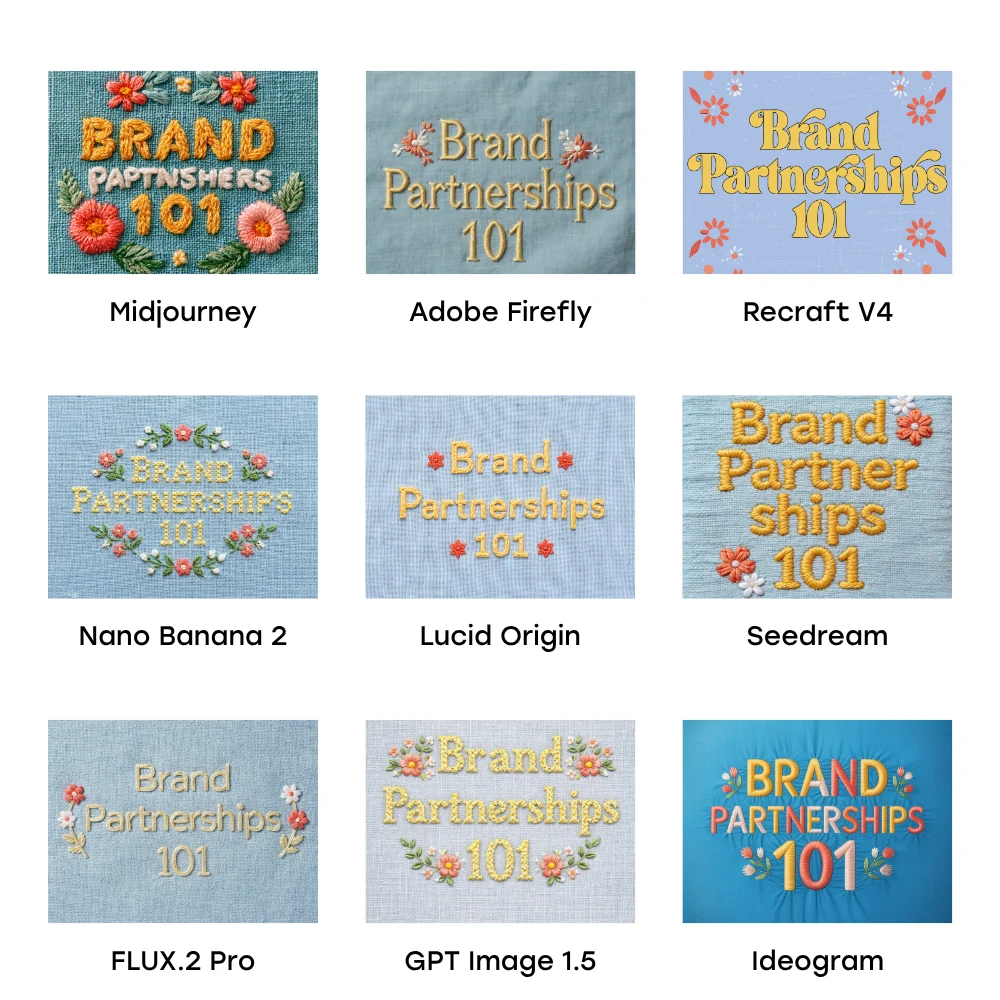
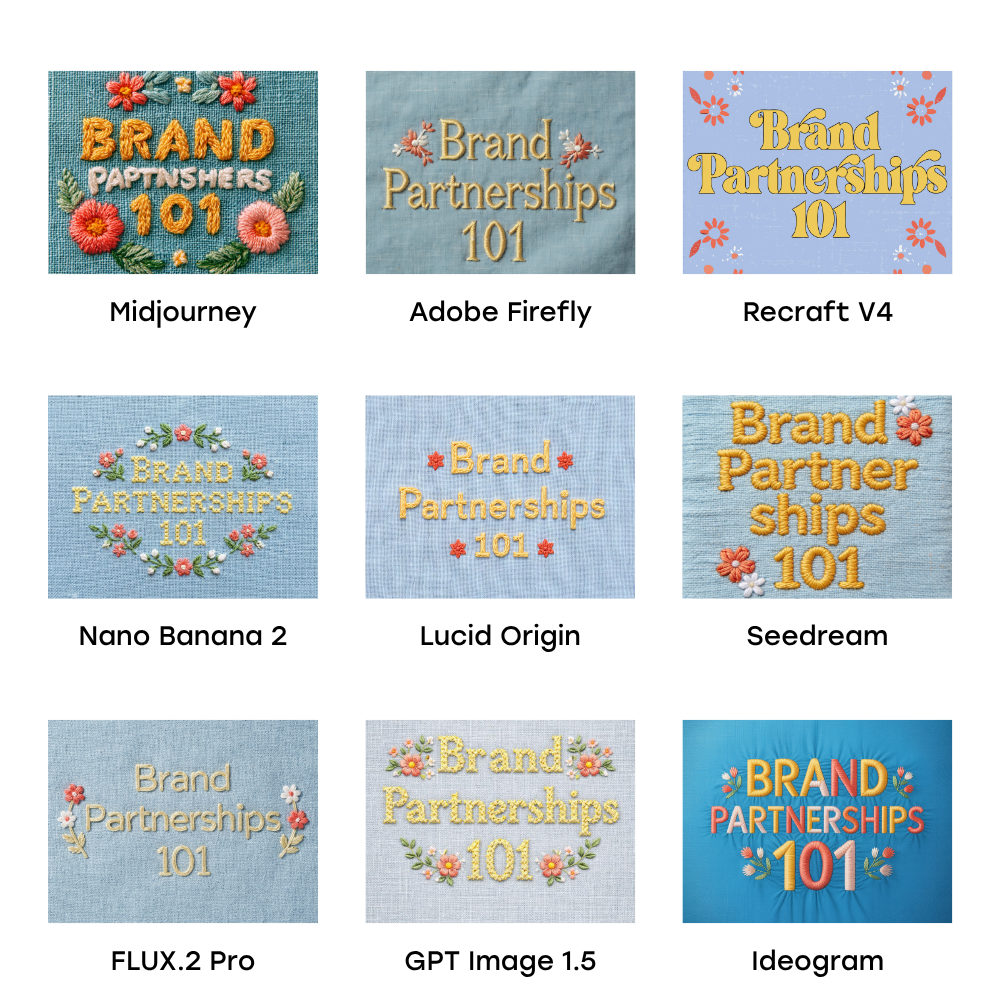
- A typographic graphic showcasing specific text ("Brand Partnerships 101") rendered with realistic fabric and embroidery textures.
Detailed Comparative Analysis of the Nine AI Image Generators

Nano Banana 2 (Google)
Positioned as a premier model for precision and object fidelity, Nano Banana 2 demonstrated exceptional capability in rendering specific real-world objects without distortion. Developed within Google’s model ecosystem, it successfully identified niche brand references and specific consumer goods within the illustration prompt. Its handling of proportions, spatial distribution, and stylistic constraints established it as the most consistent overall performer across all three test categories.

Seedream (ByteDance)
Integrated within the CapCut ecosystem, Seedream emerged as a standout model for text generation and graphic layout precision. While its photorealistic rendering of complex devices (such as smartphones) exhibited minor structural artifacts, Seedream excelled in typography and textual accuracy. Every requested label and spelling constraint within the illustration prompt was reproduced without error, making it a valuable tool for digital marketers requiring exact textual integration.

Recraft V4 Pro
Engineered specifically with designers in mind, Recraft V4 Pro offers advanced structural controls, extensive design system references, and support for precise color hex codes. Utilizing its Vector Pro model for the illustration test yielded clean, vector-adjacent outputs with strong adherence to minimalist aesthetics. Although minor compositional inconsistencies appeared during complex photorealistic tests, Recraft’s agentic refinement tools and style-matching capabilities provide professional designers with unprecedented granular control.

Midjourney
Long recognized as the industry benchmark for artistic richness and atmospheric depth, Midjourney produced visually striking compositions that prioritized mood over literal prompt compliance. While its rendering of lighting, texture, and emotional resonance remains superior, Midjourney struggled significantly when tasked with rendering complex, multi-object inventories, frequently omitting or misinterpreting individual items. Furthermore, its capacity for rendering extended text strings remains limited compared to dedicated text-focused models.

Adobe Firefly 5
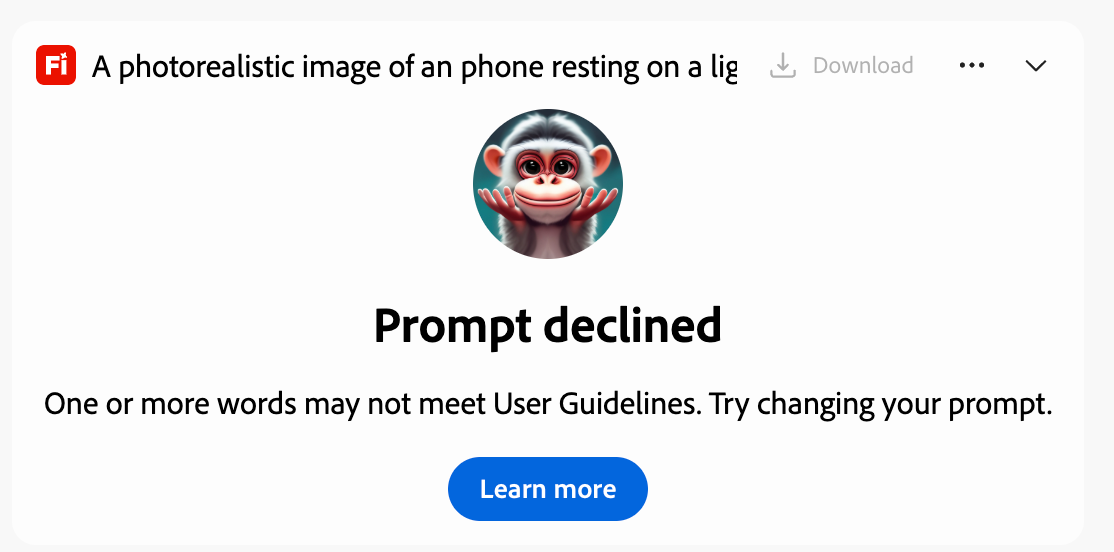
Designed explicitly for integration within commercial workflows, Adobe Firefly 5 prioritizes copyright safety and legal compliance. During testing, the model actively restricted the generation of specific trademarked brand names (such as "iPhone"), reflecting Adobe’s commitment to indemnifying enterprise users against intellectual property claims. While this restriction occasionally hampers specific product replication, Firefly’s outputs in textured typography and illustrative design demonstrated high technical competence and seamless cross-application compatibility.

FLUX.2 Pro
Operating as a high-performance model accessible via third-party platforms, FLUX.2 Pro demonstrated a unique aptitude for creative interpretation and sophisticated lighting physics. The model excelled in handling complex shadow casting and surface reflections within the product photography benchmark. Although its stylistic choices occasionally departed from strict minimalist guidelines, the resulting images possessed a distinct, professional aesthetic.

Ideogram 3.0
Marketed heavily as a solution for text-heavy graphic generation, Ideogram 3.0 delivered mixed results in the standardized tests. While it maintained strong foundational capabilities in structural layout and lighting, its execution of specific color profiles and botanical accuracy fell short of competitors like Nano Banana 2. Nevertheless, its structural stability makes it a viable secondary option for marketing teams requiring basic textual overlays.

GPT Image 1.5 (OpenAI)
Leveraging OpenAI’s native image generation architecture, GPT Image 1.5 offers high operational convenience for users already embedded within the ChatGPT ecosystem. However, when subjected to highly complex, multi-element prompts involving significant negative space (such as the expansive sticker sheet inventory), the model exhibited compression artifacts and localized rendering failures, indicating limitations in spatial management.

Lucid Origin
Lucid Origin prioritized rapid generation speeds and distinctive dimensional rendering, producing graphics with a noticeable 3D physical quality. While its literal interpretation of top-down perspectives was accurate, its fidelity to specific object details and internal text rendering revealed structural weaknesses, positioning it primarily as a tool for inspirational ideation rather than finalized production assets.

Comparative Matrix of Evaluated Generative Models

| AI Generator | Primary Target Use Case | Distinctive Technical Strength |
|---|---|---|
| Nano Banana 2 | Overall Object Accuracy | Exceptional consistency in rendering real-world branded items and precise illustration styles. |
| Seedream | Typography & CapCut Integration | Flawless textual spelling, layout precision, and multi-element alignment. |
| Recraft V4 Pro | Professional Graphic Design | Advanced style referencing, vector generation, and precise color palette adherence. |
| Midjourney | Artistic & Atmospheric Visuals | Superior visual richness, lighting dynamics, and mood-driven aesthetic outputs. |
| Adobe Firefly 5 | Enterprise & Adobe Ecosystem | Clean commercial licensing, legal indemnification, and native Photoshop/Illustrator integration. |
| FLUX.2 Pro | Creative Liberty & Physics | Advanced shadow handling, surface texture realism, and independent stylistic interpretation. |
| Ideogram 3.0 | Text-Heavy Layouts | Reliable fundamental text placement for basic marketing collateral. |
| GPT Image 1.5 | Ecosystem Convenience | Streamlined workflow integration for existing OpenAI subscribers. |
| Lucid Origin | Dimensional Textures | Distinctive 3D visual depth and rapid generation intervals. |
Economic Implications, Commercial Rights, and Copyright Realities
The widespread adoption of generative visual software introduces critical economic and legal considerations for corporate entities and independent creators alike. While the majority of platforms offer tiered subscription models—ranging from daily refreshing credit pools to unmetered enterprise accounts—the legal status of the output assets requires careful navigation.

A critical distinction must be drawn between commercial use rights and legal copyright ownership. Current legal precedent, notably established by regulatory bodies such as the United States Copyright Office, dictates that the mere generation of an image via text prompts does not confer legal authorship upon the user. Consequently, organizations utilizing AI-generated imagery for core brand assets cannot legally prevent competitors from utilizing identical or substantially similar outputs generated via parallel prompting.

Furthermore, free-tier access models frequently mandate that user inputs and corresponding outputs remain in the public domain, exposing proprietary concepts or unreleased marketing campaigns to public visibility. Enterprises operating within regulated sectors must therefore secure paid commercial tiers that guarantee data privacy, explicit commercial usage rights, and indemnification against potential intellectual property disputes.

Implications for Content Creators and Marketing Workflows

The empirical findings of this evaluation indicate that AI image generators are no longer supplementary novelties, but foundational infrastructure for digital content creation. However, they do not currently serve as complete replacements for traditional photography or bespoke graphic design. Instead, their optimal application lies in the rapid generation of supporting graphics, mood boards, conceptual mockups, and localized social media assets.

As foundation models continue to integrate advanced reasoning capabilities, the reliance on hyper-specific prompt engineering will gradually diminish, replaced by intuitive, conversational design refinement. For marketing agencies and corporate communications teams, the immediate imperative involves establishing standardized internal prompt libraries, vetting software vendors for strict commercial licensing compliance, and balancing automated generation with human-led brand curation to maintain distinct visual identities in an increasingly saturated digital marketplace.