The digital marketing landscape is undergoing a permanent behavioral shift, and professional networking habits are no exception. According to comprehensive new research released by social media management platform Buffer, the optimal window for maximizing engagement on LinkedIn has migrated decisively away from traditional business hours. An exhaustive analysis of 4.8 million posts processed through the platform indicates that professionals are increasingly consuming and interacting with career-oriented content after they have closed their laptops for the day.
For digital strategists, corporate communications teams, and independent creators, these findings challenge long-held assumptions about professional online behavior. While previous annual metrics pointed squarely to a 9-to-5 posting rhythm, the current data reveals a new standard: late afternoon and evening hours are now driving the highest engagement rates across the platform.
Methodology and Comparative Context
To establish these findings, Buffer’s data science team, led by Julian Winternheimer, evaluated a massive dataset comprising 4.8 million organic posts submitted over a two-year observation period. This extensive sample size allows for granular insights into user activity patterns across diverse global markets.
To ensure practical utility for digital marketers, all analyzed timestamps were normalized by local time zones. Consequently, a recommended publication time of 4:00 p.m. functions as a localized target, eliminating the need for complex global time zone conversions.
The contrast between recent historical data and current figures highlights a broader evolution in digital consumption. Throughout 2025, peak LinkedIn engagement was almost entirely confined to standard working hours, experiencing a sharp decline immediately after 5:00 p.m. This temporal restriction mirrored early-era professional norms where networking was strictly perceived as an office-hours activity. However, the 2026 data shows LinkedIn aligning closely with behavioral trends previously observed on consumer-centric networks like Instagram and TikTok, where evening engagement consistently reigns supreme.
The Shift to Evening Peak Engagement
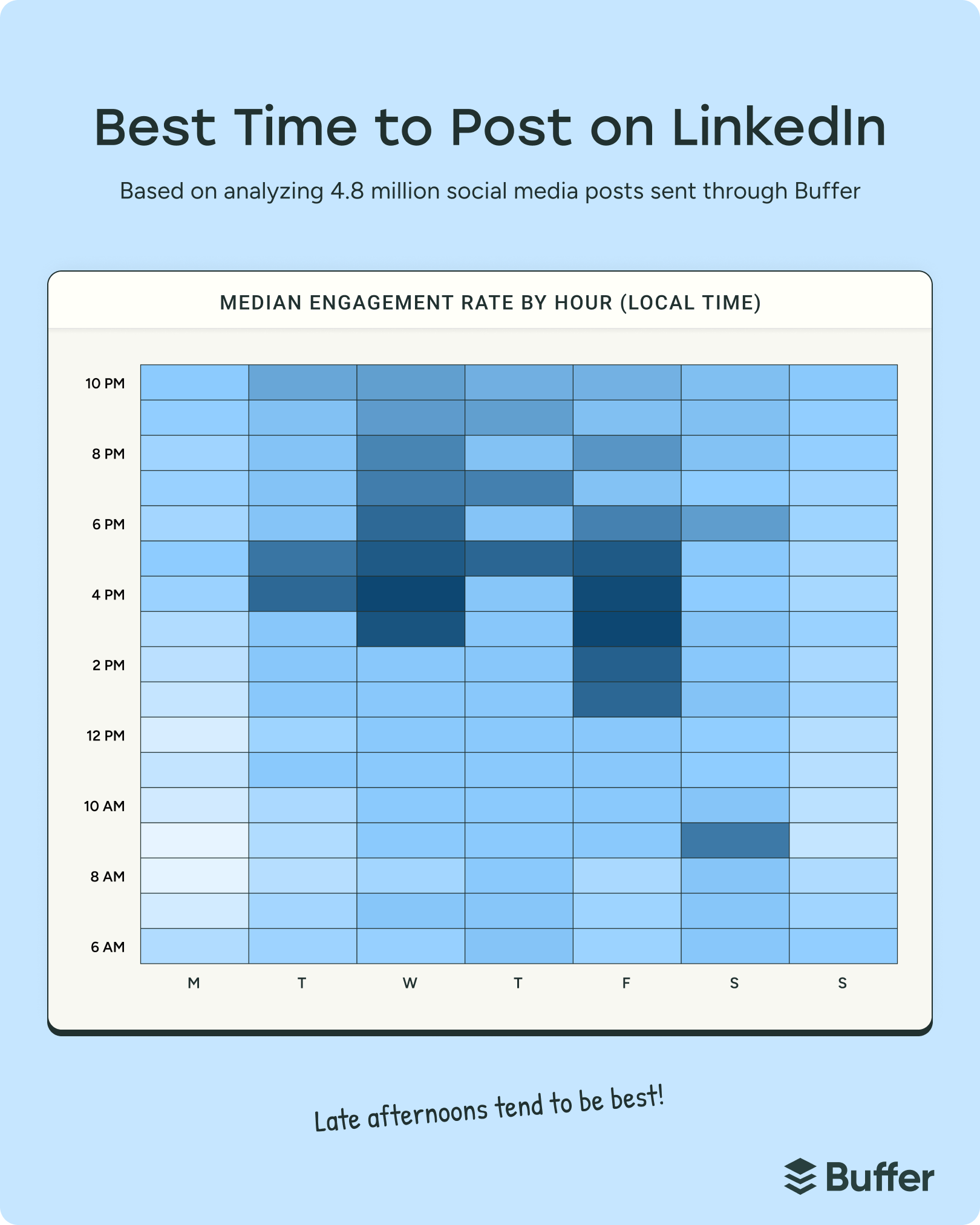
The core finding of the 2026 study is that the best overall time to post on LinkedIn is generally between 3:00 p.m. and 8:00 p.m. on weekdays. Within this broad window, Wednesday at 4:00 p.m. emerged as the single strongest time slot of the entire week. Friday afternoon also demonstrated exceptional performance, with 3:00 p.m. and 4:00 p.m. securing high interaction rates.
Rather than indicating casual or passive browsing, industry analysts suggest that late-day activity reflects a deliberate shift in how professionals process information. Users winding down their workday or navigating evening commutes are frequently engaging with thought leadership, industry insights, and career development resources with greater intent. This reflective state of mind often translates into higher-quality interactions, such as thoughtful commentary and substantive professional discourse, rather than simple passive consumption.
Conversely, the data notes a distinct cooling off for morning publications. Content shared between 6:00 a.m. and 11:00 a.m. generally yields lower engagement levels than its afternoon and evening counterparts. While midday pockets—such as traditional lunch breaks—still maintain moderate performance, they no longer represent the dominant engagement spikes observed in prior years.
Daily Breakdown of Optimal Publishing Windows
Analyzing performance on a day-by-day basis provides content planners with a reliable framework for weekly scheduling:
- Monday: Engagement tends to lag as professionals manage the initial influx of weekly tasks. The top performing slots are concentrated later in the day, specifically at 10:00 p.m., followed by 5:00 p.m. and 9:00 p.m. Strategic communicators are advised to reserve high-priority campaigns for later in the week.
- Tuesday: Similar to Monday, Tuesday sees comparatively lower overall engagement. The strongest time slots occur late in the workday and evening, led by 4:00 p.m., 5:00 p.m., and 10:00 p.m.
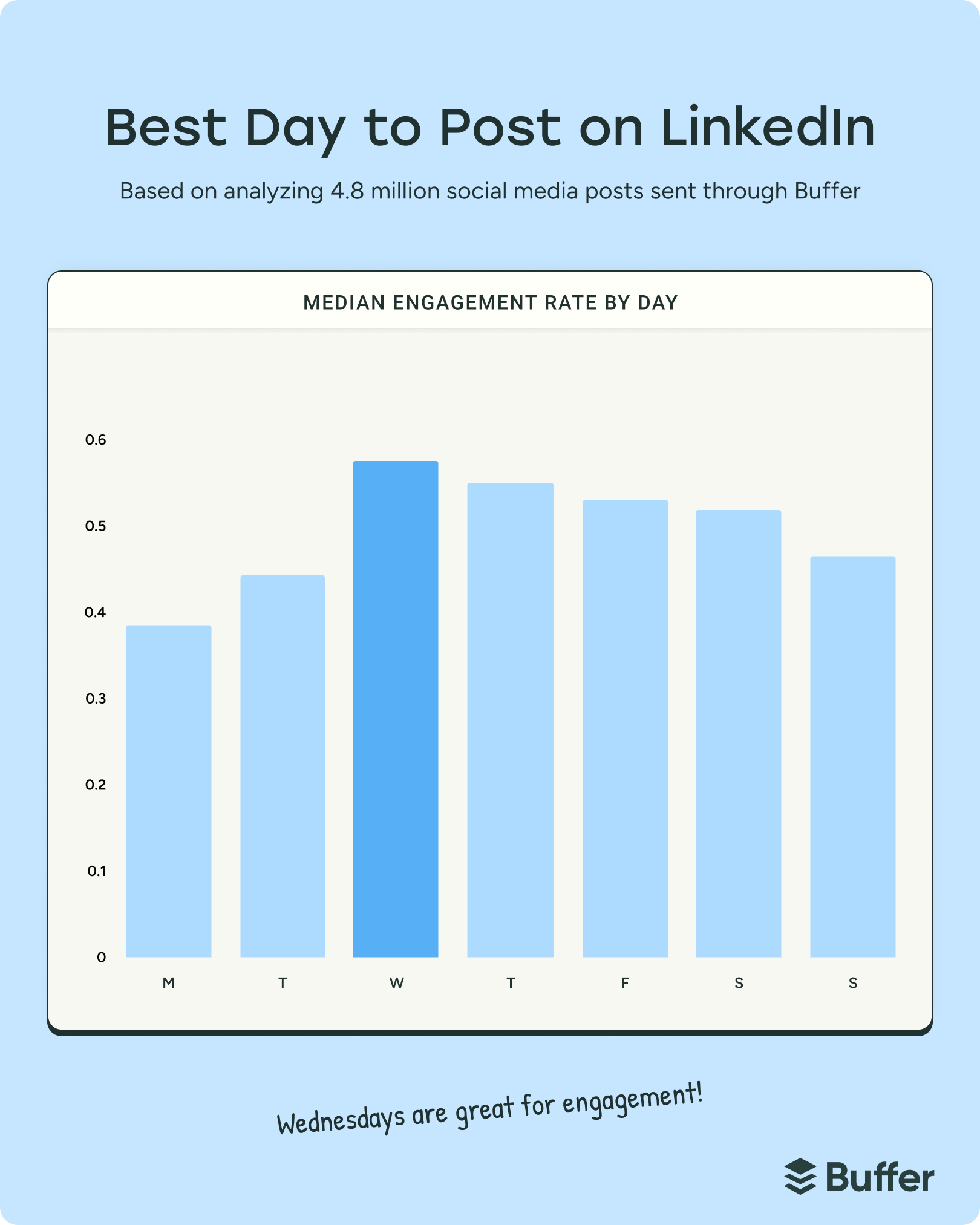
- Wednesday: Recognized as the highest-performing day of the week for LinkedIn engagement. The standout window is 4:00 p.m., supported by strong activity at 3:00 p.m. and 5:00 p.m. This mid-week afternoon slot represents the ideal time for launching major organizational updates or thought leadership pieces.
- Thursday: Engagement remains robust late in the week, with 5:00 p.m. serving as the peak hour. Strong secondary windows include 7:00 p.m. and 9:00 p.m. for audiences active during evening hours.
- Friday: As the workweek concludes, professionals remain active on the platform. The top engagement time is 3:00 p.m., immediately followed by 4:00 p.m. and 5:00 p.m.
- Saturday and Sunday: Weekend activity drops off significantly across the board. For weekend publishing, Saturday at 9:00 a.m. and Sunday at 10:00 p.m. capture minor pockets of audience attention, though marketers generally advise shifting critical content to weekdays.
Implications for the LinkedIn Algorithm and Strategy
Understanding these timing shifts is critical for navigating the LinkedIn algorithm. The platform heavily weights early user interactions—such as reactions, comments, and reposts—as primary signals of content value. When a post secures strong engagement shortly after publication, the algorithm broadens its distribution to a wider secondary audience.
However, industry experts caution that timing is merely an amplifier rather than a substitute for substance. High-frequency data shows that strategic formatting plays an equally vital role in audience retention. For instance, document-based carousel posts continue to outperform plain text updates significantly, generating substantially higher interaction rates across professional demographics.
Furthermore, discrepancies between platform datasets underscore the importance of audience specificity. While aggregated studies like Buffer’s provide an invaluable baseline, official insights from LinkedIn’s internal marketing team occasionally note strong early-week engagement depending on specific industry verticals, geographic regions, and target demographics. Consequently, social media professionals are encouraged to treat macro-level data as a strategic launching pad rather than an absolute rule.
Practical Application and Future Outlook
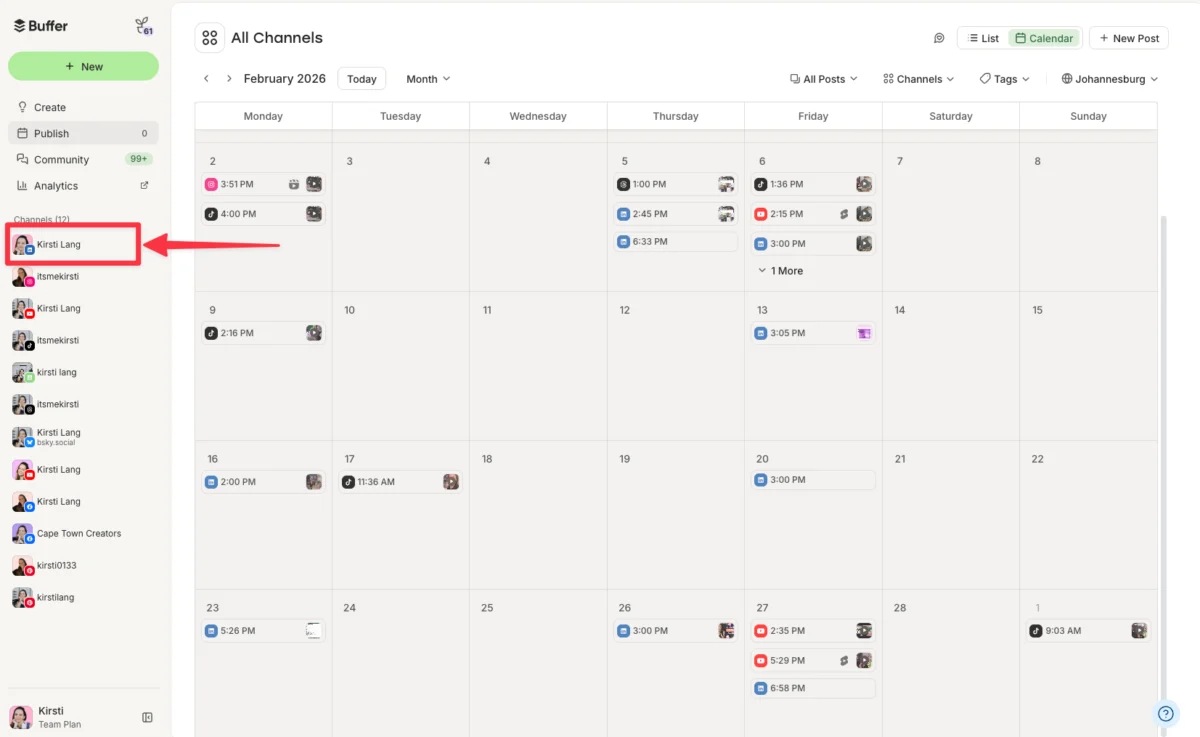
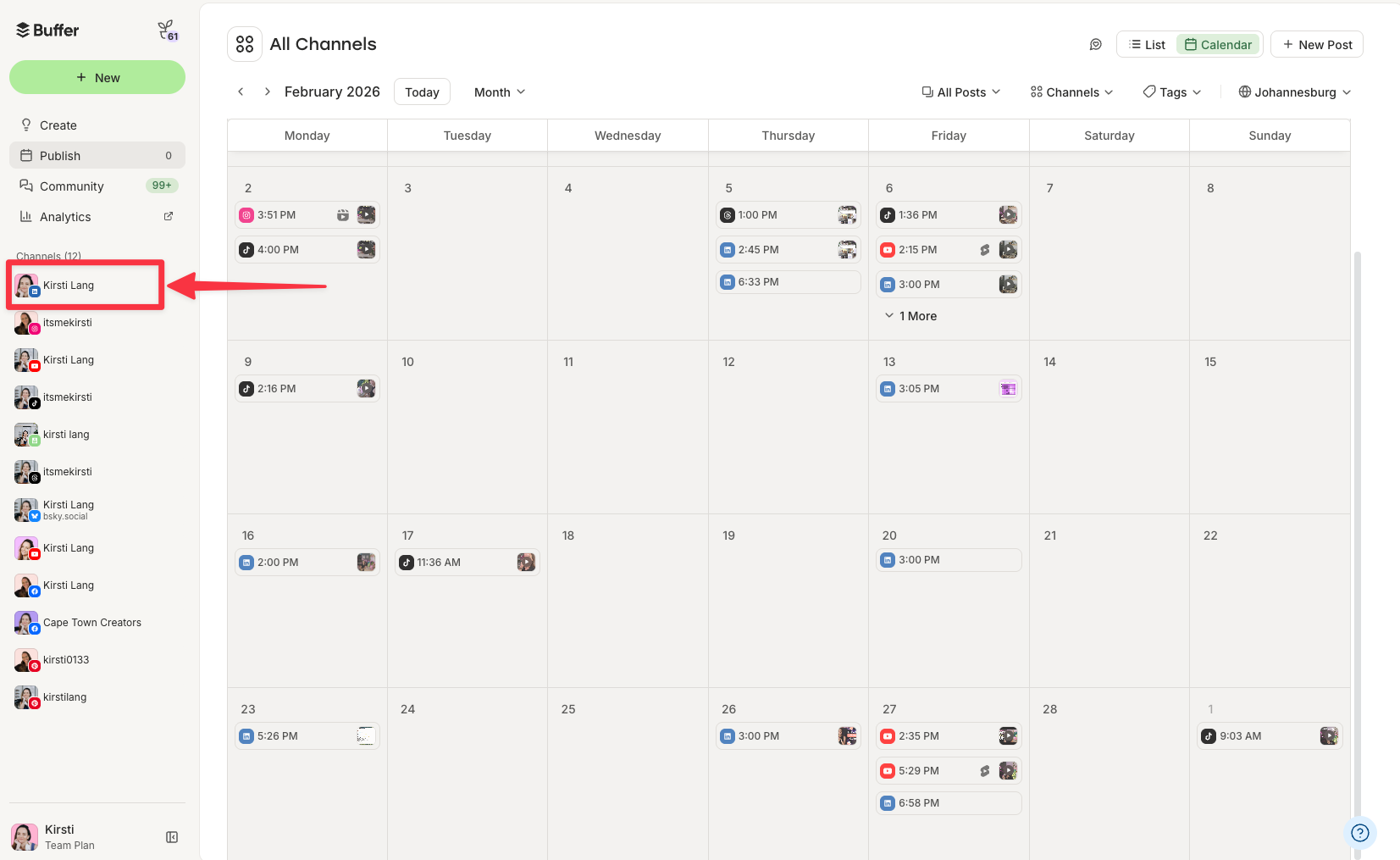
For organizations seeking to operationalize these findings, automated social media management tools have integrated these data points directly into scheduling workflows. Platforms like Buffer now automatically adjust publishing queues to align with peak engagement windows, allowing communications teams to queue content without manual time conversion or calculation.
As digital habits continue to evolve, the blurring lines between professional and personal screen time will likely prompt further shifts in social media analytics. For now, the empirical evidence is clear: the modern professional engages with career networks on their own terms, long after the traditional workday has drawn to a close.