In an increasingly interconnected digital landscape, businesses and developers alike face the persistent challenge of maintaining a cohesive presence across a multitude of social media platforms. From the omnipresent giants like Instagram and Facebook to rapidly evolving networks such as TikTok, X, and emerging decentralized platforms, the demand for seamless content distribution and management tools has never been greater. Whether an individual is "vibe-coding" personal social media workflows or an enterprise is building a robust social media management application from the ground up, the journey to integrate multiple platforms frequently encounters significant hurdles, primarily stemming from the inherent complexities of diverse Application Programming Interfaces (APIs).
The Multi-Platform Conundrum: A Developer’s Ordeal
At its core, the challenge lies in the fragmented nature of social media ecosystems. Each major social network – Instagram, Facebook, TikTok, X (formerly Twitter), LinkedIn, YouTube, Pinterest, Threads, and Bluesky – operates with its own proprietary API. These native APIs, while offering direct access and granular control over platform functionalities, present a labyrinth of inconsistencies for developers. Integrating even a handful of these can quickly lead to a tangled web of disparate codebases, varying authentication protocols, unique data formats, and platform-specific limitations.
A developer building a multi-platform application must contend with distinct API endpoints, different rate limits, varying media upload requirements, and unique error handling mechanisms for each network. This ‘messy wiring’ is further exacerbated by the platforms’ tendency to introduce frequent updates and changes to their APIs. These modifications, often unannounced or with short notice, can break existing integrations, requiring constant maintenance and refactoring. For a small development team or an independent creator, this ongoing upkeep can consume significant resources, diverting attention from core product development and innovation. The overhead associated with monitoring these changes, updating code, and re-testing integrations across multiple platforms can be substantial, leading to delays and increased operational costs.

The Genesis of Unified Posting APIs: A Streamlined Solution
Recognizing this pervasive pain point, the concept of a unified posting API emerged as a transformative solution. Imagine a universal adapter, a single multi-plug that effortlessly connects to every social network required, abstracting away the underlying complexities of individual platform APIs. This is precisely what a unified posting API delivers: a single API endpoint that serves as an intermediary, connecting to all native platform APIs on behalf of the developer.
This approach offers immediate and profound benefits. Instead of managing eight to eleven separate integrations, developers interact with a single, standardized interface. The unified API provider handles the intricate details of native API integration, including managing authentication tokens, translating data formats, navigating rate limits, implementing retry logic, and crucially, adapting to platform-specific updates. This ‘good cable management’ drastically simplifies the development process, accelerates time-to-market for new features, and significantly reduces the ongoing maintenance burden. For non-engineers or those engaging in "vibe-coding," this abstraction layer democratizes access to powerful social media automation, enabling more individuals and small teams to build sophisticated tools.
Native vs. Unified: A Strategic Decision
The choice between leveraging native APIs directly and adopting a unified posting API is a fundamental "buy it or build my own?" decision, carrying distinct trade-offs.
Native APIs:
- Pros: Offer the deepest possible control over platform-specific features, allow for highly customized integrations, and typically incur no direct monthly subscription cost (though pay-per-use fees may apply, as seen with X). This direct access can be critical for applications requiring niche functionalities or operating at extreme scales where every micro-optimization impacts cost.
- Cons: Demand significant engineering time for initial setup and ongoing maintenance. Developers must manage separate authentication flows, data formats, and error handling for each platform. Changes to native APIs can lead to frequent, workflow-breaking updates that developers must address internally.
Unified Posting APIs:
- Pros: Provide a much simpler and faster setup. Key benefits include a single login/authentication process across all integrated platforms, a standardized data format for post content, and a dedicated vendor team that proactively handles rate limits, retries, and platform API updates. This dramatically reduces engineering overhead, allowing development teams to focus on their core product.
- Cons: May introduce a monthly subscription fee, adding a recurring cost. There is also an additional layer between the developer’s code and the native platforms, which might occasionally mean slightly less granular control over certain bleeding-edge or highly specialized platform features compared to direct native API access.
For the vast majority of developers integrating social publishing into a product, a unified API saves weeks, if not months, of engineering time. However, for highly specialized platforms that publish at extreme scale, such as social ad networks or enterprise SaaS solutions with unique data requirements, native integrations might still win on cost optimization and the need for ultimate customization.
The decision often hinges on several critical questions:
- Platform Count: For two or three platforms, native APIs are generally manageable. For five or more, the engineering and maintenance load heavily favors a unified API.
- Timeline: Unified APIs significantly accelerate deployment, getting applications "posting" much faster than individual native integrations.
- Post Volume and Account Count: The pricing model of a unified API becomes paramount at scale. Per-profile pricing can escalate quickly with a growing user base, while per-post pricing can become expensive for high-cadence publishers. For low volumes across a handful of profiles, most options remain affordable.
A Landscape of Unified API Solutions
The market for unified posting APIs is dynamic and growing, offering several robust options tailored to different needs regarding platform mix, post volume, and technical requirements. Providers are constantly updating their offerings, so developers are advised to consult their official pricing pages for the most current information.
1. Buffer API
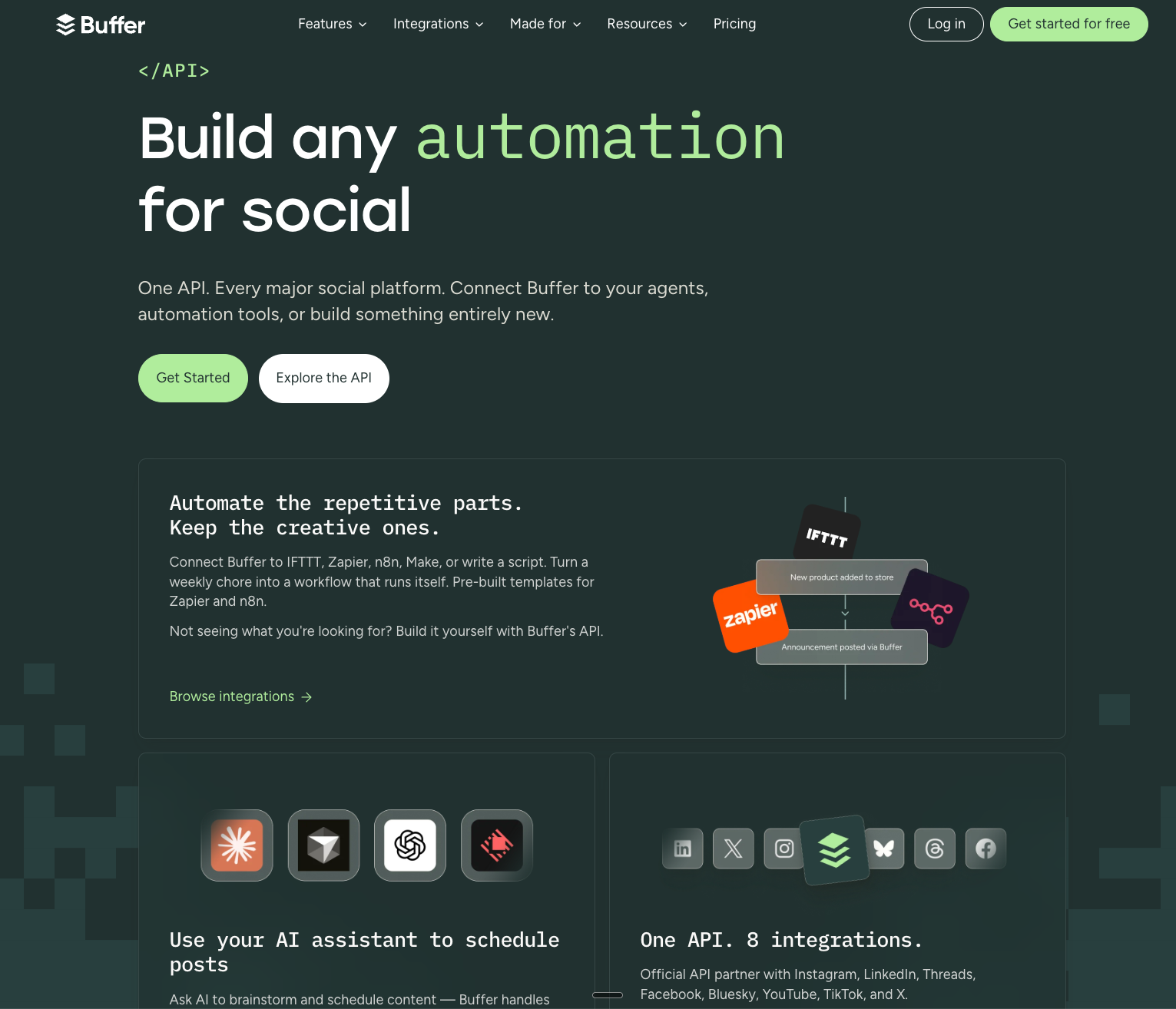
- Platforms Supported: 11 (Instagram, Facebook, LinkedIn, TikTok, X, Threads, Bluesky, Pinterest, YouTube, Google Business Profile, Mastodon).
- Pricing: Free for 1 API key; paid Buffer users receive 5 API keys.
- Best For: Creators, builders, and teams already integrated into the Buffer ecosystem who seek to automate scheduling, content ideation, or channel management directly from their own tools.
- Analysis: Buffer’s API, recently rebuilt from the ground up, utilizes GraphQL, a modern query language designed for efficiency and flexibility. It focuses on post creation, scheduling, content ideas, and basic account/channel metadata. Its strength lies in its tight integration with Buffer’s established social media management platform, offering a seamless authentication flow for existing customers. The emphasis on developer-friendly tooling and AI-tool readiness, including an MCP (Multi-Platform Content) server for AI agents like Claude or ChatGPT, positions it well for emerging AI-driven content workflows. This strategic move aligns with the increasing demand for intelligent automation in social media.
2. Ayrshare
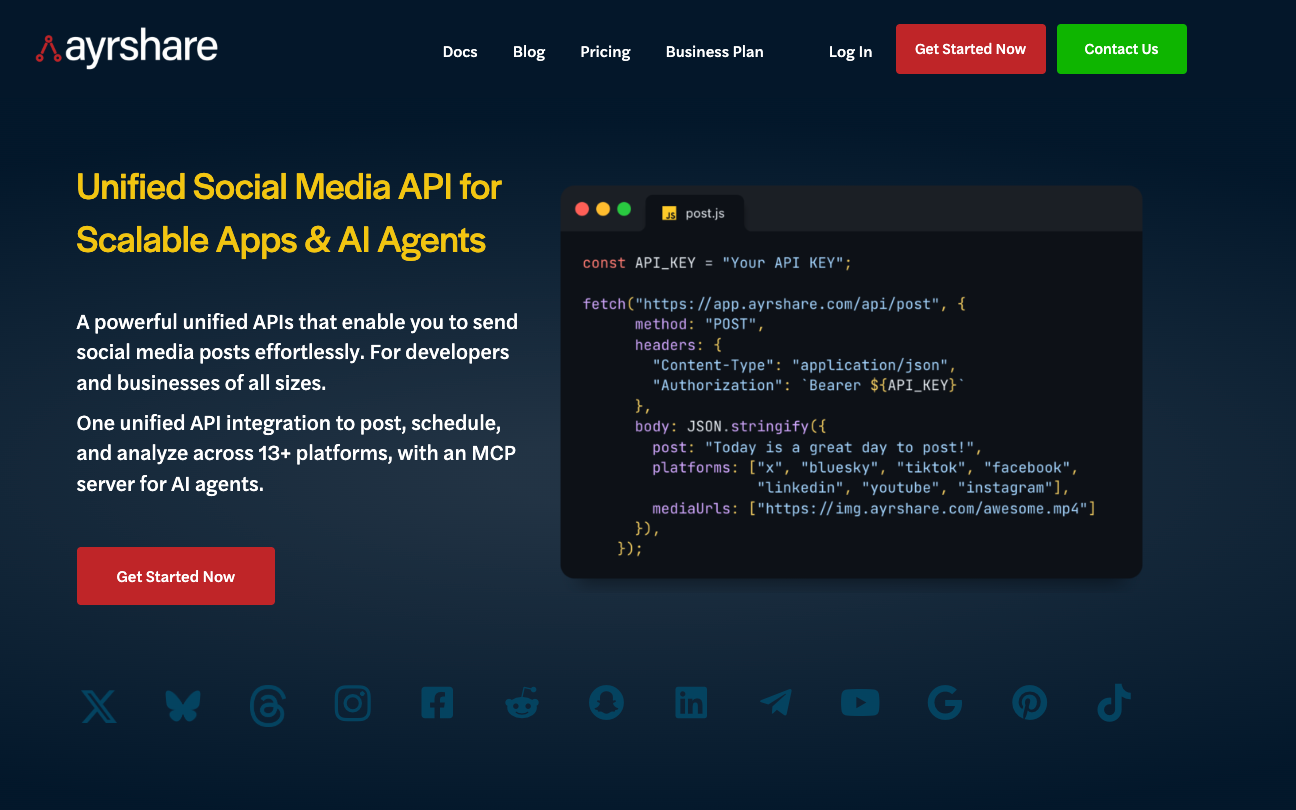
- Platforms Supported: 13+ (Instagram, Facebook, X, LinkedIn, TikTok, YouTube, Pinterest, Reddit, Telegram, Snapchat, Google Business Profile, and more).
- Pricing: Premium starts at $149/month; Business plans range from $499-$599/month.
- Best For: Companies and agencies requiring a mature, well-supported API that extends beyond basic publishing to include first-party analytics, comment management, and webhooks.
- Analysis: Ayrshare stands out as one of the longest-running API-first players, offering a comprehensive suite of features. Its support for multiple SDKs (Node.js, Python, PHP, C#, Go, Java, Ruby on Rails) underscores its commitment to developer flexibility. Beyond core publishing, features like comment and review management, messaging with auto-responses, advanced analytics, and AI-powered hashtag automation cater to businesses needing a holistic social media API solution. The pricing, however, can be a significant factor for B2C products with thousands of customer accounts, making it more suitable for B2B or agency models where per-profile costs are absorbed by client retainers.
3. Postiz
- Platforms Supported: 30+, including X, LinkedIn, Instagram, Facebook, TikTok, YouTube, Pinterest, Threads, Bluesky, Mastodon, Discord, Nostr, and Farcaster.
- Pricing: Free for self-hosted deployments; Cloud plans start at $29/month for 5 accounts and 400 posts (with a 14-day trial).
- Best For: Developers prioritizing the broadest platform support, full data control, and the flexibility of an open-source codebase for extension.
- Analysis: Postiz distinguishes itself through its open-source nature, with its full source code available on GitHub. This transparency and extensibility appeal to developers who desire complete control over their infrastructure, data, and customization. The option to self-host (on platforms like Railway or a Docker-enabled server) allows for significant cost control at scale, eliminating per-post or per-profile fees. Its integration with no-code automation tools like n8n and Make.com further broadens its appeal, bridging the gap between developers and citizen integrators. Its support for emerging decentralized networks highlights a forward-thinking approach to the evolving social media landscape.
4. Post for Me

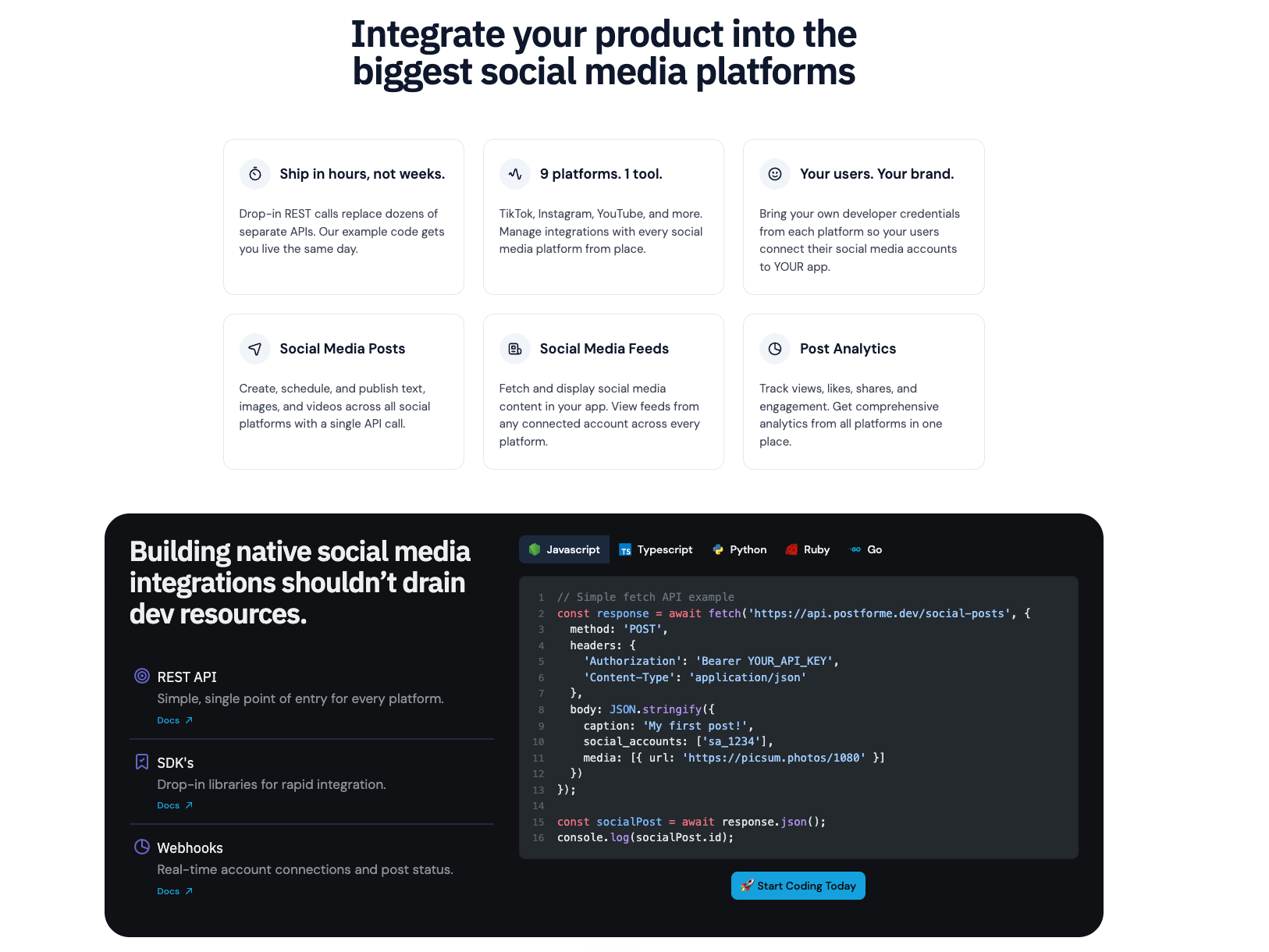
- Platforms Supported: 9 (TikTok, Instagram, Facebook, X, LinkedIn, YouTube, Threads, Pinterest, Bluesky).
- Pricing: $10/month for 1,000 posts; plans scale up to $1,000/month with unlimited accounts and API keys.
- Best For: Indie developers and bootstrapped SaaS applications seeking predictable per-post pricing without the overhead of per-seat fees.
- Analysis: Post for Me offers a highly cost-effective entry point for developers, particularly those with predictable, moderate post volumes. Its pricing model, based solely on post count rather than profile count, is advantageous for applications managing many low-activity accounts. While its platform list is slightly shorter than some competitors, it covers the most widely used major networks, making it a pragmatic choice for smaller projects or startups aiming for efficient resource allocation.
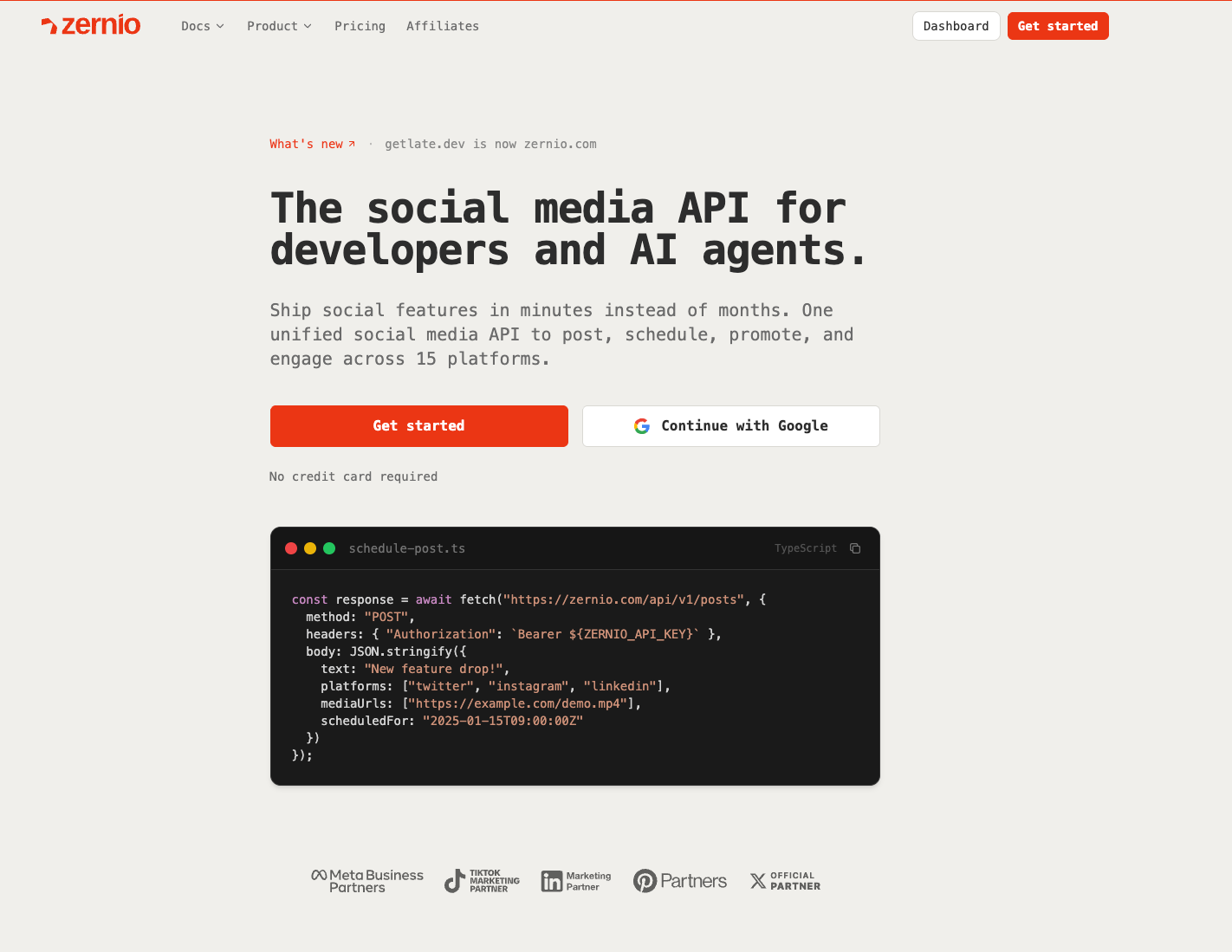
5. Zernio
- Platforms Supported: 15 platforms through a single endpoint.
- Pricing: Starts at $19/month.
- Best For: Developers building with AI agents who require out-of-the-box MCP server integration.
- Analysis: Zernio’s primary differentiator is its dedicated MCP (Multi-Platform Content) server, specifically designed to facilitate integration with AI agents like Claude or ChatGPT within publishing workflows. This feature caters directly to the burgeoning field of AI-driven content creation and automation, making it a compelling choice for developers looking to embed advanced AI capabilities into their social media tools. Its focus on supporting AI agents highlights a proactive stance on future technological trends in content management.
6. Outstand
- Platforms Supported: 10 (X, LinkedIn, Instagram, Facebook, TikTok, YouTube, Threads, Bluesky, Pinterest, Google Business Profile).
- Pricing: $0.01 per post.
- Best For: Pay-as-you-go projects or proof-of-concept builds where traditional monthly subscriptions are not ideal due to bursty or unpredictable publishing patterns.
- Analysis: Outstand’s unique per-post pricing model offers unparalleled flexibility for projects with highly variable publishing volumes. For low-volume side projects or initial proof-of-concept phases, it can prove more economical than fixed monthly subscriptions. However, for high-volume applications, developers must carefully calculate the cost-effectiveness against flat-rate plans. This model is particularly attractive for developers who prefer granular cost control aligned directly with usage.
Market Dynamics and Future Outlook
The unified posting API market is driven by several key trends. The explosion of social media platforms, coupled with the increasing sophistication of digital marketing strategies, necessitates tools that can efficiently manage multi-channel content. The rise of AI and machine learning is profoundly impacting content creation and scheduling, with API providers now prioritizing integrations that empower AI agents. Decentralized social media platforms like Nostr and Farcaster represent another frontier, and API providers that quickly adapt to these emerging networks will gain a competitive edge.
The ongoing tension between social media platforms and third-party integrators remains a critical dynamic. Platforms frequently update their APIs, sometimes with significant changes or stricter access policies (as exemplified by X’s shift to a pay-per-use model in February 2026, which effectively replaced its free tier). These changes force unified API providers to constantly adapt and developers to remain vigilant about their chosen solutions’ stability and future-proofing.
For developers, unified APIs mean reduced time-to-market, lower maintenance burdens, and the ability to focus on their core product’s unique value proposition. For businesses, these APIs enable enhanced multi-platform presence, consistent branding, streamlined content distribution, and the potential for richer, consolidated analytics. The broader implication is a more efficient and innovative developer ecosystem, where the technical complexities of social media integration are increasingly abstracted, allowing for greater creativity and faster iteration in the development of social tools.
Addressing Common Queries
What are the most affordable unified APIs?
Users on Buffer’s free plan receive one API key at no cost. For self-hosted solutions, Postiz is free if deployed on personal infrastructure (e.g., Docker, Railway). Among hosted options, Post for Me offers a low entry point at $10/month for 1,000 posts. Outstand’s $0.01-per-post pricing is highly competitive for very low publishing volumes.
Are native social media APIs free to use?
Most native APIs, including Meta Graph (for Instagram and Facebook), LinkedIn, TikTok, YouTube, Pinterest, Threads, and Bluesky, are free to use, though they impose rate limits and quota systems. X (formerly Twitter) is a notable exception; as of February 2026, new developers pay per request, with costs such as approximately $0.015 for text posts and $0.20 for posts containing URLs. Existing Basic and Pro subscribers for X’s API may retain their legacy plans for now.
Can content be posted to Instagram via an API?
Yes. Instagram content can be published directly through Meta’s Instagram Graph API. This requires an Instagram Business or Creator account linked to a Facebook Page, and the integrating application must undergo Meta’s app review process for approval before going live. Alternatively, any unified API on the provided list facilitates Instagram posting, simplifying the integration process.
Which unified API supports the most platforms?
Postiz currently leads with support for over 30 platforms, encompassing mainstream networks and emerging decentralized platforms like Nostr, Farcaster, and Mastodon. Ayrshare and Zernio typically support between 13 to 15 platforms, while Buffer’s API covers 11.
What replaced the X API free tier?
In February 2026, X transitioned its API pricing to a default pay-per-use model, discontinuing the old free, Basic ($200/month), and Pro ($5,000/month) tiers for new developers. Existing subscribers on Basic and Pro plans were allowed to maintain their current subscriptions.
Ready to Build?
The evolving landscape of social media demands agile and efficient integration solutions. Unified posting APIs offer a powerful pathway for developers and businesses to overcome the complexities of multi-platform management, fostering innovation and streamlining content distribution. For those embarking on this journey, whether leveraging a unified solution or opting for direct native API integration, thorough research and strategic planning are paramount. Resources such as developer documentation, community forums, and dedicated support channels are invaluable in transforming ambitious ideas into functional, impactful social media tools.