In an increasingly digital landscape, the distinction between a rudimentary posting schedule and a robust social media marketing strategy has become critical for brands and creators alike. While regular content publication is a fundamental component of online presence, it represents merely a fraction of the comprehensive strategic approach required to achieve tangible business outcomes. A true strategy transcends the ‘when’ and ‘what’ of posting, delving into the core questions of audience identification, message articulation, and performance measurement. This holistic perspective is essential for converting social media activity into meaningful return on investment (ROI), fostering brand loyalty, and driving conversions.
The Evolving Imperative for Strategic Social Media
Social media has evolved far beyond its initial role as a platform for personal connection, transforming into a powerhouse for commerce, community building, and thought leadership. However, this evolution has also introduced significant complexity. Many organizations and individual creators find themselves caught on what has been termed a "content treadmill," relentlessly producing content without a clear direction or means to assess its efficacy. This reactive approach often leads to resource drain and missed opportunities, underscoring the necessity for a documented, iterative plan. Such a plan defines target platforms, audience segmentation, content themes, and, crucially, the metrics by which success will be gauged. It addresses the fundamental inquiries: where to engage, who to target, what message to convey, and how to ascertain effectiveness.
Drawing on over a decade of experience in developing social media strategies for diverse brands and content creators, coupled with insights from industry peers and data-backed research, a seven-step framework emerges as a reliable guide for constructing a potent social media marketing strategy from the ground up. This framework emphasizes an iterative process, acknowledging the rapid pace of change within social media algorithms and user behaviors.
I. The Foundational Audit: Understanding Your Current Landscape
The initial and often overlooked step in developing a comprehensive social media strategy is conducting a thorough audit of existing online assets. This involves a meticulous review of every owned social media account, analyzing past content, assessing platform-specific performance, and identifying critical gaps. Just as a business cannot chart a future course without understanding its current standing, a social media presence requires an honest appraisal of its present state.
This audit necessitates asking pointed questions: What content resonates most with the current audience? Which platforms yield the highest engagement or reach? Are there dormant accounts that could be repurposed or retired? As Sabreen Haziq, Senior Brand and Community Manager at Buffer, notes, "When I joined Buffer, one of the first things I did was audit each of our channels with one question in mind: ‘Where are we really growing, and where are we just present?’" This distinction is vital for allocating resources effectively, allowing strategists to identify areas for aggressive growth, experimental content, or the protection of established successes.

Complementing the self-audit is a concise yet impactful competitor analysis. Examining three to five key competitors reveals what the target audience is already exposed to and, more importantly, highlights unmet needs or content niches that your brand can uniquely fill. This competitive intelligence should be lightweight yet informative, focusing on platforms, posting frequency, content angles, and key observations. Compiling this information into a simple grid allows for quick identification of market gaps, providing a strategic advantage.
II. Pinpointing the Core Audience: Defining Who You Serve
With a clear understanding of the current operational landscape, the next critical step is to define the target audience with precision. This involves moving beyond broad demographics to grasp their motivations, challenges, and aspirations. For established brands, this often aligns with existing customer profiles. For content creators, it might require a more introspective approach: envisioning the single individual most eager for your help and understanding their core struggles.
Audience research extends beyond intuition, incorporating data from various sources:
- Surveys and Interviews: Direct engagement provides qualitative insights into audience preferences and pain points.
- Website and Social Analytics: Quantitative data reveals user behavior, popular content, and demographic trends.
- Online Communities: Engaging with relevant forums, Facebook groups, or Reddit communities offers a window into audience discussions and questions.
- Competitor Analysis: Observing who engages with competitor content can reveal shared audience segments.
While a crystal-clear audience profile is the ultimate goal, it’s important not to let the absence of perfect data hinder content creation. Tami Oladipo, Buffer’s Senior Content Creator, advises against attempting to define an audience before producing any content. "You can’t know who resonates with your content until the content is out there and people have resonated. You find them by making stuff and watching who leans in." This highlights the iterative nature of audience definition, where initial content serves as a magnet, revealing who is truly attracted to the message.
III. Crafting Measurable Objectives: Setting SMART Goals
Effective social media strategy demands goals that are not merely aspirational but quantifiable and actionable. The SMART (Specific, Measurable, Achievable, Relevant, Time-bound) framework, a staple in business planning for decades, remains invaluable here. Vague objectives like "grow on Instagram" are replaced by precise targets such as "Reach 1,000 non-followers per month by Q4."

Goals must directly support overarching business outcomes, whether that’s increasing brand awareness, driving website traffic, generating leads, or boosting sales. If a social media goal cannot be directly linked to a tangible business result, its utility within the strategy is questionable. For instance:
- Brand Awareness: Measured by reach, impressions, follower growth.
- Community Engagement: Measured by comments, shares, direct messages, interaction rate.
- Lead Generation/Sales: Measured by link clicks, conversion rates, sign-ups, product trials.
Limiting goals to one or two per platform per quarter is crucial for focus. Attempting to pursue too many objectives simultaneously can dilute effort and result in content that achieves none effectively. A goal like "grow brand awareness" necessitates different content approaches than "drive email sign-ups." Key Performance Indicators (KPIs) act as the measurable components of these SMART goals, providing specific numbers to track progress. Sabreen Haziq’s goal for Buffer’s brand channels, "I want to lift our average per-post engagement rate, measured against follower count, on LinkedIn, Instagram, and Threads by 20% over our current baseline by the end of Q4 2026," exemplifies a well-structured, measurable objective.
IV. Strategic Platform Selection: Aligning Mindset and Medium
Identifying where your audience spends time is only part of the equation; understanding their mindset on those platforms is paramount. A B2B audience might scroll TikTok for entertainment in the evenings but make purchasing decisions on LinkedIn. A craft enthusiast might be on Instagram daily but use Pinterest for product discovery. The strategic choice of platforms hinges on aligning audience mindset with your marketing objectives.
Four key considerations guide platform selection:
- Social Media Algorithms: Each platform’s algorithm rewards distinct behaviors. LinkedIn prioritizes professional discourse and educational content, often favoring carousels. Pinterest functions as a visual search engine, rewarding high-quality images and video. TikTok thrives on short-form, authentic video. Instagram balances aspirational visuals with engaging short-form video (Reels). Understanding these algorithmic biases allows for content optimization and strategic resource allocation.
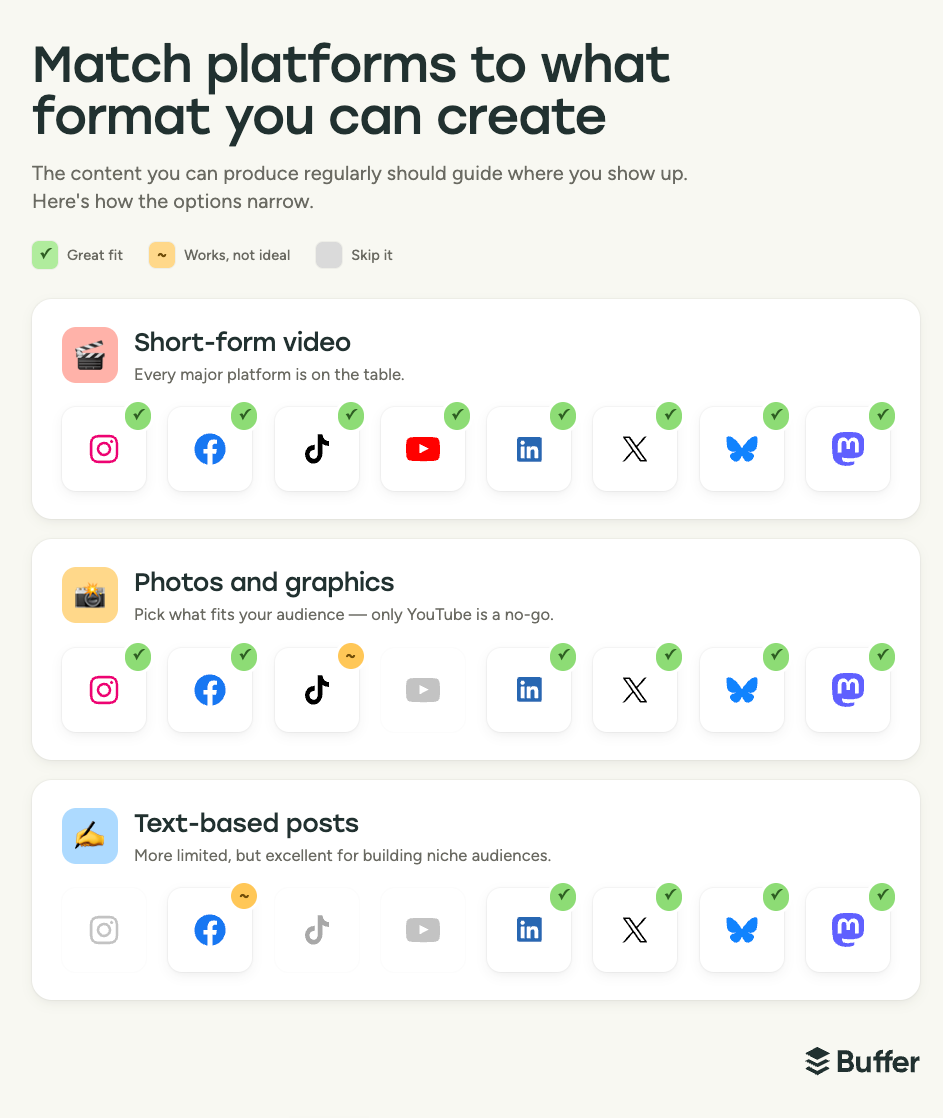
- Content Format Feasibility: The type of content you can consistently produce significantly influences platform choice. While short-form video garners high reach across many platforms, it requires specific resources. If photos and graphics are more feasible, Instagram and Facebook remain strong contenders. Text-centric strategies thrive on platforms like LinkedIn and X (formerly Twitter). Buffer’s "State of Social Media Engagement Report 2026," which analyzed over 52 million posts, highlights the best-performing formats: LinkedIn carousels (21.77% median engagement), Pinterest video (5.75%), Instagram carousels (6.9%), and X text posts (3.56%). Importantly, as Sabreen Haziq points out, "Social is a pretty democratic medium, and it doesn’t always reward the most premium, polished content… You don’t need the best gear to make something good." Substance and direction trump high production value.
- SEO Importance: The growing trend of younger audiences using social platforms as search engines (e.g., TikTok and Instagram for product discovery, YouTube as the second-largest global search engine) means search engine optimization (SEO) on social media is increasingly vital. Platforms with strong search behavior warrant strategic weighting, necessitating the use of searchable phrases and relevant keywords in captions and content descriptions.
- Platform Subculture: Every platform fosters a unique cultural environment. TikTok embraces fast-paced, unpolished authenticity. LinkedIn cultivates a professional, increasingly "edu-tainment" tone. Instagram leans towards aspiration and visual storytelling. X and Threads are built for real-time commentary and rapid information exchange. Aligning your brand’s voice and content style with a platform’s subculture is crucial for genuine resonance. Furthermore, as social media consultant Jade Beason emphasizes, personal enjoyment of a platform is a powerful motivator: "If you don’t enjoy that platform, it’s not going to work… it’s going to be super easy for you to give up and lose motivation."
V. Developing Content Pillars: Thematic Cohesion and Brand Lore
Content pillars are the 3-5 recurring thematic topics that define a brand’s social media output. They serve as a navigational compass, preventing content creators from reinventing the wheel with every post and ensuring a coherent, recognizable brand identity for the audience. Consider Erin McGoff, a popular Instagram and TikTok creator, who has built a powerful brand around "career advice from a big sister." Her content pillars are clearly defined, creating predictable value for her audience and fostering an immediate sense of recognition and trust.
Content pillars should reside at the intersection of three key elements:
- Your Expertise/Passion: What unique knowledge or perspective do you bring?
- Your Audience’s Interests: What problems are they trying to solve? What questions do they have?
- Your Brand’s Mission/Values: How does your content align with your core identity and objectives?
To uncover these pillars, a useful prompt is to imagine being invited on a podcast: what 3-5 topics would you consistently discuss? These topics, once defined, become the "spine of everything," as Sabreen Haziq describes. She advises delving into "brand lore" – the unique truths about your brand that differentiate it from competitors. For a creator, this is their authentic story; for a company, it’s its distinct value proposition. This deep understanding informs pillars that are not merely trendy but rooted in genuine identity.
While pillars provide structure, flexibility is key. Kendall Dickieson, a social media consultant, advocates for keeping pillars loose enough to allow for experimentation and adaptation. "If a social media team knows they have some freedom to test and play around, then the team won’t feel so limited in sharing concepts that might seem way too out of hand." This agility allows for exploring new formats, styles, and trends, preventing stagnation and fostering innovation.
The role of Artificial Intelligence (AI) in this step is noteworthy. AI tools excel at ideation, repurposing content across platforms, and brainstorming caption variations. However, their strength lies in efficiency, not originality or authentic voice. Human-generated content continues to outperform fully AI-written content in engagement. AI should be leveraged to remove friction in the creative process, allowing human strategists to focus on developing unique perspectives and compelling narratives.
VI. Operationalizing the Strategy: The Content Calendar and Posting Schedule
With content pillars established, the strategy transitions into tangible execution through a social media content calendar and a defined posting schedule. This operational workflow is crucial for maintaining consistency and quality, preventing last-minute content decisions that often compromise strategic alignment.
A robust content calendar, ideally integrated with a scheduling tool like Buffer, transforms the abstract strategy into a clear, publishable timeline. Such tools offer a visual overview of planned posts across multiple platforms, enable easy rescheduling via drag-and-drop functionality, and often provide data-driven recommendations for optimal posting times. This automation minimizes administrative burden, freeing up time for creative development and strategic analysis.

Regarding posting frequency, while industry benchmarks exist, the mantra "one post a week per platform is a great starting point" should guide initial efforts. Consistency trumps sheer volume. Buffer’s research from its "State of Social Engagement report," analyzing over 52 million posts, provides best-in-class cadences:
- TikTok: 3-5 posts per week
- Instagram: 3-5 posts per week (with Reels performing exceptionally for reach)
- Facebook: 2-3 posts per week
- LinkedIn: 2-5 posts per week
- X (formerly Twitter): 1-3 posts per day
- Pinterest: 5-10 pins per day (often incorporating multiple images/videos per pin)
- Threads: 2-3 posts per week
- Bluesky: 1-2 posts per day
These figures represent optimal targets for sustained growth, but capacity should dictate starting points. The key is to establish a sustainable rhythm that aligns with available resources and consistently delivers value.
VII. Continuous Optimization: Tracking Analytics and Refining Strategy
The final, yet ongoing, step in the social media marketing framework is the disciplined tracking of analytics and the subsequent refinement of the strategy. This feedback loop is essential for maintaining relevance and ensuring that efforts are genuinely contributing to stated goals. Monthly review of key metrics, rather than weekly, helps to identify meaningful trends over random fluctuations.
Patience is a virtue in social media strategy. As Kendall Dickieson observes, "Most strategies need at least 3 months to show real impact, so patience is key." Prematurely abandoning a strategy based on short-term data can prevent the compounding effects of consistent effort.
The metrics tracked should directly correspond to the SMART goals established in Step 3. A non-exhaustive list includes:
- Awareness: Reach, impressions, follower growth.
- Engagement: Likes, comments, shares, saves, interaction rate.
- Traffic/Conversions: Link clicks, website visits, sign-ups, leads generated, sales attributed.
- Audience Demographics: Shifts in audience age, location, interests.
Tools like Buffer’s analytics dashboard consolidate cross-platform data, streamlining the analysis process. The discipline of regularly reviewing the same metrics in a consistent manner is more important than the specific tool used. Monthly, strategists should identify what is performing well and consider scaling those efforts. Quarterly, a more critical assessment is warranted for underperforming areas: should the approach be adjusted, or does it simply require more time?

Tami Oladipo highlights the role of strategy as a "North Star" during this phase: "If my goal is awareness and my engagement rate dips, I’m not going to panic since engagement isn’t the metric I tied to that goal. The strategy tells me what to actually worry about, and what I can let go." This clarity allows for focused adjustments and prevents reactive, unstrategic shifts. The interplay of agility and a long-term perspective—leaning into what works while allowing for creative exploration—is the hallmark of a successful, enduring social media strategy.
Conclusion: The Iterative Path to Digital Success
The journey from casual posting to strategic social media mastery is an iterative cycle of auditing, planning, executing, analyzing, and adjusting. In an era where digital presence is paramount, even modest efforts in strategic planning—a clear articulation of goals, a brief competitor overview, or a simple audience sketch—can yield significant returns. The competitive advantage no longer belongs solely to those with the largest budgets, but to those with the most thoughtful and adaptable strategies. By embracing this structured framework, brands and creators can move beyond the content treadmill, cultivating engaged communities, achieving measurable business objectives, and navigating the dynamic social media landscape with purpose and precision.