The contemporary digital landscape demands a pervasive presence across numerous social media platforms, posing a significant integration challenge for developers building tools and workflows. Whether crafting bespoke social media management systems or embedding publishing capabilities into broader applications, the path to connecting with diverse social networks can quickly become intricate and resource-intensive. While platforms like Instagram, Facebook, TikTok, X (formerly Twitter), LinkedIn, and others offer their own Application Programming Interfaces (APIs) for programmatic interaction, leveraging these native interfaces often results in a complex web of disparate integrations, each requiring specific authentication protocols, data formats, and ongoing maintenance. This complexity is compounded by the platforms’ frequent updates and modifications to their APIs, necessitating continuous adaptation from developers.
The fundamental dilemma revolves around efficiency and scalability. Integrating directly with eight to eleven separate native APIs means managing multiple codebases, adhering to distinct rate limits, handling varied error responses, and constantly updating integrations to align with platform changes. This can quickly consume substantial engineering resources, particularly for products aiming for broad social media coverage. An alternative solution has emerged as a strategic imperative: the unified posting API. This innovative approach acts as a single intermediary, abstracting away the underlying complexities of individual platform APIs and presenting a standardized interface for developers. Conceptually, it transforms a tangled mess of individual wires into a single, universal multi-plug, streamlining connectivity to every required social network.
The Evolving Landscape of Social Media Integration
The proliferation of social media platforms over the past two decades has fundamentally reshaped how businesses, brands, and individuals engage with their audiences. From Meta’s ecosystem (Facebook, Instagram, Threads) to short-form video powerhouses like TikTok, professional networks like LinkedIn, and microblogging platforms such as X and Bluesky, maintaining a cohesive and consistent presence across these channels is critical for digital strategy. This multi-platform requirement has fueled the growth of social media management tools, analytics dashboards, and content scheduling systems, all of which rely heavily on robust API integrations.

Historically, developers building these solutions had no choice but to engage directly with each platform’s API. This approach, while offering maximum control and customization, came with a heavy operational burden. Each API presented its own learning curve, documentation, authentication methods (OAuth 1.0, OAuth 2.0, API keys), and data structures for posts, media, and user profiles. Moreover, the inherent volatility of platform APIs, with deprecations, version updates, and policy changes occurring regularly, meant that development teams were perpetually engaged in maintenance rather than innovation. This fragmented environment created a significant barrier to entry for smaller development teams and increased time-to-market for new features or products.
Native vs. Unified APIs: A Strategic Development Decision
The choice between leveraging native platform APIs and adopting a unified posting API represents a classic "buy versus build" strategic decision for developers. Each path presents distinct advantages and trade-offs concerning control, cost, speed, and ongoing maintenance.
Native APIs: Deep Control at High Cost
Direct integration with native APIs provides unparalleled control over the publishing process. Developers can harness the full breadth of each platform’s features, often accessing niche functionalities not exposed by unified solutions. This approach typically incurs no direct monthly subscription fees from the social networks themselves, though specific platforms like X have moved to a pay-per-use model for their API access, replacing previous free tiers. The primary cost associated with native APIs is the significant investment in engineering time for initial setup, ongoing maintenance, and continuous adaptation to platform-specific changes. This includes managing multiple authentication flows, parsing varied data formats, handling platform-specific error codes, and implementing retry logic and rate limit management for each individual integration. For highly specialized applications requiring granular control or those operating at extreme scale, where cost-per-call becomes a critical factor (e.g., social advertising networks or enterprise-level SaaS with thousands of client accounts), native integrations might still be the preferred route, despite the complexity.
Unified Posting APIs: Streamlined Efficiency for Rapid Deployment
Unified posting APIs offer a compelling alternative by acting as an abstraction layer over multiple native APIs. This approach simplifies the integration process dramatically, providing developers with a single API endpoint, a consistent data format for post submissions, and often a consolidated authentication mechanism. The vendor behind the unified API assumes responsibility for maintaining the individual native integrations, managing platform updates, handling rate limits, and implementing robust retry mechanisms. This translates into several significant benefits for developers:
- Faster Time-to-Market: Developers can integrate publishing functionality across multiple networks in a fraction of the time it would take with native APIs.
- Reduced Engineering Overhead: A single integration point minimizes development and maintenance effort, freeing up engineering teams to focus on core product innovation.
- Simplified Management: Developers no longer need to track changes across numerous platform documentations or debug platform-specific issues, as the unified API provider handles these complexities.
- Standardized Workflow: A consistent API structure across platforms simplifies data handling and application logic.
The primary trade-off for this convenience is typically a recurring monthly or per-use fee, and a potential reduction in the deepest, most granular control offered by native APIs. However, for most developers integrating social publishing into a product, a unified API can save weeks, if not months, of engineering time, making the recurring cost a justifiable investment.
Key Considerations for Developers
The decision between native and unified APIs, and subsequently, the choice of a unified API provider, hinges on several critical factors:
- Number of Platforms Required: For applications needing to connect with only two or three social networks, managing native APIs might be feasible. However, as the number of required platforms grows to five or more, the engineering and maintenance burden rapidly tips the scales in favor of a unified API solution.
- Timeline for Deployment: If rapid deployment and faster time-to-market are paramount, a unified posting API can significantly accelerate the development process by abstracting away complex integrations.
- Post Volume and Account Count: The pricing models of unified APIs vary widely. Some charge per-profile, which can become expensive for B2C products supporting thousands of customer accounts. Others charge per-post, which can escalate costs with high publishing cadences. Understanding the projected scale of usage is crucial for selecting the most cost-effective option. For low volumes across a handful of profiles, most unified API options remain affordable.
- Specific Feature Requirements: Beyond basic posting, some unified APIs offer advanced features such as analytics, comment management, AI-powered hashtag generation, or multi-channel publishing (MCP) server capabilities for AI agents. These specialized features can be a deciding factor for applications with broader functional needs.
- Data Control and Open Source Preference: Developers prioritizing full control over their data or wishing to extend the codebase might lean towards open-source unified API solutions that allow self-hosting and customization.
A Chronology of API Evolution and Platform Shifts
The history of social media APIs is marked by continuous evolution, reflecting both technological advancements and the strategic priorities of platform owners. Early APIs often focused on basic content retrieval and posting, evolving over time to include richer media support, analytics, and more sophisticated interaction capabilities.
A significant turning point occurred in early 2023 when X (formerly Twitter) drastically altered its API access policies. Previously offering various tiers, including a free tier for developers, X transitioned to a predominantly pay-per-use model. This change effectively ended broad free access, imposing costs per request, with varying rates for text posts versus those containing URLs. This shift highlighted the precariousness of relying solely on native API access, underscoring the risk of sudden policy changes impacting developer costs and operational viability. Such changes further solidified the value proposition of unified APIs, which absorb these platform-level policy shocks, shielding developers from direct impact and maintaining a stable integration environment. Other platforms, while generally offering free API access, impose rate limits and quota systems, requiring careful management from developers.
Leading Unified API Providers: A Comparative Overview
The market for unified social media posting APIs has matured, offering a range of solutions tailored to different developer needs and scales. Each provider updates its offerings frequently, so direct consultation of their pricing and documentation pages is always recommended before commitment.
-
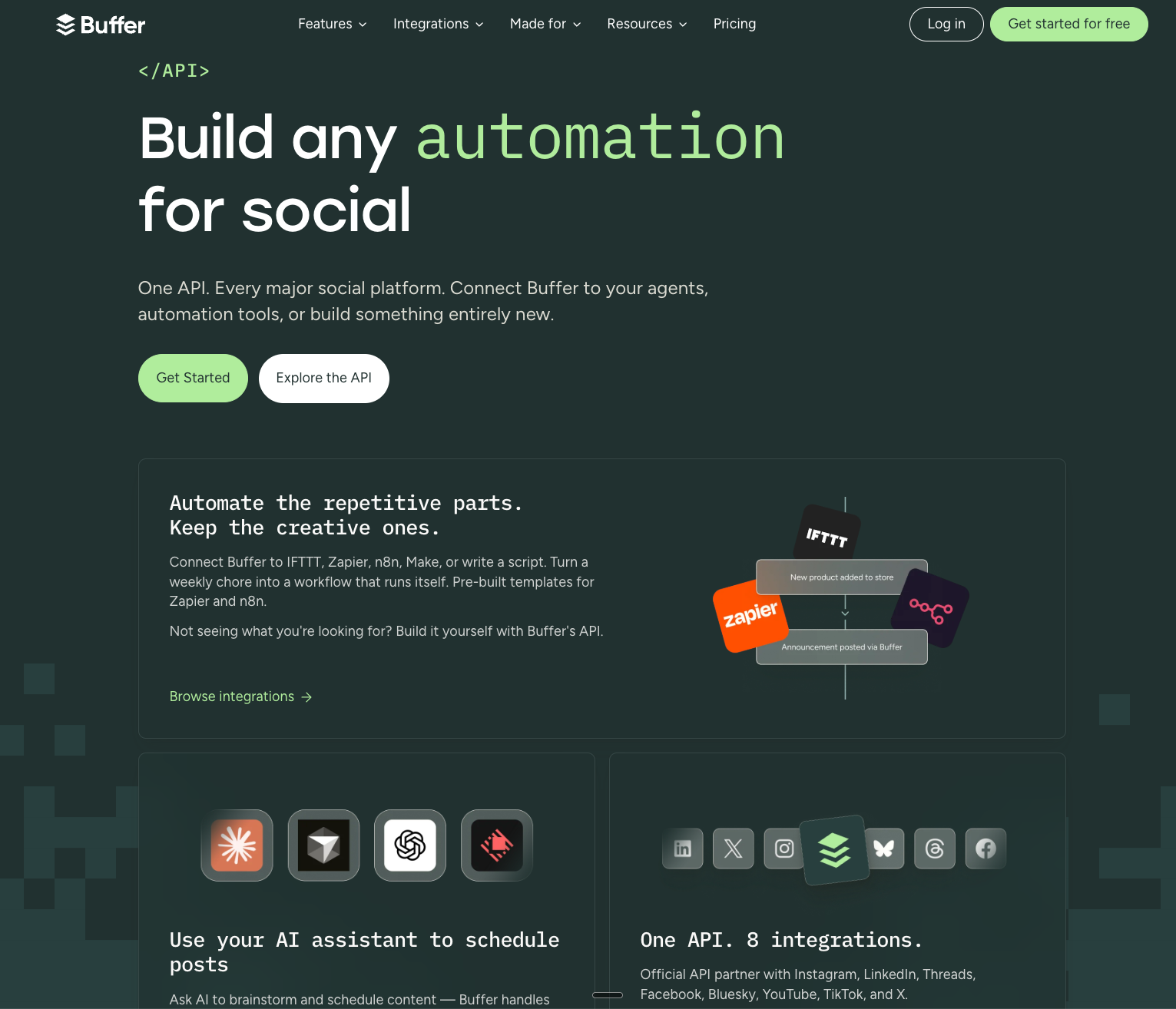
Buffer API:
- Platforms: Supports 11 platforms, including Instagram, Facebook, LinkedIn, TikTok, X, Threads, Bluesky, Pinterest, YouTube, Google Business Profile, and Mastodon.
- Pricing: Accessible to existing Buffer users, with free users receiving one API key and paid users up to five.
- Best for: Creators, builders, and teams already integrated with Buffer’s ecosystem, seeking to automate scheduling, content ideation, or channel management from custom tools. The Buffer API leverages GraphQL, a modern data querying language, and focuses on robust documentation and AI-tool readiness. It also includes an MCP server, enabling AI tools like Claude or ChatGPT to connect directly for content workflows. Its seamless integration with existing Buffer channels simplifies authentication and permissions.
-
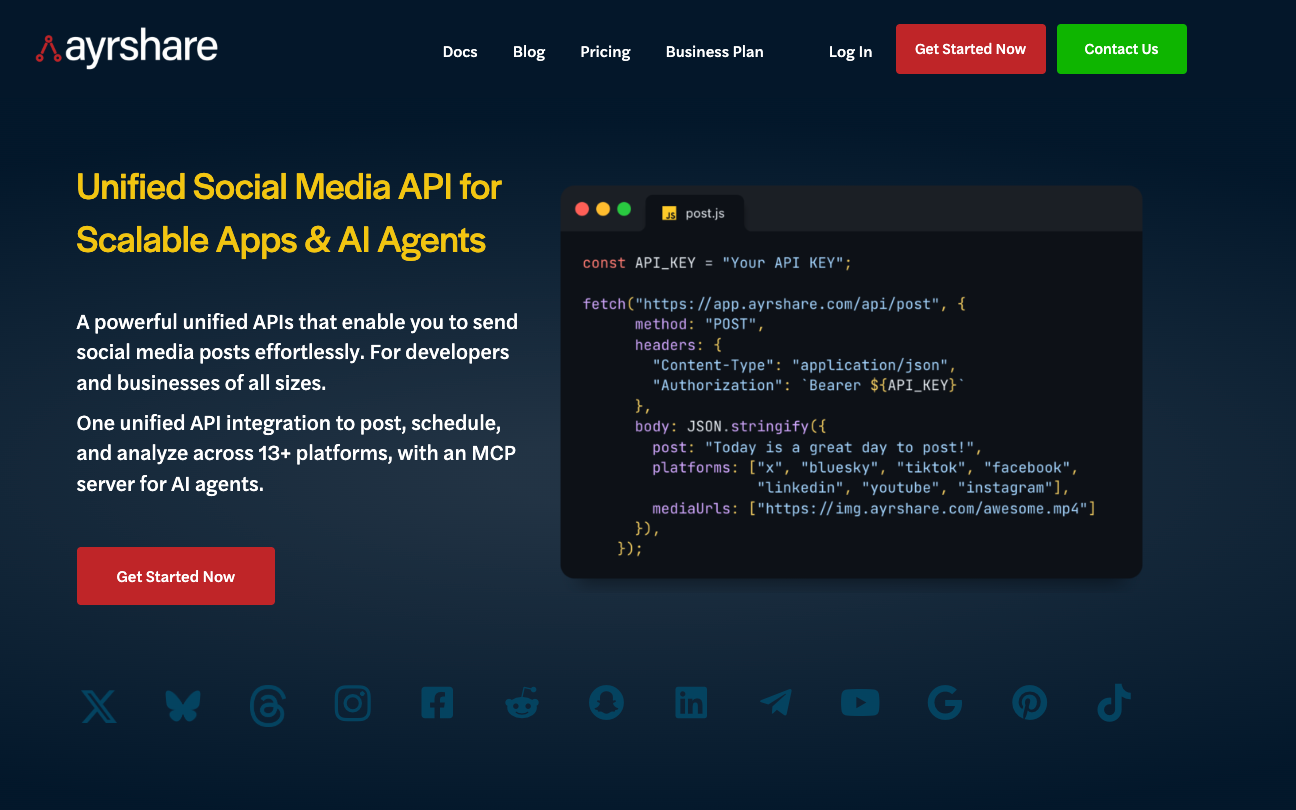
Ayrshare:

- Platforms: Offers broad support for 13+ platforms, including Instagram, Facebook, X, LinkedIn, TikTok, YouTube, Pinterest, Reddit, Telegram, Snapchat, and Google Business Profile.
- Pricing: Premium plans start around $149/month, with Business tiers ranging from $499-$599/month, often tied to a number of social profiles.
- Best for: Companies and agencies requiring a mature, feature-rich API with extensive SDKs (Node.js, Python, PHP, C#, Go, Java, Ruby on Rails). Ayrshare distinguishes itself with features beyond publishing, such as first-party analytics, comment and review management, messaging with auto-responses, and AI-powered hashtag automation. Its comprehensive suite makes it suitable for larger operations, though its per-profile pricing model can become substantial at extreme scale.
-
Postiz:
- Platforms: Boasts the broadest platform support, covering 30+ networks, including mainstream platforms like X, LinkedIn, Instagram, Facebook, TikTok, YouTube, Pinterest, Threads, Bluesky, Mastodon, Discord, as well as emerging decentralized networks like Nostr and Farcaster.
- Pricing: Offers a free self-hosted option (deployable via Docker, Railway, or on a custom server) and a cloud-hosted plan starting at $29/month for 5 accounts and 400 posts, with a 14-day trial.
- Best for: Developers prioritizing maximum platform breadth, full data control through self-hosting, or those seeking an open-source codebase for extensibility. Postiz integrates well with no-code automation platforms like n8n and Make.com.
-
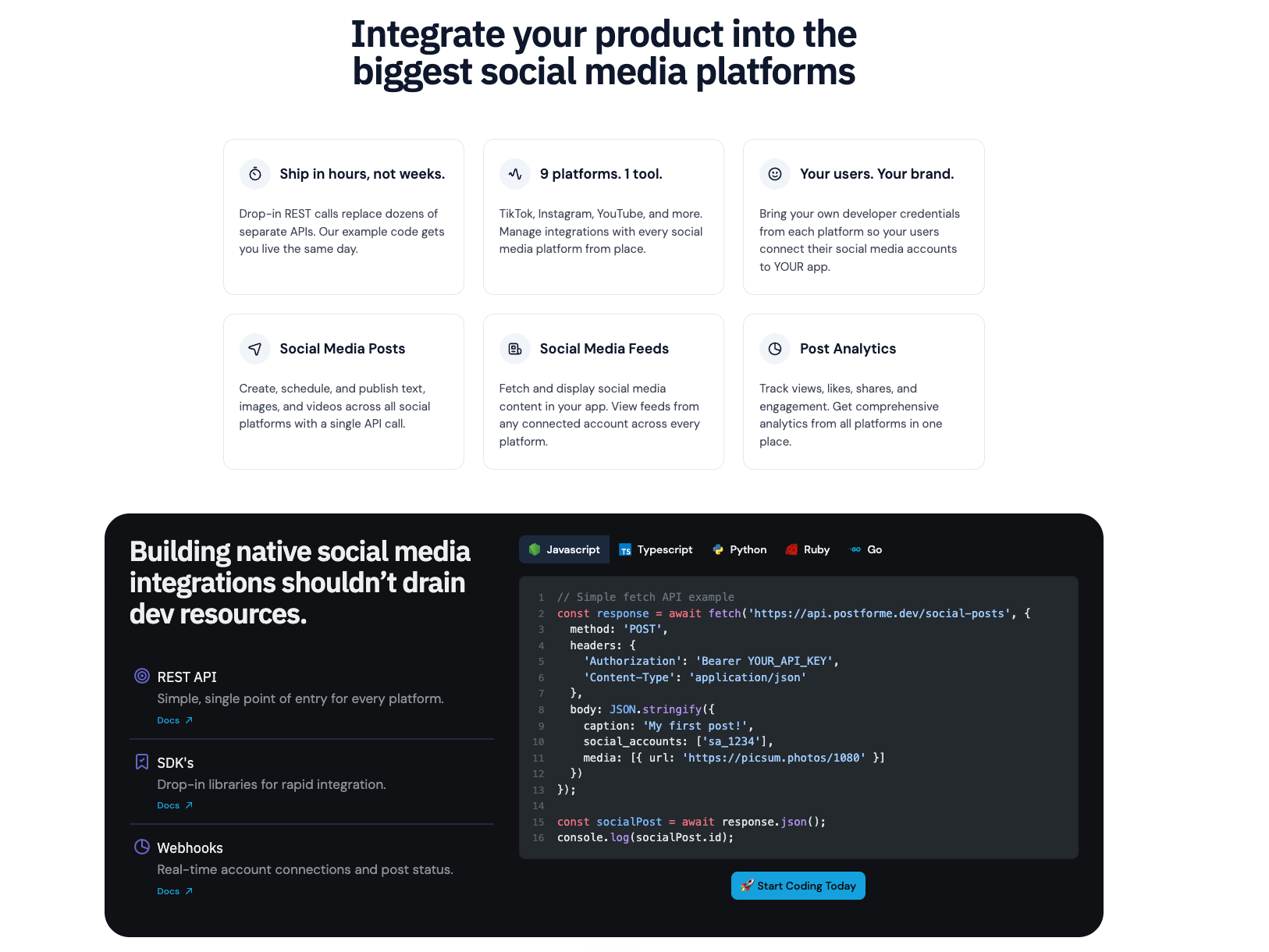
Post for Me:
- Platforms: Supports 9 key platforms: TikTok, Instagram, Facebook, X, LinkedIn, YouTube, Threads, Pinterest, and Bluesky.
- Pricing: Commences at $10/month for 1,000 posts, with plans extending up to $1,000/month, all offering unlimited accounts and API keys.
- Best for: Indie developers and bootstrapped SaaS applications benefiting from a predictable per-post pricing model, avoiding per-seat or per-profile fees. This model is advantageous for applications with many low-activity accounts or a clear understanding of their monthly posting volume.
-
Zernio:
- Platforms: Integrates with 15 platforms through a single API endpoint.
- Pricing: Starting at $19/month.
- Best for: Developers specifically building with AI agents who require out-of-the-box MCP server integration. Zernio’s focus on enabling AI-driven publishing workflows makes it a strong contender for the growing field of AI-powered content automation.
-
Outstand:
- Platforms: Connects to 10 platforms, including X, LinkedIn, Instagram, Facebook, TikTok, YouTube, Threads, Bluesky, Pinterest, and Google Business Profile.
- Pricing: Features a distinct pay-per-post model at $0.01 per post.
- Best for: Projects with bursty publishing patterns, low-volume side projects, or proof-of-concept builds where traditional monthly subscriptions might be an inefficient cost structure. Its transparent per-use pricing allows for precise cost management based on actual activity.
The Broader Implications for Development and Content Strategy
The rise of unified social media APIs carries significant implications across the digital ecosystem. For SaaS developers, these APIs dramatically lower the barrier to entry for integrating social publishing features, enabling faster product iterations and broader market reach without diverting extensive resources to API maintenance. This empowerment extends to indie developers and small teams, allowing them to compete with larger players by leveraging efficient third-party integrations.
Furthermore, the growing integration of AI agents into content creation and scheduling workflows highlights the importance of MCP servers and AI-ready APIs. Solutions like Buffer’s and Zernio’s, which cater to AI agent connectivity, are pivotal in automating complex content strategies and optimizing publishing schedules based on performance data.
For content creators and marketers, even those who primarily use no-code social media scheduling tools, understanding the underlying API landscape provides valuable context. It clarifies the "how" behind multi-platform posting and offers insights into potential limitations or capabilities. The continuous tension between platforms seeking to control their ecosystems and developers striving for efficiency and cross-platform utility will likely drive further innovation in this space, with unified APIs playing an increasingly central role in mediating these dynamics.
Frequently Asked Questions
- What are the most cost-effective unified API options? Users on Buffer’s free plan can access one API key at no cost. For those opting for self-hosting, Postiz is free. Among hosted solutions, Post for Me offers a low entry point at $10/month for 1,000 posts, while Outstand’s $0.01-per-post pricing is highly competitive for very low publishing volumes.
- Do native social media APIs cost money? Most native APIs, including Meta Graph (Instagram and Facebook), LinkedIn, TikTok, YouTube, Pinterest, Threads, and Bluesky, are free to use, though they impose rate limits and quota systems. X (formerly Twitter) is a notable exception, having moved to a pay-per-request model in early 2023, effectively ending its free tier and introducing costs for new developers.
- Can content be posted to Instagram via an API? Yes, Instagram allows posting through Meta’s Instagram Graph API directly or via any of the unified APIs listed. Direct API publishing requires an Instagram Business or Creator account linked to a Facebook Page, and the application typically needs Meta’s app review approval before going live.
- Which unified API offers the broadest platform support? Postiz leads in this category, supporting over 30 platforms, including mainstream networks and emerging decentralized social media platforms like Nostr and Farcaster. Ayrshare and Zernio support around 13 to 15 platforms, while Buffer’s API covers 11.
- What replaced the X API free tier? In early 2023, X (formerly Twitter) replaced its tiered API pricing, including the free tier, with a pay-per-use model as the default for new developers. Existing subscribers on older Basic or Pro plans could, for a period, maintain their plans, but the general access shifted to a request-based billing structure.
The strategic choice of an API integration path is paramount for any developer or organization aiming for effective and scalable social media engagement. Whether embracing the deep control of native APIs or the streamlined efficiency of a unified solution, understanding the nuances of each option is key to building robust, future-proof digital products.