Angie Faith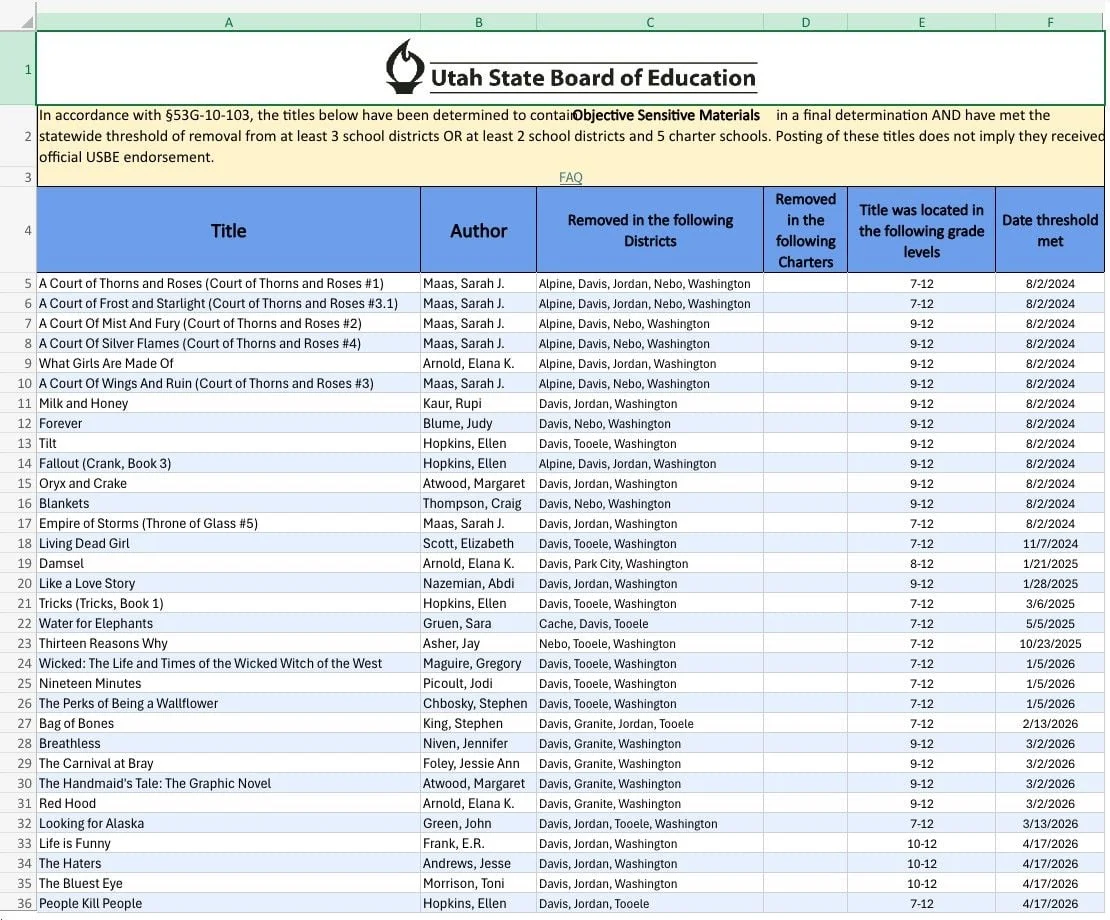
Thirteen books have been banned in the state since the beginning of 2026. The first year of the state’s book removal law, 2024, had more books banned (14); Utah is on course to easily surpass that number if this rate of censorship continues. The cumulative total of books prohibited across Utah’s public schools now stands at 32, a significant increase since the implementation of House Bill 29 (HB 29) in July 2024. This legislation, one of the strictest of its kind nationwide, empowers parents to challenge materials deemed "sensitive" and mandates the removal of books classified as "objective sensitive material" or "pornographic" by state code if they face removal in multiple school districts.
The Genesis of HB 29: A Legislative Timeline
The origins of Utah’s current book ban landscape can be traced back to the 2024 legislative session, culminating in the passage of HB 29. This bill, which took effect on July 1, 2024, established a statewide framework for identifying and removing books from public school libraries and curricula. The law’s retroactive clause means that books already flagged for removal prior to its effective date were immediately subject to the new regulations.
Initially, the list of banned books comprised 13 titles. However, the mechanism established by HB 29 has proven to be a powerful catalyst for broader censorship. Under the law, any time a public or charter school removes a book identified as "sensitive material," the State Board of Education must be notified. If a book meets a specific threshold of removals across districts – defined as being deemed "objective sensitive material" or "pornographic" in at least three public school districts or two public school districts and five charter schools statewide – it is then officially banned from all public schools across the state. This tiered approach has facilitated a rapid expansion of the prohibited materials list.
The Growing List of Prohibited Titles and Demographic Concerns
As of the latest reporting, the number of books prohibited in Utah public schools has more than doubled from its initial count, reaching 32 titles. A notable demographic trend within this list is the disproportionate representation of works by women. Of the 32 banned books, 24 are authored by women, raising concerns about gender bias in censorship efforts.
The full list of banned titles includes:
- Blankets by Craig Thompson (2003)
- A Court of Frost and Starlight by Sarah J. Maas (2018)
- A Court of Mist and Fury by Sarah J. Maas (2016)
- A Court of Silver Flames by Sarah J. Maas (2021)
- A Court of Thorns and Roses by Sarah J. Maas (2015)
- A Court of Wings and Ruin by Sarah J. Maas (2017)
- Empire of Storms by Sarah J. Maas (2016)
- Fallout by Ellen Hopkins (2010)
- Forever by Judy Blume (1975)
- Milk and Honey by Rupi Kaur (2014)
- Oryx & Crake by Margaret Atwood (2003)
- Tilt by Ellen Hopkins (2012)
- What Girls Are Made Of by Elana K. Arnold (2017)
- Living Dead Girl by Elizabeth Scott (2008)
- Damsel by Elana K. Arnold (2018)
- Like A Love Story by Abdi Nazemian (2019)
- Tricks by Ellen Hopkins (2009)
- Water for Elephants by Sara Gruen (2006)
- Thirteen Reasons Why by Jay Asher (2007)
- Wicked: The Life and Times of the Wicked Witch of the West by Gregory Maguire (1995)
- Nineteen Minutes by Jodi Picoult (2007)
- The Perks of Being a Wallflower by Stephen Chbosky (1999)
- Bag of Bones by Stephen King (1998)
- Breathless by Jennifer Niven (2020)
- The Carnival at Bray by Jessie Ann Foley (2014)
- The Handmaid’s Tale: The Graphic Novel by Margaret Atwood and illustrated by Renee Nault (2019)
- Red Hood by Elana K. Arnold (2020)
- Looking for Alaska by John Green (2005)
- Life Is Funny by E.R. Frank (2002)
- The Haters by Jesse Andrews (2016)
- The Bluest Eye by Toni Morrison (1970)
- People Kill People by Ellen Hopkins (2018)
The average publication date of these banned titles is 2009, placing them, on average, 17 years in the past. This statistic suggests that many of these books have been available in school libraries for a considerable period without prior widespread controversy, leading some to argue that the current wave of bans reflects a manufactured panic rather than a genuine, widespread issue with pedagogical materials.
The Concentration of Power in Book Removal
Despite the existence of 42 public school districts in Utah, the majority of book bans under HB 29 have originated from a concentrated number of districts. Data indicates that only nine districts have been responsible for initiating the removals that have led to statewide bans.
Prominently, the Davis School District has been implicated in 31 of the bans, while the Washington School District accounts for 29. The Jordan School District has contributed 12 bans, with reports suggesting this district is actively reviewing its records and potentially "catching up" on previous removals. The Tooele School District has also been involved in nine removals. This concentration of removals within a few districts highlights how decisions made by a limited number of entities can have a sweeping impact across the entire state’s educational system, challenging the notion of purely "local control" that proponents of such legislation often cite.

Broader Context and Comparative Analysis
Utah’s HB 29 is not an isolated phenomenon. Several states have enacted similar legislation or adopted policies that lead to widespread book removals. South Carolina, for instance, maintains its own sanctioned list of books that must be removed from all public school districts. Currently, their list comprises 21 titles, making it the state with the most extensive statewide book ban policy. A lawsuit challenging South Carolina’s book ban laws, filed by the ACLU on behalf of librarians and students, is currently pending.
It is crucial to note that legislation like HB 29 and its counterparts typically do not extend to private or homeschooling institutions, indicating a deliberate focus on the public education system.
Analysis of Implications and Future Trends
The escalating number of book bans in Utah, driven by HB 29, raises several significant implications for education and intellectual freedom within the state.
- Chilling Effect on Curriculum and Library Holdings: The threat of a book being removed statewide based on challenges in a few districts can create a chilling effect. Educators and librarians may self-censor, opting to avoid acquiring or recommending materials that could potentially be challenged, even if they are age-appropriate and educationally valuable.
- Disproportionate Impact on Diverse Voices: The demographic trend of female authors being disproportionately affected suggests a potential bias in the review and challenging process. This could lead to a narrowing of perspectives and experiences available to students, particularly those from marginalized communities.
- Erosion of Local Control: While HB 29 is often framed as a measure to enhance local control for parents, the mechanism of statewide bans effectively centralizes decision-making power. Decisions made by a few districts can override the professional judgment of educators and librarians in other districts, limiting their autonomy.
- Focus on Older Titles: The average publication date of banned books indicates a trend toward removing titles that have been in circulation for decades. This suggests that current challenges may not be addressing emerging issues but rather revisiting established literary works, potentially driven by contemporary interpretations or political agendas.
- Legal Challenges and Their Effectiveness: The existence of legal challenges, such as the one filed against HB 29, indicates ongoing opposition to these restrictive measures. However, the continued acceleration of book bans since the lawsuit was filed suggests that legal action alone may not be sufficient to halt the trend.
Expert and Community Reactions (Inferred)
While specific statements from all involved parties were not provided in the original text, the patterns observed in Utah’s book bans can be inferred to elicit significant concern from various stakeholders.
Educators and Librarians: Many in these professions likely view the increasing bans as a direct threat to their ability to curate diverse and comprehensive collections that meet the academic and developmental needs of students. They may express frustration over the time and resources diverted from educational priorities to address book challenges and removals.
Parent Groups: While HB 29 was enacted with parental rights in mind, it is probable that a spectrum of parental opinions exists. Some parents may actively support the book removals, viewing them as necessary to protect children from "inappropriate" content. Conversely, other parent groups likely advocate for intellectual freedom and oppose what they perceive as censorship, emphasizing the importance of access to a wide range of literature.
Civil Liberties Organizations: Organizations like the ACLU are likely to view these bans as a violation of First Amendment rights, arguing that the removal of books based on subjective interpretations of "sensitivity" or "pornography" stifles free expression and limits students’ access to information and diverse viewpoints.
Authors and Publishers: Authors whose works are banned may express disappointment and concern over the silencing of their voices and the potential impact on readership. Publishers might face increased scrutiny and pressure regarding the content of their publications for school markets.
The Path Forward
The current trajectory in Utah suggests that the number of banned books is likely to continue its upward trend. The state’s approach, which prioritizes statewide removal based on a limited number of district-level challenges, creates a potent engine for censorship. As the school year progresses, the ongoing implementation of HB 29 and the potential for new challenges mean that educators, students, and parents will likely witness further alterations to the literary landscape within Utah’s public schools. The debate over HB 29 and its consequences highlights a critical juncture in the ongoing national conversation about censorship, intellectual freedom, and the role of literature in shaping young minds.