Cintya Tara Annisa
The modern specialty coffee movement has long maintained that water is the silent partner in the pursuit of the perfect cup, a sentiment supported by a decade of rigorous scientific inquiry and technological advancement. While the contemporary industry relies on high-tech reverse osmosis systems and mineral-titration kits, historical records suggest that the obsession with water quality in coffee preparation is not a product of the 21st century, but rather a sophisticated tradition dating back to the 16th-century Ottoman Empire. Recent research highlighted by Sprudge Special Projects reveals that the intricate relationship between mineral content, water source, and coffee extraction was a cornerstone of the imperial coffee ritual at Topkapı Palace in Istanbul, predating modern laboratory analysis by nearly five hundred years.
The Evolution of Water Science in Specialty Coffee
To understand the historical significance of Ottoman coffee water, one must first examine the current state of the industry. Over the last decade, the role of water in coffee preparation has transitioned from a niche concern to a primary focus of professional baristas and home enthusiasts alike. The publication of Water For Coffee by Maxwell Dashwood and Christopher Hendon marked a turning point in this evolution. Now in its second edition, the work provides a scientific framework for how specific minerals—namely calcium, magnesium, and bicarbonate—interact with coffee compounds to modulate flavor, acidity, and body.
This scientific awakening has birthed a new sector of the coffee economy. Companies such as Third Wave Water and Lotus Water have commercialized mineral packets designed to "remineralize" distilled or reverse-osmosis water to precise specifications. Industrial filtration giants like Pentair have developed sophisticated systems for cafes that allow for the fine-tuning of Total Dissolved Solids (TDS). What was once considered the "realm of the super geek" is now a standard operational procedure in high-end coffee bars globally. However, the revelation that these same principles were applied in the 16th century suggests that the "third wave" of coffee is, in many ways, a rediscovery of ancient wisdom.
The Imperial Protocol: Coffee as a State Performance
At the height of the Ottoman Empire, coffee was far more than a morning stimulant; it was a highly choreographed performance of power and hospitality. Within the walls of Topkapı Palace, the preparation of coffee was governed by strict protocols and executed by a dedicated hierarchy of staff. At the pinnacle of this structure was the kahvecibaşı, or chief coffee maker, a position of significant prestige and trust.
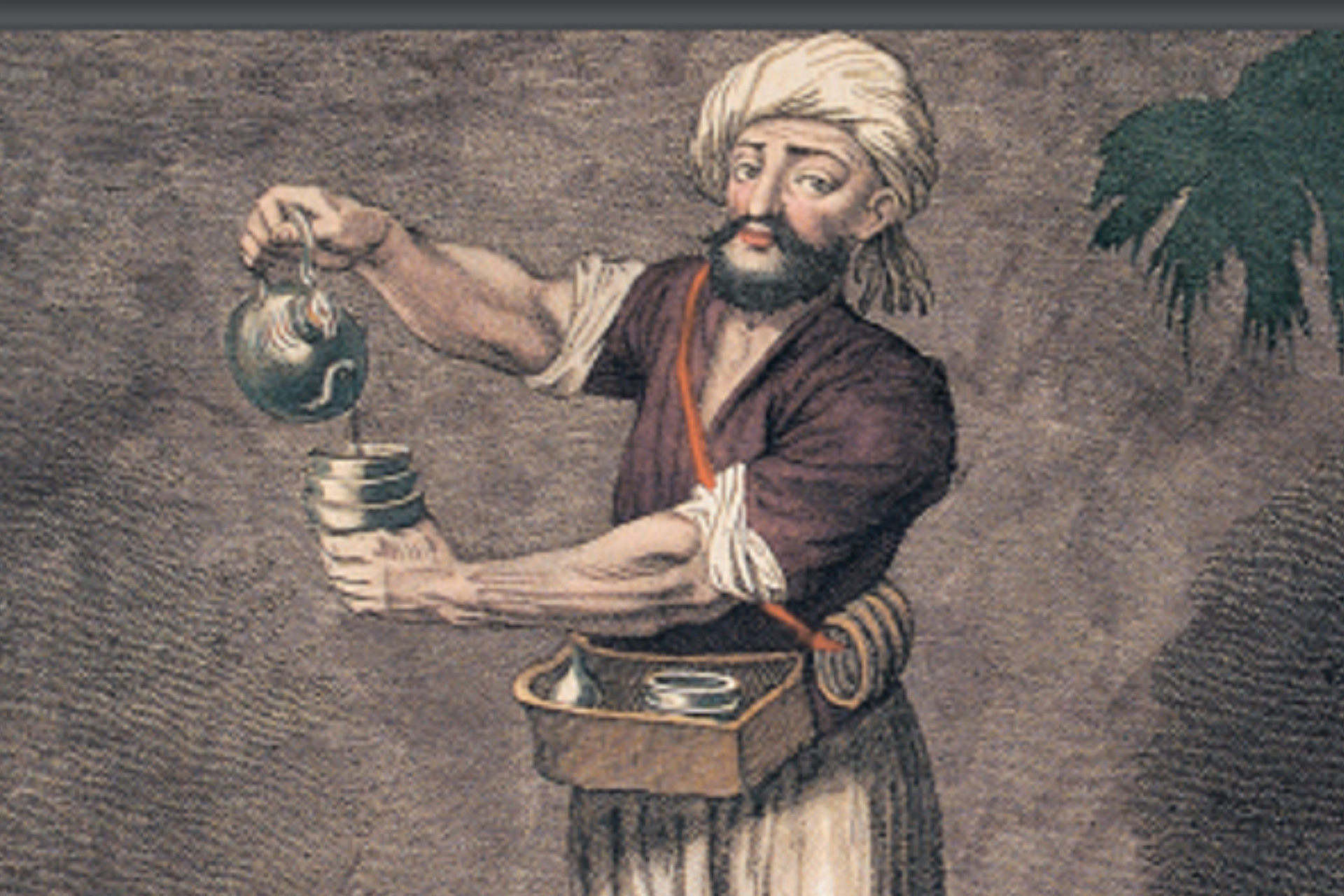
The kahvecibaşı did not work in isolation. He commanded a team of attendants who managed every stage of the process, from the roasting of beans in specialized pans to the fine grinding of coffee in bronze mills. The service itself involved elegant ewers and cups housed in silver zarfs (ornamental cup holders), ensuring that the sensory experience was as visual as it was gustatory. Yet, as writer and coffee professional Duygu Kurtuluş notes in her feature for Sprudge, the most decisive element of this elaborate stage was the water. The Ottomans understood that even the finest beans and the most skilled roasting could be undermined by inferior water.
The Gümüşsuyu Spring: A Dedicated Supply Chain
The logistics of the Ottoman coffee ritual reveal a level of dedication to water quality that rivals modern mineral-profiling. Historical records indicate that from the beginning of the 16th century, the primary source of brewing water for the palace was the Gümüşsuyu spring, located in the Eyüp district of Istanbul. Gümüşsuyu, which translates to "Silver Water," was renowned for its purity and specific mineral balance, which was deemed ideal for the preparation of the Sultan’s coffee.
The procurement of this water was not left to chance. A special corps of bostancıs (palace guards and gardeners), known as the Gümüşsuyu Ocağı, was tasked exclusively with the extraction and delivery of the water. The process was arduous and highly regulated:
- Extraction: Water was drawn directly from the head of the spring to ensure maximum freshness.
- Containment: The water was filled into large, high-quality leather waterskins designed to prevent contamination.
- Transport: These skins were transported by boat across the Golden Horn to Sarayburnu.
- Delivery: Upon reaching the palace, the water was delivered directly to the Coffee Room, bypassing general storage to maintain its specific properties.
This dedicated supply chain highlights an early understanding of what modern science calls "water chemistry." By selecting a specific spring and ensuring its untainted delivery, the Ottoman court was effectively controlling the TDS and pH levels of their brew long before those terms were coined.
Chronology of Coffee and Water Integration in the Ottoman Empire
The integration of specialized water into coffee preparation followed a clear historical timeline as the beverage rose to prominence in the Mediterranean:
- 1517: The Ottoman conquest of Egypt and the Hejaz region (modern-day Saudi Arabia) introduces the empire to coffee culture via Yemen.
- 1554: The first coffeehouses open in Istanbul (in the Tahtakale district), sparking a rapid expansion of coffee consumption among the public.
- Late 16th Century: Coffee becomes a staple of the imperial court. The office of the kahvecibaşı is formalized, and the search for the "perfect water" leads to the selection of Gümüşsuyu.
- 17th Century: The coffee ritual becomes increasingly complex, with the introduction of silver service ware and specific protocols for foreign dignitaries, where the quality of the water was used as a subtle indicator of status.
- Modern Era: While the kahvecibaşı role eventually faded with the fall of the empire, the tradition of using specific spring water for Turkish coffee persisted in local culture, eventually merging with the global specialty coffee movement.
Comparative Analysis: Ancient Wisdom vs. Modern Science
When comparing the 16th-century Ottoman approach to modern water science, the parallels are striking. Modern baristas seek water that is low in carbonates but contains enough magnesium and calcium to "grab" the flavor compounds from the coffee grounds. Historians and coffee professionals suggest that the Gümüşsuyu spring likely possessed a naturally occurring mineral profile that achieved this balance.
In the 16th century, "purity" was judged by clarity, taste, and the way the water interacted with the coffee foam (köpük). A thick, stable foam is the hallmark of well-made Turkish coffee, and the mineral content of the water plays a crucial role in surface tension and foam stability. While the Ottomans lacked TDS meters, their empirical observations led them to the same conclusion as today’s experts: the source of the water is as important as the source of the bean.
Industry Perspectives and the Role of Journalism
The documentation of these historical practices is part of a broader effort by coffee journalists to provide depth to the industry’s narrative. The Sprudge Special Projects Desk, which published Kurtuluş’s research, serves as a hub for long-form journalism that connects coffee’s past with its future. Supported by industry leaders like La Marzocco—a company that has manufactured espresso machines in Florence since 1927—these projects aim to increase the global understanding of coffee culture.
A spokesperson for La Marzocco noted that increasing knowledge and understanding is the most effective way to develop a thriving future for the coffee industry. By looking back at the 16th century, the industry gains a better appreciation for the "rituals" of today. Whether it is a barista in London calibrating a reverse osmosis system or a bostancı in 1580 carrying leather skins of Gümüşsuyu water, the goal remains the same: the manipulation of an aqueous solvent to express the truest essence of the coffee bean.
Broader Implications for the Global Coffee Industry
The revelation of the Ottoman Empire’s sophisticated water logistics has several implications for the modern coffee landscape. First, it challenges the Eurocentric or modern-centric view that coffee "science" is a recent invention. It acknowledges the Middle East and the Ottoman Empire not just as the historical home of coffeehouses, but as the birthplace of coffee quality control.
Second, it highlights the importance of "terroir" in water. Just as coffee professionals discuss the soil and altitude of a coffee farm, there is a growing movement to recognize the terroir of water sources. The Ottoman preference for Gümüşsuyu suggests that certain geographical locations produce water that is uniquely suited for specific brewing methods.
Finally, this historical perspective reinforces the idea that coffee is an intersection of art, science, and ritual. The meticulous nature of the kahvecibaşı serves as a reminder that the "performance" of coffee—the care taken in every step—is what elevates it from a commodity to a cultural treasure. As the specialty coffee industry continues to innovate with new technology in 2025 and beyond, it does so by standing on the shoulders of the 16th-century masters who first recognized that the secret of the cup is, and always has been, in the water.