Hanik Kholidah
The physiological transition from adolescence to mature adulthood is characterized by a series of structural changes within the human musculoskeletal system that often go unnoticed until mobility is compromised or chronic pain emerges. While significant clinical attention is traditionally directed toward muscular strength and bone density, a growing body of research highlights the critical role of ligaments—the non-contractile connective tissues that bind bone to bone—in maintaining spinal integrity and preventing age-related postural decline. Unlike muscle tissue, which is designed for contraction and can be strengthened through traditional resistance exercise, ligaments serve as the body’s primary stabilizers. When these tissues lose elasticity or suffer from micro-trauma, the resulting joint instability can lead to a cascade of degenerative conditions, most notably in the thoracic and cervical regions of the spine.
The Biological Framework of Ligamentous Health
To understand the necessity of targeted spinal care, one must first examine the etymology and function of the ligament. Derived from the Greek ligare, meaning "to bind," ligaments provide the essential tension required to keep the skeletal framework aligned. In the human spine, ligaments are distributed in a complex network: some run along the anterior and posterior surfaces of the vertebral bodies to ensure stability, while others reside within the spinal canal or connect the spinous processes at the rear.
Unlike muscles, ligaments do not possess the same level of vascularity or metabolic activity, meaning they heal slowly and are prone to a phenomenon known as "ligamentous creep." This refers to the gradual deformation of connective tissue under constant stress. Over decades of life, factors such as untreated physical trauma—ranging from minor falls to high-impact vehicular accidents—and the cumulative strain of sedentary behavior cause these tissues to shorten and stiffen. This stiffening is a primary contributor to the "hunched" posture often associated with aging, known clinically as hyperkyphosis.

The Chronology of Spinal Degeneration
The progression of spinal stiffness typically follows a predictable timeline influenced by both acute events and chronic lifestyle habits. In the early stages of adulthood, the spine maintains a high degree of flexibility. However, if an individual experiences a traumatic event—such as a slip and fall or a sports injury—and fails to seek rehabilitative treatment, the affected ligaments begin to fibrose.
By the fourth and fifth decades of life, the impact of professional environments becomes a dominant factor. The modern workforce is increasingly characterized by prolonged periods of sitting and "tech neck," a condition where the head is perpetually tilted forward to view screens. This posture places an immense mechanical load on the ligaments of the thoracic spine. Research indicates that for every inch the head moves forward from its neutral alignment, the effective weight of the head on the spine increases by approximately ten pounds. This chronic loading forces the ligaments to adapt to a shortened, stressed state, eventually leading to a permanent alteration of the spinal curve.
Data and Statistics on Spinal Health and Aging
The implications of neglecting ligamentous health are reflected in broader public health data. According to the Centers for Disease Control and Prevention (CDC), chronic back pain is one of the leading causes of disability in the United States, with a significant percentage of cases originating in the thoracic and lumbar regions. Furthermore, studies on aging populations suggest that hyperkyphosis is associated with a higher risk of falls, impaired respiratory function, and a decrease in overall quality of life.
Clinical observations suggest that while traditional exercise is vital for cardiovascular health and muscular tone, it often fails to address the stiffness of the spinal ligaments. This has led to the development of Gravity-Assisted Ligament Stretching (GALS), a methodology designed to use controlled, static positioning to influence the viscoelastic properties of connective tissue.

Methodology: Vertical Foam Roller Interventions
One of the primary non-invasive interventions for restoring spinal mobility involves the use of a foam roller in a vertical orientation. This technique is designed to counteract the internal rotation of the shoulders and the forward collapse of the chest.
Procedure for Vertical Alignment:
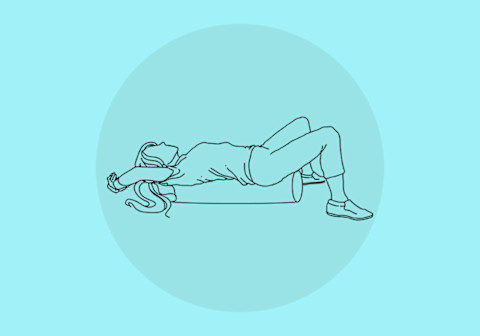
The individual begins by sitting at one end of a long foam roller and slowly reclining until the entire length of the spine, from the sacrum to the cranium, is supported. Stability is maintained by bending the knees and placing the feet flat on the floor, shoulder-width apart. Once positioned, the arms are extended to the sides.
The objective of this exercise is not active movement or muscular engagement, but rather passive surrender to gravity. By remaining in this static pose for two to three minutes, the individual allows the ligaments on the anterior side of the spine to gradually lengthen. Medical professionals emphasize that for those with significant shoulder stiffness, the arms should initially be placed in a more neutral position, such as resting on the abdomen, before gradually progressing to an "outstretched" posture over several weeks.
Advanced Interventions: The T4 Horizontal Stretch
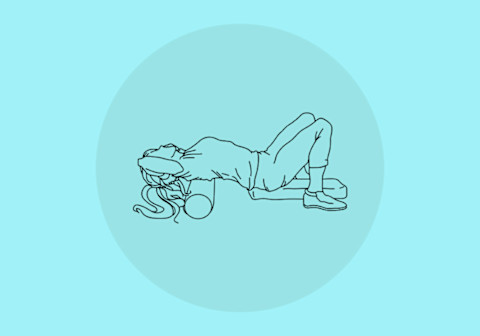
For individuals seeking to address specific "apex" points of spinal curvature, the horizontal or "T4" stretch is employed. The fourth thoracic vertebra (T4) is frequently the site of the greatest degree of kyphotic curvature in the upper back.
Procedure for Horizontal Realignment:
In this variation, the foam roller is placed perpendicular to the spine. The individual leans back so that the roller contacts the mid-back at the point of maximum curvature. To protect the cervical spine, the hands are placed behind the head for support. In advanced applications, the pelvis is slightly elevated to increase the gravitational pressure on the thoracic ligaments.
Unlike dynamic stretching, which targets the muscles, this horizontal intervention focuses on the deep connective tissues. Experts suggest that holding this position for increments of 30 seconds to two minutes can facilitate structural changes in the spinal architecture that are unattainable through standard gym routines.
Professional Perspectives and Clinical Analysis
The shift toward gravity-assisted stretching represents a broader movement in physical therapy and chiropractic care toward "passive restoration." Dr. Kelli Pearson, a prominent advocate for this approach and author of Eight Minutes To Ageless, argues that caring for ligaments requires minimal physical effort but high consistency. The prevailing clinical view is that "more is not always better"; rather, the application of low-load, long-duration tension is the most effective way to remodel collagenous tissues like ligaments.
Medical practitioners note that these exercises serve as a form of "mechanical hygiene." Just as dental hygiene prevents the accumulation of plaque, daily ligamentous stretching prevents the accumulation of "postural plaque"—the stiffening and calcification of the tissues that support the spine.
Broader Impact and Long-term Implications
The long-term benefits of maintaining ligamentous elasticity extend beyond simple posture. A mobile spine ensures better neural communication between the brain and the rest of the body, as the spinal cord is housed within the vertebral column. Furthermore, by reducing the kyphotic curve, individuals can maintain better lung capacity, as a hunched posture often compresses the thoracic cavity and limits diaphragmatic excursion.
As the global population continues to age, the economic burden of musculoskeletal disorders is expected to rise. Simple, equipment-minimal interventions like foam rolling offer a cost-effective strategy for preventative care. By addressing the "creep" of spinal ligaments early, maturing adults can preserve their mobility, reduce their reliance on pain medication, and maintain an active lifestyle well into their later years.
In conclusion, the health of the spine is inextricably linked to the state of its ligaments. While the aging process is inevitable, the degree of physical decline is often a function of how well these "binding" tissues are maintained. Through the integration of gravity-assisted stretching and an awareness of the mechanical stresses of modern life, individuals can effectively mitigate the structural challenges of maturation, turning the process of aging into a manageable and healthy transition.